Key Takeaways
- RAG stands for Retrieval Augmented Generation — a method that lets an AI look up real information before answering, instead of relying only on what it memorized during training.
- It works like an open-book exam: the AI retrieves relevant documents first, then generates its answer based on them.
- RAG solves two of the biggest AI problems — outdated knowledge and made-up answers (hallucinations).
- It is the reason most serious business AI tools can answer questions about your specific documents, products, or data.
- You do not need to be a programmer to understand RAG — the core idea is simple, and knowing it helps you understand how modern AI apps actually work.
You have probably noticed that AI chatbots sometimes confidently tell you things that are completely wrong, or admit they do not know anything past a certain date. Both of these problems have the same root cause — and the same solution. That solution is called RAG, and it is quietly powering most of the useful AI tools you interact with today.
RAG — Retrieval Augmented Generation — sounds like intimidating technical jargon, and most explanations make it worse by drowning you in machine learning terminology. But the core idea is genuinely simple, and once it clicks, you will understand how modern AI apps actually answer questions about real, specific, up-to-date information instead of just making things up from memory.
This guide explains what RAG is in plain language, for someone who is not a programmer. The Data Pips Team will show you what problem it solves, how it works using a simple analogy, why nearly every serious AI application uses it, and what it means for you. No assumptions about technical background. By the end, you will understand one of the most important concepts in modern AI. Let us get into it.
First — The Problem RAG Solves
To understand why RAG exists, you first need to understand a fundamental limitation of how AI language models work. Do not worry — this is simple.
A large language model (LLM) — the technology behind tools like ChatGPT — learns by being trained on a massive amount of text. During training, it absorbs patterns and information, and that knowledge gets “baked in.” But this creates two big problems:
Problem 1: The Knowledge Is Frozen in Time
Once an AI model is trained, its knowledge stops at a certain point — its “training cutoff.” It does not know anything that happened after that date. Ask it about something recent, and it either does not know or gives outdated information. The model’s knowledge is frozen at the moment training ended, like a textbook that can never be updated.
Problem 2: It Makes Things Up (Hallucinations)
When an AI does not actually know something, it often does not say “I don’t know.” Instead, it confidently generates a plausible-sounding answer that may be completely false. This is called a “hallucination,” and it is one of the most dangerous problems in AI, because the wrong answer sounds just as confident as a right one. The model is designed to produce fluent text, not necessarily true text.
Problem 3: It Doesn’t Know YOUR Information
A general AI model was trained on public internet data. It knows nothing about your company’s internal documents, your product catalog, your customer data, or your specific knowledge. Ask it a question about your business, and it simply cannot answer, because that information was never part of its training.
These three problems — frozen knowledge, hallucinations, and no access to your specific data — severely limit how useful a raw AI model can be for real-world tasks. And this is exactly the gap that RAG fills.
— Data Pips Team
What Is RAG — In Plain English?
Now the definition, made simple.
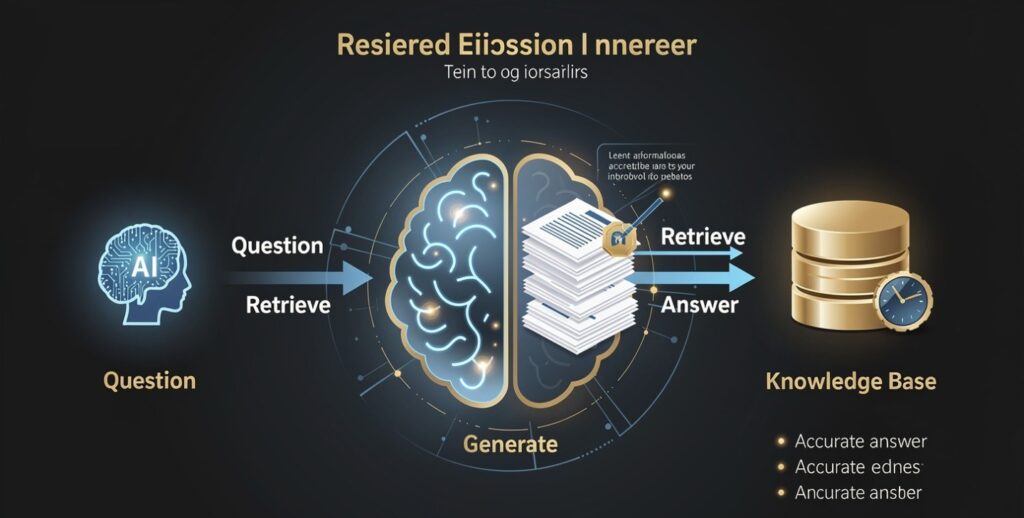
RAG (Retrieval Augmented Generation) is a method that lets an AI look up relevant, real information first, and then use that information to generate its answer — instead of relying only on what it memorized during training.
Let us break down the name itself, because it actually explains the whole concept:
- Retrieval — the AI first retrieves (looks up, fetches) relevant information from a knowledge source, like a set of documents or a database.
- Augmented — this retrieved information augments (adds to, strengthens) what the AI knows.
- Generation — the AI then generates its answer, based on the retrieved information rather than just its frozen memory.
So RAG simply means: retrieve relevant information, add it to the AI’s context, and generate an answer based on it. According to IBM, RAG is a technique that grounds an AI model’s responses in external, authoritative sources of knowledge, making the answers more accurate and current.
The genius of RAG is that it does not require retraining the AI. Instead of trying to cram new information into the model’s frozen memory (which is expensive and slow), RAG just gives the model the right information at the moment it needs it — like handing someone the exact page they need to answer a question.
The Open-Book Exam Analogy
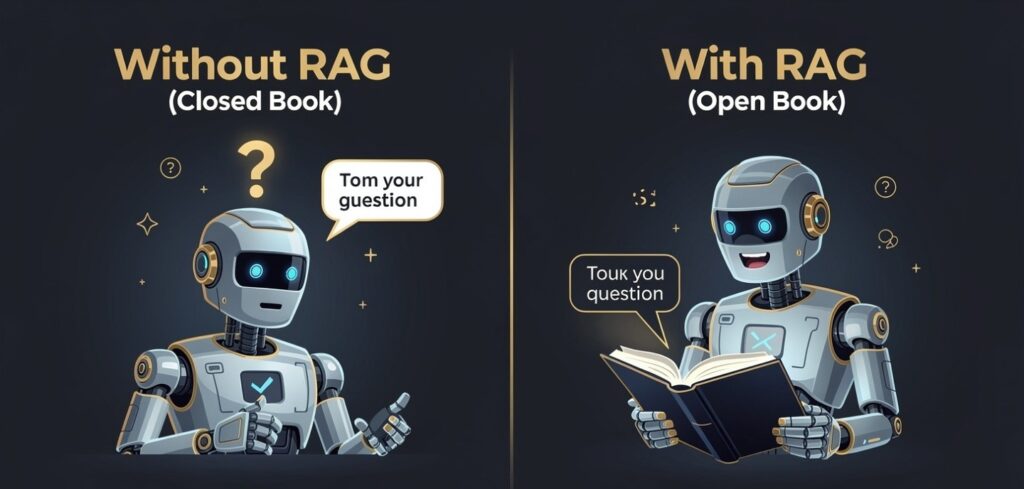
Here is the analogy that makes RAG click for everyone. Think about two types of exams.
A closed-book exam is where you answer from memory alone. You studied beforehand, and now you must recall everything without any reference. If you forget something, or if the material has changed since you studied, you are stuck — and you might confidently write down a wrong answer because you misremembered. This is how a raw AI model works: answering purely from its frozen, memorized training.
An open-book exam is completely different. You are allowed to look up information in your textbook before answering each question. You do not need to have memorized everything perfectly, because you can find the relevant page, read it, and base your answer on accurate, current information. You are far less likely to be wrong, because you are answering from the actual source rather than fuzzy memory.
RAG turns the AI’s closed-book exam into an open-book exam. When you ask a question, the system first “looks up” the relevant information from a knowledge source, hands that information to the AI, and then the AI answers based on what it just looked up. The AI no longer has to rely on potentially outdated or imperfect memory — it has the actual reference material right in front of it.
This single shift — from answering by memory to answering by reference — is why RAG dramatically reduces hallucinations and lets AI work with current, specific information. It is a beautifully simple idea with enormous practical impact.
How RAG Actually Works (Step by Step)
Let us walk through what actually happens when you ask a question to a RAG-powered AI system. We will keep it simple and non-technical.
Step 1: You Ask a Question
You type a question — for example, “What is our company’s refund policy?” In a normal AI, this question would go straight to the model, which would answer from its frozen memory (and likely fail, since it never knew your company’s policy). In a RAG system, something happens first.
Step 2: The System Retrieves Relevant Information
Before answering, the RAG system searches through a knowledge source — your company documents, a database, a collection of files — to find the pieces most relevant to your question. It might find the exact section of your policy document that discusses refunds. This searching is usually done using something called a vector database, which is a clever way of finding information based on meaning rather than just exact keywords. You do not need to understand the technical details — just know that the system finds the most relevant information for your question.
RAG’s retrieval step runs on vector databases and embeddings, explained simply — the quiet engine that turns meaning into searchable numbers.
Step 3: The Information Is Added to the AI’s Context
The relevant information that was retrieved gets handed to the AI along with your original question. Essentially, the system says to the AI: “Here is the user’s question, AND here is the relevant information you should use to answer it.” Now the AI has the actual source material right in front of it.
Step 4: The AI Generates an Answer Based on the Retrieved Information
Finally, the AI generates its answer — but now it is basing that answer on the real, retrieved information rather than its frozen memory. The result is an answer that is accurate, current, and specific to your actual documents. According to AWS, this process allows the AI to reference authoritative knowledge bases before generating a response, keeping the output relevant and accurate.
That is the entire RAG process: ask, retrieve, add to context, generate. Four simple steps that transform a forgetful, sometimes-hallucinating AI into one that answers accurately from real sources.
Real Example: The Customer Support Chatbot
Imagine a company that wants an AI chatbot to answer customer questions about its products. Without RAG, the chatbot would rely on a general AI model that knows nothing about the company’s specific products, prices, or policies. Ask it “Does product X come with a warranty?” and it would either say it does not know, or worse, confidently invent a wrong answer.
Now the company adds RAG. They feed all their product manuals, FAQs, policy documents, and specifications into a knowledge base. When a customer asks “Does product X come with a warranty?”, the RAG system first retrieves the exact section of the product documentation that discusses warranties, hands it to the AI, and the AI generates an accurate answer based on the real document.
The same chatbot, with the same underlying AI model, went from useless and unreliable to genuinely helpful and accurate — purely because RAG let it look up the real information before answering. And when the company updates its policies, they just update the documents in the knowledge base; no expensive retraining of the AI needed.
Lesson: RAG is what makes AI useful for real businesses with real, specific, changing information. It bridges the gap between a general AI model and your particular knowledge.
Why RAG Matters So Much
RAG is not just a technical detail — it is one of the most important enabling technologies behind practical AI. Here is why it matters.
It Makes AI Trustworthy for Real Work
By grounding answers in real, retrieved documents, RAG dramatically reduces hallucinations. This is the difference between an AI you can actually rely on for business and one that might confidently mislead you. For any serious application — customer support, legal research, medical information, financial analysis — accuracy is non-negotiable, and RAG is how that accuracy is achieved.
It Keeps AI Current Without Retraining
Instead of the slow, expensive process of retraining an entire AI model to add new knowledge, RAG lets you simply update the knowledge base. New information becomes instantly available to the AI. This is enormously more practical and affordable, which is why so many real applications choose RAG.
It Lets AI Use YOUR Specific Information
This is perhaps the biggest reason RAG matters. It is what allows an AI to answer questions about your company documents, your products, your data — information that no general model was ever trained on. RAG is the bridge between powerful general AI and your specific, private knowledge. This unlocks a huge range of practical business applications.
It Is More Affordable and Accessible
Because RAG does not require the expensive process of retraining a model, it is far more accessible to smaller businesses and individuals. You can build genuinely useful AI applications with RAG without the massive resources needed to train or fine-tune a model from scratch. This accessibility is part of why understanding AI tools can become a real income opportunity — our guide on building multiple income streams touches on how AI skills are creating new earning paths.
— Data Pips Team
RAG vs Fine-Tuning: A Quick Comparison
You will often hear RAG mentioned alongside “fine-tuning,” another method for customizing AI. They solve overlapping problems in different ways, and beginners often wonder which is which.
Fine-tuning means actually retraining a model on additional data to change its behavior or teach it new knowledge — essentially modifying the AI’s “memory” itself. It is powerful but more expensive, slower, and requires technical expertise.
RAG leaves the model’s memory untouched and instead gives it the right information at the moment it needs it — the open-book approach. It is generally cheaper, faster to update, and better for information that changes frequently.
A simple way to remember the difference: fine-tuning changes how the AI thinks and behaves, while RAG changes what information the AI has access to when answering. Many advanced systems actually use both together. For a complete breakdown of when to choose each approach, read our detailed guide on fine-tuning vs RAG and which to choose.
| Factor | RAG | Fine-Tuning |
|---|---|---|
| What it changes | Information the AI can access | How the AI thinks/behaves |
| Cost | Generally lower | Generally higher |
| Updating knowledge | Easy — just update documents | Hard — requires retraining |
| Best for | Current, specific, changing info | Specialized behavior or style |
What Nobody Tells Beginners About RAG
1. RAG Is Only as Good as Its Knowledge Base
RAG retrieves information from a knowledge source, which means the quality of your answers depends entirely on the quality of what you put in. If your documents are outdated, disorganized, or incomplete, the AI will retrieve and base its answers on bad information. “Garbage in, garbage out” applies fully. A great RAG system starts with well-organized, accurate, up-to-date source material. The retrieval is only as valuable as what there is to retrieve.
2. Retrieval Quality Is the Hard Part
The “generation” part — the AI writing the answer — is usually reliable. The genuinely hard part is the “retrieval” — making sure the system finds the RIGHT information for each question. If retrieval pulls irrelevant or partial information, the answer suffers even if the AI is excellent. Much of the real engineering effort in RAG systems goes into making retrieval accurate, which is why it does not always work perfectly out of the box.
3. It Reduces Hallucinations but Doesn’t Eliminate Them
RAG dramatically reduces made-up answers by grounding the AI in real sources, but it does not make hallucinations impossible. The AI can still occasionally misinterpret retrieved information or fill gaps with invention. RAG is a powerful safeguard, not a perfect guarantee. For critical applications, human review of important AI outputs remains wise. Treat RAG as a major improvement, not a complete solution to AI accuracy.
4. You Can Build Simple RAG Without Being a Hardcore Programmer
While advanced RAG systems require real technical skill, the barrier to building basic RAG applications has dropped dramatically. Many no-code and low-code tools now let you create simple RAG-powered chatbots by uploading documents and connecting them to an AI. This means understanding RAG is not just academic — it can be a practical, learnable skill that opens real opportunities, even for non-programmers willing to learn. Learning a valuable new skill like this connects directly to compounding a skill into a wealth machine.
5. RAG Is Everywhere, Even When You Don’t See It
Many AI tools you already use employ RAG behind the scenes without advertising it. When an AI assistant answers questions about a document you uploaded, searches the web before responding, or answers questions about a specific knowledge base, RAG (or something very similar) is often at work. Understanding RAG helps you see how modern AI applications actually function under the hood — and makes you a more informed, capable user of AI tools.
Quick Action Steps
Now It’s Your Move
- Remember the open-book analogy. RAG turns the AI’s closed-book exam (answering from memory) into an open-book exam (looking up real information first). This single image captures the whole concept.
- Recall the three problems RAG solves. Frozen knowledge, hallucinations, and no access to your specific information. RAG addresses all three by letting the AI retrieve real, current, specific data.
- Understand the four steps. Ask, retrieve, add to context, generate. Knowing this flow helps you understand how nearly every serious AI app works.
- Know the difference from fine-tuning. RAG changes what information the AI can access; fine-tuning changes how the AI thinks. Different tools for different jobs.
- Respect the knowledge base. RAG is only as good as the documents you feed it. Accurate, organized, current source material is the foundation of good answers.
- Explore no-code RAG tools if curious. You do not need to be a hardcore programmer to experiment with building simple RAG applications. This is a learnable, valuable skill.
- Stay a critical user. RAG reduces but does not eliminate AI errors. For important information, verify rather than blindly trusting any AI output.
Frequently Asked Questions
RAG stands for Retrieval Augmented Generation. In simple terms, it is a method that lets an AI look up relevant, real information first, and then use that information to generate its answer — instead of relying only on what it memorized during training. Think of it like the difference between a closed-book exam (answering from memory) and an open-book exam (looking up the right page before answering). RAG turns the AI’s closed-book approach into an open-book one, which makes its answers far more accurate, current, and specific to real sources.
RAG stands for Retrieval Augmented Generation. The name describes exactly what it does: Retrieval means the AI first retrieves or looks up relevant information from a knowledge source; Augmented means this retrieved information augments or strengthens what the AI knows; and Generation means the AI then generates its answer based on that retrieved information. So RAG simply means retrieving relevant information, adding it to the AI’s context, and generating an answer grounded in that real information rather than relying solely on the model’s frozen training memory.
RAG is important because it solves three major limitations of AI models: frozen knowledge (a model’s training stops at a certain date), hallucinations (the AI confidently making up wrong answers), and lack of access to your specific information (a general model knows nothing about your private documents). By letting the AI retrieve real, current, specific information before answering, RAG dramatically reduces hallucinations, keeps answers current without expensive retraining, and allows AI to work with your particular data. This is why nearly every serious business AI application uses RAG — it is what makes AI trustworthy and useful for real work.
The key difference is what each one changes. Fine-tuning retrains the AI model on additional data, modifying how the AI itself thinks and behaves — like changing its memory. RAG leaves the model untouched and instead gives it the right information at the moment it needs it, like an open-book exam. A simple way to remember: fine-tuning changes how the AI thinks, while RAG changes what information the AI has access to when answering. RAG is generally cheaper, faster to update, and better for frequently changing information, while fine-tuning is better for specialized behavior or style. Many advanced systems use both together.
RAG dramatically reduces AI mistakes and hallucinations by grounding answers in real, retrieved sources, but it does not eliminate them entirely. The AI can still occasionally misinterpret the retrieved information or fill gaps with invention. Additionally, RAG is only as good as its knowledge base — if you feed it outdated or inaccurate documents, it will base answers on that bad information. So RAG is a powerful safeguard that makes AI much more reliable, but not a perfect guarantee of accuracy. For critical applications, human review of important AI outputs remains a wise practice.
Not necessarily. While building advanced, production-grade RAG systems requires real technical skill, the barrier to creating simple RAG applications has dropped dramatically. Many no-code and low-code tools now let you build basic RAG-powered chatbots by simply uploading your documents and connecting them to an AI, without writing code. This means understanding and even experimenting with RAG is accessible to non-programmers who are willing to learn. Understanding how RAG works also makes you a more informed and capable user of the many AI tools that already use it behind the scenes.
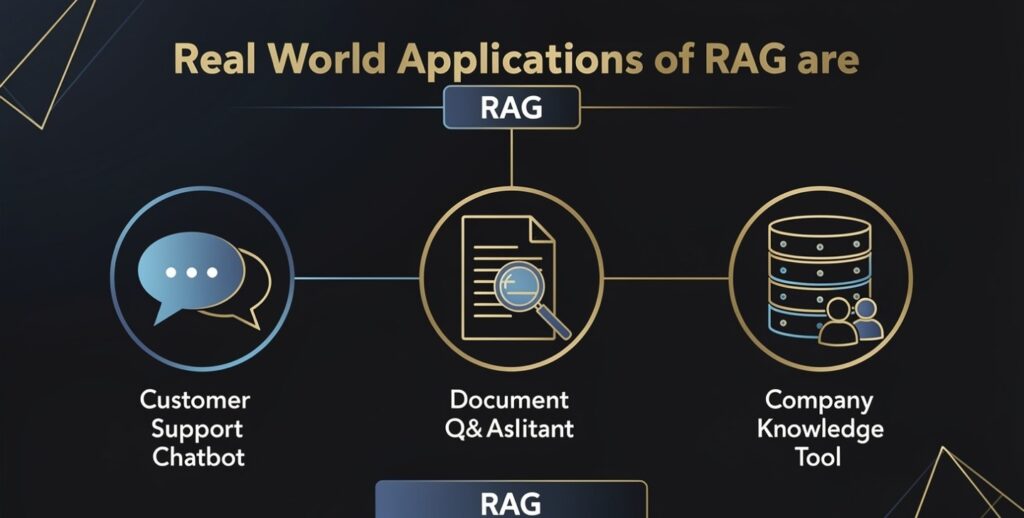
RAG is used widely, often behind the scenes without being advertised. Common examples include customer support chatbots that answer questions about a company’s specific products and policies, AI assistants that answer questions about documents you upload, internal company tools that let employees query large knowledge bases, AI systems that search the web before responding to keep answers current, and specialized assistants in fields like legal, medical, and financial services where accuracy from authoritative sources is critical. Essentially, any time an AI needs to answer questions based on specific, current, or private information rather than just its general training, RAG or a similar approach is likely at work.
Now It’s Your Move
That intimidating acronym — RAG — turned out to be a beautifully simple idea. Retrieval Augmented Generation just means letting an AI look up real information before it answers, instead of relying on its frozen, sometimes-faulty memory. It is the open-book exam for AI, and that single shift solves three of the biggest problems holding AI back: outdated knowledge, confident wrong answers, and not knowing your specific information.
Now you understand why nearly every serious AI application uses RAG. It is the bridge between a powerful general AI model and the real, current, specific knowledge that makes AI actually useful for businesses and individuals. When an AI answers questions about your uploaded document, your company’s products, or up-to-date information, RAG or something like it is quietly doing the work behind the scenes.
And here is the practical takeaway: this is not just abstract knowledge. Understanding how RAG works makes you a smarter, more capable user of every AI tool you touch. And because the barrier to building simple RAG applications has dropped so dramatically, it is a genuine, learnable skill that opens real opportunities — even if you are not a hardcore programmer. In a world where AI literacy is becoming as valuable as computer literacy once was, understanding concepts like RAG puts you ahead.
Remember the open-book analogy. Know the four steps. Understand the difference from fine-tuning. Respect that RAG is only as good as its knowledge base. And stay a critical user who verifies important information rather than blindly trusting any AI.
You now understand one of the most important concepts in modern AI — one that most people use every day without ever knowing its name. Use that understanding to navigate the AI world with more clarity and confidence.
For your next steps, dive deeper into how RAG compares to other customization methods with our complete guide on fine-tuning vs RAG and which to choose. And if learning AI skills appeals to you, see how compounding a skill into a wealth machine can turn new knowledge into real opportunity.