- Emotional interference — not bad strategy — is the number one reason compound growth gets destroyed in money, business, and skill.
- Every panic exit, every impulsive pivot, every “this time is different” decision resets your compounding clock back to zero.
- Compounding rewards boredom. Your nervous system is wired to punish boredom. That conflict is the real battle.
- You do not need a better strategy. You need a system that protects your strategy from your own emotions.
Emotional interference is the quiet force that kills more compound growth than any market crash, recession, or bad investment ever will. It does not announce itself. It does not show up as a single catastrophic mistake. It shows up as a thousand small emotional decisions that, one by one, reset the clock on something that needed time more than anything else.
Most people think compounding fails because of bad math, bad timing, or bad luck. It does not. Compounding fails because humans cannot sit still while watching a number grow slowly. The math has never been the problem. You are the problem — and so is everyone else trying to build wealth, a business, or a skill through compound effort.
This article is not going to comfort you. It is going to show you exactly how emotional interference operates, why your brain is built to sabotage compounding, and what the Data Pips Team has learned — through real losses, real recoveries, and real discipline — about protecting growth from your own emotions.
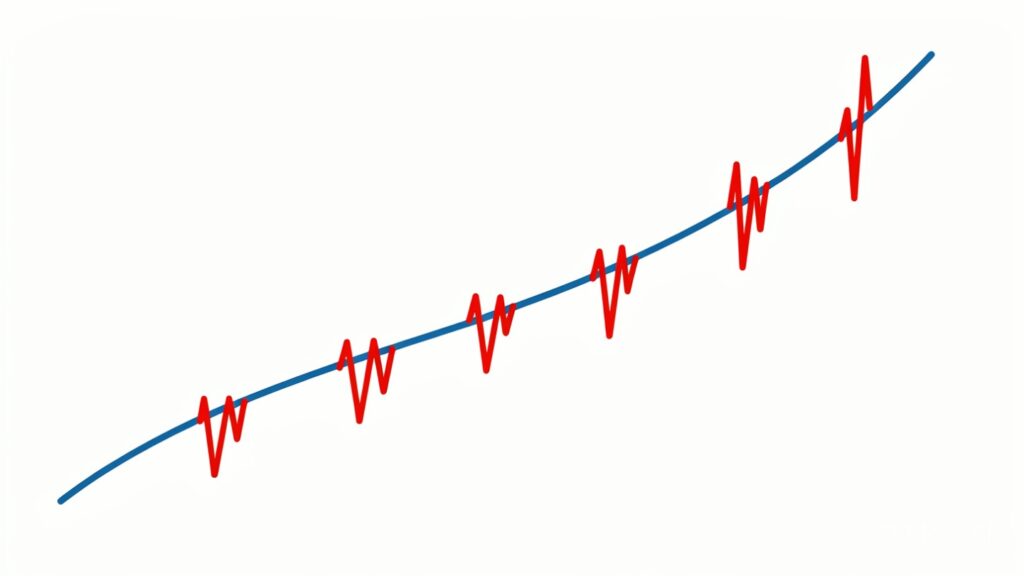
What Emotional Interference Actually Is
Emotional interference is any decision driven by fear, excitement, impatience, ego, or comparison that disrupts a process that was otherwise working. It is not always a dramatic decision. Most of the time it is small. A slightly early exit. A slightly oversized position. A slightly impulsive pivot away from a plan that simply needed more time.
Compounding — whether in money, business, or skill — has one non-negotiable requirement: uninterrupted time. The moment you interrupt it, you do not just lose the time you already invested. You lose the exponential curve that was building underneath the surface, invisible, waiting for the later years to pay off.
According to Investopedia, compounding is the process where returns generate their own returns over time — meaning the majority of the growth happens in the later stages, not the early ones. This is exactly why emotional interference is so destructive. It almost always happens before the real growth arrives.
You are not failing because compounding does not work. You are failing because you keep interrupting it right before it was about to start working.
Why Your Brain Is Wired to Sabotage Compounding
This is not a willpower problem. It is a biology problem.
Human brains evolved to respond to immediate threats and immediate rewards. For most of human history, slow and steady did not save your life — fast reaction did. That wiring did not disappear because you opened a brokerage account or started a business. It is still running in the background of every decision you make.
Three psychological forces specifically attack compounding:
Loss aversion. Research in behavioral psychology consistently shows that the pain of losing money feels significantly stronger than the pleasure of gaining the same amount. This means a small drawdown in your portfolio or a slow month in your business feels far worse emotionally than it actually is financially — and that distorted feeling drives premature exits. Psychology Today’s coverage of loss aversion explains this asymmetry in detail.
Present bias. Your brain values an immediate reward more than a larger future reward, even when the math clearly favors waiting. This is why “take profit now” feels better than “let it compound for three more years,” even when the second option is mathematically superior.
Boredom intolerance. Compounding, by definition, looks boring in its early and middle stages. Nothing dramatic happens. The curve is flat-looking even though the underlying math is working. Humans are not built to tolerate long stretches of “nothing is happening” — so they intervene. They check the account too often. They tweak the strategy. They chase something more exciting. Every intervention resets the clock.
“Compounding does not fail because the math is wrong. It fails because you could not survive being bored long enough to let the math work.”
— Data Pips Team
The Three Places Emotional Interference Destroys Compounding
Emotional interference is not limited to investing. It shows up in three areas that all rely on the same compound mechanism — time plus consistency.
1. Money and Investing
The single most common destroyer of investment compounding is panic selling during downturns, followed closely by impulsive switching between strategies after a few months of underperformance. The investor who stays invested through volatility almost always outperforms the investor who reacts to every dip — not because they pick better investments, but because they do not interrupt the process.
2. Business Growth
Business compounding works through consistent reinvestment, consistent customer relationships, and consistent brand building over years. Emotional interference here looks like abandoning a marketing channel after three slow weeks, firing a strategy after one bad quarter, or chasing a shiny new opportunity before the current one has had time to mature. Our breakdown of the specific mistakes that sabotage compounding covers this in detail.
3. Skill and Career Development
Mastery compounds the same way money does — slowly, then suddenly. Emotional interference here looks like quitting a skill right before the competence curve bends upward, or constantly switching fields because progress “feels too slow,” when in reality the foundation being built is invisible until it is not.
| Emotional Trigger | What It Feels Like | What It Actually Does |
|---|---|---|
| Panic during a drawdown | “I’m protecting myself” | Locks in the loss and removes you before recovery |
| Excitement after a quick win | “I found the secret” | Leads to oversized risk and gives back gains |
| Boredom during stability | “Nothing is happening, I should change something” | Disrupts a process that was actually working |
| Comparison to others | “They are growing faster than me” | Triggers premature strategy changes based on someone else’s timeline |

The Trading Psychology Connection
Nowhere is emotional interference more visible — or more expensive — than in trading. The Data Pips Team has watched this pattern repeat for years across forex and gold markets: a trader builds a small, steady equity curve through disciplined risk management, then a single emotional trade undoes weeks or months of progress.
The lesson learned through real losses in gold and forex markets was simple but brutal: slow, boring, controlled growth beats fast, exciting, emotional growth every single time over a long enough timeline. A trader taking 2–3 disciplined trades a day with strict risk control will compound their account far more reliably than a trader chasing 10 emotional trades looking for one big win.
The market does not punish bad analysis nearly as often as it punishes emotional interference. Most blown trading accounts were not blown by a wrong prediction — they were blown by a right prediction followed by an emotional decision to risk too much, hold too long, or revenge trade after a loss.
Read our complete guide on capital preservation in trading to understand how this principle applies directly to protecting a trading account from emotional decisions.
During a period of significant personal financial pressure, our founder experienced firsthand how emotional decision-making during a difficult market stretch in gold trading led to abandoning a working strategy under stress, rather than staying disciplined through a temporary drawdown. The lesson learned was not about the strategy — the strategy was sound. The lesson was that emotional state, not technical skill, determined whether the compounding process survived. That single insight reshaped how every trading and business decision has been approached since.
How to Build a System That Protects Compounding From Your Emotions
You cannot delete your emotions. You can build systems that prevent your emotions from making decisions for you. Here is exactly how.
Pre-commit to rules before emotion arrives. Decide your exit criteria, your risk limits, and your strategy review schedule before you are in an emotional state. Once you are anxious, excited, or bored, your decision-making is already compromised. Rules written in a calm state protect you from decisions made in an emotional one.
One mechanical fix for emotional interference is dollar-cost averaging — a fixed monthly investment schedule that takes your feelings out of the decision.
Set a review schedule, not a reaction schedule. Decide in advance that you will review your portfolio, business metrics, or skill progress on a fixed schedule — weekly, monthly, quarterly — rather than reacting every time something moves. Checking a slow-compounding asset daily guarantees you will see normal volatility and misinterpret it as a signal to act.
Separate the process from the outcome. A single bad month does not mean a strategy is broken. A single great month does not mean a strategy is perfected. Judge your process by whether you followed your own rules, not by the short-term outcome, which is heavily influenced by randomness over short timeframes.
Build a “cooling off” rule for big decisions. Any decision to exit a long-term position, abandon a business strategy, or quit a skill should require a mandatory waiting period — 48 to 72 hours minimum — before execution. Most emotional decisions lose their urgency once the immediate feeling passes.
Track your interference, not just your results. Keep a simple log every time you deviate from your plan due to emotion. Over a few months, this log becomes the most valuable data you own — it shows you exactly which emotional triggers cost you the most compounding.
A study referenced by Harvard Business Review on investor psychology found that investors who checked their portfolios less frequently consistently outperformed those who monitored constantly — largely because reduced monitoring reduced opportunities for emotional interference.
What Nobody Tells You About Emotional Interference and Compounding
1. The damage is usually invisible until years later. Emotional interference rarely shows up as a single dramatic loss. It shows up as the gap between what your money, business, or skill could have become versus what it actually became. Most people never calculate that gap, which is exactly why they keep repeating the same pattern.
2. Financial education does not fix this. You can understand exactly how compounding works mathematically and still sabotage it emotionally. Knowledge and behavior are not the same thing. This is why so many financially literate people still make undisciplined decisions — the problem was never a lack of information.
3. Stress compounds emotional interference. External stress — financial pressure, family pressure, health issues — dramatically increases the likelihood of impulsive decisions. The National Institute of Mental Health’s research on stress confirms that chronic stress impairs the prefrontal cortex functions responsible for long-term planning and impulse control — the exact functions compounding requires.
4. Comparison is the most underestimated trigger. Watching someone else’s faster, louder success creates a psychological pressure to abandon your own slower, quieter process. Most premature exits from a compounding strategy are not caused by the strategy failing — they are caused by comparison to someone else’s different timeline, different risk tolerance, or different starting point.
5. The fix is boring, and that is exactly why most people will not do it. The actual solution to emotional interference is unglamorous: written rules, fixed review schedules, mandatory waiting periods, and tracking your own behavior. None of this feels exciting. But excitement was never the goal. Protecting the compound curve was.

The Mindset Shift That Changes Everything
Most people approach compounding as a math problem. It is not. It is a psychological endurance problem disguised as a math problem.
The math of compounding has never failed anyone who left it alone long enough. Every failure traces back to a human decision that interrupted a process that was already working. This means the real skill you need to develop is not a better strategy, a better investment, or a better business model. It is the ability to tolerate boredom, withstand short-term pain, and resist the urge to act when nothing dramatic is required.
This is why rewiring how you respond emotionally matters more than almost any technical skill you could learn. Our guide on rewiring your mindset from zero walks through exactly how to start building that emotional foundation, regardless of where you are starting from.
The compound curve is patient. It will wait for you to get out of your own way. The only question is how much time you are willing to waste interrupting it before you finally do.
Quick Action Steps: Protect Your Compound Growth Starting Today
Step 1: Write down your current investing, business, or skill-building rules on paper today — not in your head. If you cannot write them clearly, you do not actually have a system, you have a feeling.
Step 2: Set a fixed review schedule for whatever you are trying to compound. Remove daily or constant checking. Replace it with weekly, monthly, or quarterly reviews only.
Step 3: Create a 48-hour cooling-off rule for any major decision to exit, pivot, or abandon a current strategy.
Step 4: Start an interference log. Every time you deviate from your plan emotionally, write down what triggered it. Review this log monthly.
Step 5: Identify your single biggest emotional trigger from the table above and build one specific rule this week to defend against it.
Want to understand the deeper mistakes that sabotage long-term growth? Read our full breakdown of compounding sabotage and why investors specifically destroy their own progress.
Frequently Asked Questions
What is emotional interference in compounding?
Emotional interference is any decision driven by fear, excitement, boredom, or comparison that disrupts a compounding process before it has had enough time to produce significant results. It includes panic selling, impulsive strategy switching, premature exits, and oversized risk-taking after a win.
Why does compounding feel so boring in the beginning?
Compounding is mathematically exponential, meaning the majority of visible growth happens in later stages, not early ones. In the early and middle stages, the growth is happening but is not yet visually dramatic. This creates a mismatch between what your brain expects to see and what is actually happening beneath the surface.
How do I stop myself from panic selling during a downturn?
Write your exit rules in advance, during a calm emotional state, before any downturn occurs. Reduce how frequently you check your portfolio or business metrics. Add a mandatory 48 to 72 hour waiting period before executing any major exit decision, which allows the initial emotional spike to pass before you act.
Does this apply outside of investing?
Yes. Emotional interference affects any process that relies on consistency over time — business growth, skill mastery, fitness, relationships, and career development all compound the same way money does. The same psychological triggers that cause panic selling also cause people to quit businesses, skills, and habits too early.
Can experienced investors and traders still suffer from emotional interference?
Yes, often more dangerously than beginners because experienced people trust their own judgment more, which can lead to larger position sizes and bigger emotional decisions. Experience reduces some emotional reactions but does not eliminate them. This is why even highly skilled traders and investors maintain strict written rules rather than relying on judgment alone.
How long does it take to fix emotional interference patterns?
There is no fixed timeline, but most people see meaningful improvement within 3 to 6 months of consistently tracking their emotional triggers and following pre-written rules. The goal is not to eliminate emotions entirely, which is not realistic, but to build systems that prevent those emotions from controlling your decisions in the moment.
What is the single most effective tool against emotional interference?
A written, pre-committed set of rules created during a calm emotional state, combined with a fixed review schedule that limits how often you check on the thing you are trying to compound. Most emotional interference happens because of unnecessary monitoring combined with the absence of clear, predetermined rules.
Disclaimer: This article is for educational and informational purposes only and does not constitute financial, investment, trading, or psychological advice. Compounding outcomes depend on individual circumstances, risk tolerance, and market conditions, all of which vary significantly from person to person. The Data Pips Team makes no guarantees regarding financial outcomes from applying the strategies described in this article. Consult a licensed financial advisor before making investment decisions, and a qualified mental health professional if emotional or psychological challenges are significantly affecting your decision-making.