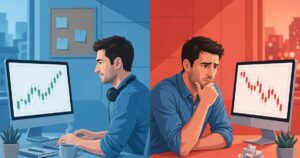
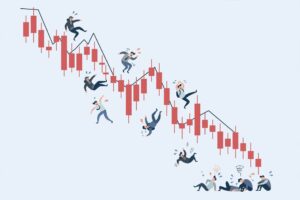
Most traders blow their accounts — not because their strategy failed, but because they couldn’t wait.

Introduction: The Trade You Don’t Take Is Often Your Best Trade
Most traders spend months — sometimes years — mastering chart patterns, indicators, and entry strategies. They study RSI, Fibonacci retracements, and market structure. They back-test their systems. They build elaborate setups.
And then they blow their accounts anyway.
Not because their strategy failed them. But because they couldn’t wait.
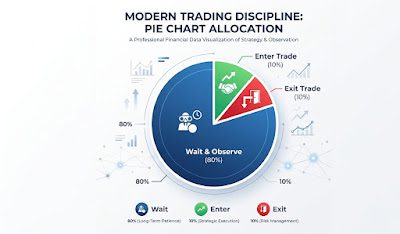
Here is the uncomfortable truth that no trading course teaches upfront: trading is 10% buying, 10% selling, and 80% waiting. The majority of a professional trader’s time is spent doing nothing — watching, observing, letting the market breathe, and waiting for the moment when conditions align perfectly.
This article breaks down the three specific patience skills every trader must develop — not as a soft character trait, but as a hard, trainable, tactical edge. Master these, and you won’t just make money — you’ll keep it.
Why Patience Is the Most Undervalued Edge in Trading
Before we get to the three skills, it is important to understand why patience is so rare and so powerful.
The human brain is wired for action. Dopamine — the neurotransmitter associated with reward — spikes not when you receive something, but when you anticipate it. This means the act of clicking “Buy” or “Sell” gives the brain a reward hit, regardless of whether the trade is actually good.
This is why traders overtrade. It feels productive. It feels exciting. It feels like you are “doing the work.”
But the market does not reward activity. It rewards accuracy and discipline.
According to research from Investopedia on the cost of overtrading, retail traders who place fewer, higher-quality trades consistently outperform those who trade frequently — and the gap is not small. The cost of overtrading is not just financial. It is psychological. Every bad trade erodes confidence, distorts judgment, and makes the next decision worse.
A landmark study by finance professors Brad Barber and Terrance Odean, summarized in their well-known research titled “Trading Is Hazardous to Your Wealth”, found that the most active retail traders earned the worst returns — directly because of excessive trading driven by overconfidence. Patience, therefore, is not passive. It is the most active form of risk management available to any trader.
The 3 Patience Skills Every Trader Must Develop
Skill 1: Waiting for the Setup — Defeating FOMO Before It Defeats You
The first and most fundamental patience skill is learning to wait for your setup to form completely before entering a trade.
This sounds simple. In practice, it is one of the hardest disciplines in all of trading.
Here is the scenario most traders know intimately: you have identified a level. You have marked your zones. You know the trade is forming. The candle is moving. The setup looks right. And then — before your confirmation signal actually triggers — you enter early.
Sometimes it works. More often, it does not. And when it does not, you are not just losing money. You are losing confidence in your own system, which leads to the next bad decision, and the one after that.
This premature entry is driven by FOMO — the Fear Of Missing Out. FOMO tells you that if you do not enter right now, the trade will leave without you and you will miss the entire move.
FOMO is almost always wrong, for two reasons. First, the market creates setups constantly. A move you “missed” is not a loss — it is data. It tells you what kind of setups your market produces, which prepares you better for the next one. Second, professional traders do not chase candles. They plan levels. They know their entry zone in advance, and they either get their price or they do not. If they do not, they move on — without hesitation, without grief, and without revenge.
How to build this skill:
Define your setup with written rules. If you cannot describe your entry in one sentence, it is not clear enough. A vague setup is an open invitation for FOMO to fill in the gaps.
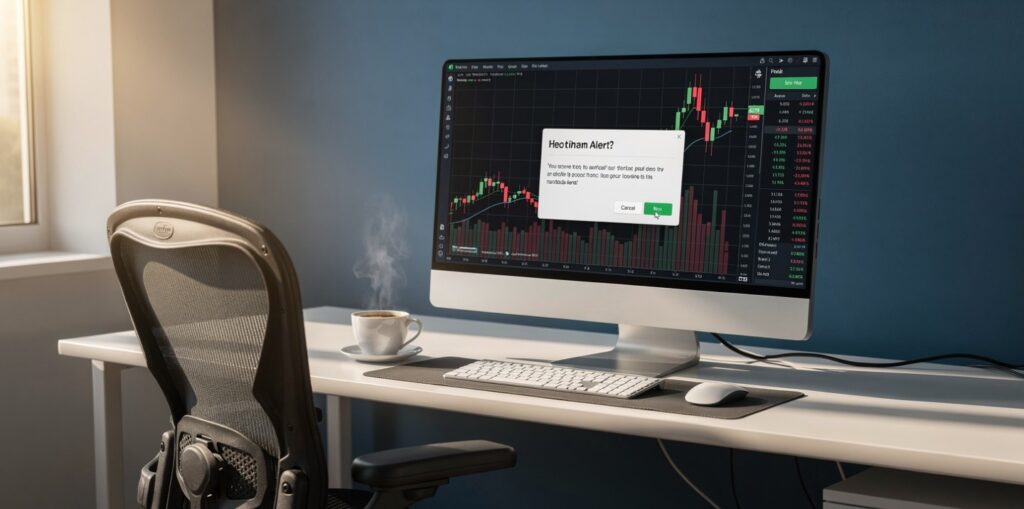
Use price alerts, not constant screen watching. When you watch price move tick-by-tick, your emotional brain activates and overrides your analytical brain. Set alerts. Walk away. Return only when price reaches your level.
Journal your missed trades. When you do not enter and price moves without you, log it. More often than you expect, you will see that the “missed” move reversed shortly after. FOMO lies — and your journal proves it.
Skill 2: Holding the Trade — The Patience to Let Profits Run
You have done the hard work. You waited for your setup. You entered with discipline. The trade is now in profit and moving in your direction.
This is exactly when most traders self-destruct.
The second patience skill is the ability to hold a winning trade to its target — without closing it early out of anxiety, greed, or the fear that it will reverse.
The psychology here is subtle but devastating. When a trade is in profit, the brain shifts into loss-protection mode. Every tick against you feels like a threat. The profit feels “real” — like money you already have and are about to lose. So the impulse is to close early and “lock in the gains.”
The result? You cut your winners short and let your losers run. This is statistically the single most common reason why technically sound traders remain unprofitable.
Here is a crucial truth: a strategy’s profitability depends entirely on your winners being larger than your losers. If your system has a 50% win rate but your average win is only 0.5R while your average loss is 1R, you will lose money systematically — no matter how disciplined your entries are. Holding your winners to target is not optional. It is structural.
How to build this skill:
Set your target before you enter. When you define your exit level in advance, removing it becomes a decision that requires a new reason. Without a pre-set target, every adverse tick becomes a reason to exit.
Move to a higher timeframe once in the trade. Many traders close winners early because they watch lower-timeframe noise. Switch to a higher timeframe after entry. The “scary” retracement that made you exit often looks like normal consolidation on a higher timeframe.
Understand your system’s R-multiple. Know what your average winning trade should produce. If your edge requires a 3R win to stay profitable, exiting at 1R is not caution — it is self-sabotage.
Skill 3: Waiting After a Loss — The Antidote to Revenge Trading
Of the three patience skills, this one is the most dangerous to neglect — and the most emotionally challenging to develop.
Every trader will experience stop losses. The stop loss is not a failure. It is a cost of doing business, built into the probability structure of any trading system. A strategy with a 60% win rate still loses 40% of the time. Losses are inevitable, expected, and necessary.
The problem is not the loss. The problem is what happens in the 15 minutes after the loss.
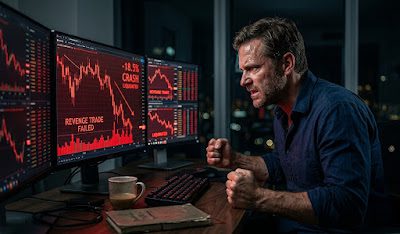
When a stop loss hits, the emotional brain does not process it as “this was part of the plan.” It processes it as a threat — and it wants the threat resolved immediately. The result is revenge trading: the compulsive need to “get your money back” right now, by any means necessary.
Revenge trades share specific characteristics. They are typically entered without a proper setup, oversized (because you are trying to recover faster), based on the previous trade’s price action rather than current market conditions, and emotionally driven rather than analytically driven.
The predictable result is a second loss, often larger than the first. Then a third. Then a drawdown that takes days or weeks to recover — if it is recovered at all.
The antidote is deceptively simple but requires enormous discipline: after a stop loss, do nothing. Wait. The market will still be there in 30 minutes, in an hour, tomorrow. No trade taken out of emotional distress can ever be a high-quality trade.
How to build this skill:
Establish a “cooling off” rule. After every stop loss, set a minimum waiting period before your next entry — 30 minutes, one hour, or the rest of the session. Make it non-negotiable.
Step away from the screen. Physical distance from the charts breaks the emotional feedback loop. Stand up, walk, get water. Your nervous system needs a reset.
Ask one question before re-entering: “Am I entering this trade because the setup is valid, or because I want to recover my loss?” If there is any doubt, the honest answer is the latter.
The Hidden Fourth Skill: Taking Unprompted Breaks from the Market
There is a discipline that ties all three patience skills together — and most trading education never mentions it.
Take breaks from the market even when you have no reason to. Not after a big loss. Not after a bad week. Randomly, deliberately, without any trigger that justifies it.
Here is why this matters more than most traders realize. The market punishes traders most severely not during their worst periods — it punishes them during their transitions. The shift from a losing streak into overconfidence. The move from a winning streak into recklessness. The moment when consistent discipline quietly slides into comfortable arrogance.
You will rarely see these transitions coming from the inside.
A structured break — stepping away from all trading activity for one to three days, with no charts, no P&L checks, no market analysis — gives you the perspective to see your own patterns from the outside. It resets your emotional baseline. It interrupts developing bad habits before they become entrenched ones.
Professional traders who build this habit into their schedule report something counterintuitive: they perform better on fewer trading days. The break does not cost them opportunities. It prevents them from destroying their equity during low-quality, emotionally compromised sessions.

Bringing It Together: The 80% Principle
Trading is 10% buying, 10% selling, and 80% waiting.
Most traders invert this ratio. They spend 80% of their time in positions and 20% waiting. They are rewarded with consistent losses and emotional exhaustion.
The professional approach is the opposite. You spend the majority of your time in observation mode — studying price, understanding context, waiting for conditions to align. When everything is right, you enter with precision. You hold with conviction. And when the market invalidates your thesis, you exit cleanly and wait again.
This is not a passive strategy. It requires more active mental discipline than constant trading. It requires you to override powerful neurological impulses — every time, session after session, for the entirety of your trading career.
But here is what is on the other side of that discipline: keeping your money is more valuable than making it. A trader who makes 40% in gains but loses 50% to impulsive, emotional trading has made nothing. A trader who makes 20% and keeps all of it — because they have mastered the patience to wait — has built real, compounding equity.
The market rewards patience because it is the one edge that technology cannot replicate and algorithms cannot replace. In a world of high-frequency trading and AI-powered execution, the human ability to consciously choose to do nothing remains one of the most durable competitive advantages available.
What Nobody Tells You About Patience in Trading
Every trading guide tells you to “be patient.” Almost none of them tell you what patience actually costs, or why it is so much harder than it sounds.
Patience feels like losing, even when it is winning. When you sit out a move that runs without you, every part of your brain screams that you failed — that you should have been in it. The wins from patience are invisible: the losses you did not take, the revenge trades you did not place, the accounts you did not blow. You never get a dopamine hit for a disaster you avoided. This is exactly why patience is so rare — it is unrewarding in the moment and only pays off in the aggregate, over months you cannot feel day to day.
The market specifically punishes your strengths turning into arrogance. The most dangerous moment is not after a loss — it is after a winning streak, when discipline quietly becomes confidence and confidence quietly becomes recklessness. The trader who just had ten good trades is in more danger than the one who just had three bad ones, because the winning trader has stopped watching themselves. Patience includes being suspicious of your own success, not just managing your failures.
“Just be patient” is useless without removing the temptation. Willpower fails under emotional pressure — this is well established in behavioral psychology. Telling yourself to be patient while staring at a live chart is like telling yourself to diet while sitting in a bakery. The traders who actually develop patience do it structurally: alerts instead of screen-watching, pre-set targets instead of live decisions, mandatory cooling-off periods instead of relying on self-control in the heat of the moment. You do not out-discipline the impulse. You build an environment where the impulse has less to act on.
Most “patience problems” are actually unclear-rules problems. Traders blame their lack of patience, but the real issue is usually that their setup is too vaguely defined. When your entry criteria are crystal clear and written down, waiting is easy — the trade either qualifies or it does not. When your criteria are fuzzy, every candle looks like a maybe, and “maybe” is what FOMO feeds on. Before you blame your discipline, check whether your rules are actually specific enough to be obeyed.
Summary: The Patience Skills at a Glance
Skill 1 — Wait for the Setup: Do not enter until your complete confirmation signal appears. FOMO is not a strategy. A missed trade is data, not a loss.
Skill 2 — Hold the Winning Trade: Define your target before you enter, and honor it. Cutting winners short is the most common source of structural unprofitability.
Skill 3 — Wait After a Loss: Never re-enter immediately after a stop loss. The market will still exist in 30 minutes. A revenge trade cannot, by definition, be a quality trade.
Bonus — Take Unprompted Breaks: Step away when there is no visible reason to. It resets your baseline, interrupts bad patterns early, and preserves your most valuable asset: clear judgment.
Frequently Asked Questions
Q: How do I stop FOMO trades from ruining my account?
Define your entry rules with absolute precision, in writing. Use price alerts instead of watching charts in real time. And keep a journal of the trades you did not take — you will quickly discover that FOMO cost you far less than the impulsive entries it would have caused. The clearer your rules, the easier patience becomes.
Q: Is it normal to feel emotional after a stop loss?
Completely normal. The challenge is not eliminating the emotion — it is preventing the emotion from driving the next trade. Build a structured waiting period into your plan that activates automatically after every loss, so the decision to wait is already made before the emotion arrives.
Q: How long should I hold a winning trade?
Until your pre-defined target, or until price action gives a clear technical reason to exit. The answer should never be “until I feel nervous enough to close.” If you find yourself closing winners based on anxiety rather than a planned exit, that is a structural problem worth fixing.
Q: How often should I take breaks from trading?
At minimum, after any significant winning or losing streak. Ideally, build in one scheduled “market-free” day per week regardless of performance. The breaks you take when nothing is wrong are often more valuable than the ones you take after something goes wrong.
Q: Can patience really be trained, or is it a personality trait?
It can absolutely be trained — but not through willpower alone. It is trained structurally, by building systems that reduce the number of moments you have to rely on self-control: written rules, price alerts, pre-set targets, and mandatory cooling-off periods. Patience is less about having a calm personality and more about designing an environment where impatience has fewer opportunities to act.
Q: Why do I keep breaking my own trading rules even when I know better?
Because knowing a rule and following it under emotional pressure are two completely different things. When the emotional brain activates, it overrides the analytical brain — willpower is not enough in that state. The solution is to remove the decision from the heated moment entirely: set alerts so you are not watching live, pre-define targets so exits are automatic, and enforce cooling-off periods so re-entry is impossible for a set time. You break rules in the moment; you keep them by designing the moment in advance.
Disclaimer: This article is for educational purposes only. Trading forex, stocks, and precious metals involves substantial risk of loss and is not suitable for every investor. Past performance is not indicative of future results. Always do your own research.