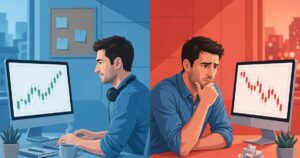
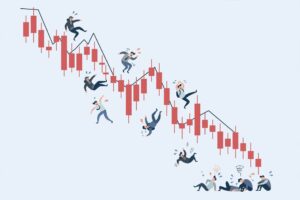
In the world of trading, most beginners spend years searching for the Holy Grail — a perfect indicator, an unbeatable system, a strategy with a 100% win rate. They buy courses, collect indicators, and jump from one method to the next, convinced that the right technical setup is the missing piece.
It is not.
The real difference between a professional trader and an amateur is not the chart patterns they know. It is the mindset they have built. Trading is 20% strategy and 80% psychology. Most traders never truly accept this, which is why most traders never truly succeed.
The numbers back it up — why psychology outweighs strategy in trading breaks down the 80/20 split and the trading journal method that catches expensive emotional mistakes fastest.
1. The Power of Discipline and Patience
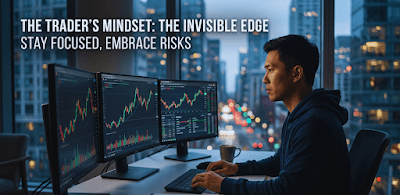
The market is, in its most fundamental nature, a device for transferring money from the impatient to the patient. This is not a metaphor — it is a structural reality. The institutions that consistently profit in markets do so largely because they are willing to wait for conditions that retail traders, driven by boredom and FOMO, are not willing to wait for.
A successful trader operates with the mindset of a sniper, not a machine gunner. The machine gunner fires constantly, hoping that the volume of attempts will produce results. The sniper waits — sometimes for a long time — until the conditions are exactly right, and then acts with precision.
Trading out of boredom is one of the most expensive habits in this field. Every trade entered without meeting your full criteria is a bet placed against your own edge. The market does not reward activity. It rewards correct activity at the right time.
FOMO — Fear of Missing Out — is perhaps the single most destructive emotion in trading. The feeling that a move is happening and you are not in it drives traders to enter late, without structure, and with inadequate risk management. That position almost always ends badly. And the move that felt like it was going to go forever usually reverses immediately after the FOMO entry fills.
The practice: Define your criteria before the market opens. Write down exactly what needs to be true for you to enter a trade. If those criteria are not met, you do not trade — regardless of what the price action looks like in the moment.
2. Emotional Neutrality: The Zen State
Professional trading requires a level of emotional detachment that feels unnatural to most people when they first encounter the concept. When you enter a trade, your heart rate should not spike. You should not feel excitement, dread, or the urge to watch every tick as if your life depends on it.
If a loss makes you angry, you are gambling. If a win makes you feel invincible, you are gambling. The emotional volatility that most traders experience is the clearest signal that they are not yet operating as professionals — they are still attached to individual trade outcomes in a way that distorts their decision-making.
The goal is to reach a state where you are genuinely indifferent to the outcome of any single trade because you understand and trust your long-term edge. A surgeon does not celebrate every successful incision or spiral into crisis over a single complication. They execute their process with calm precision because they have done it enough times to trust the process itself.
This state does not come immediately. It is built through screen time, journaling, consistent rule-following, and gradually accumulating enough data about your own trading to replace emotional reactions with probabilistic understanding.
The practice: After every trade — win or lose — rate your emotional state before, during, and after the position. Over time, patterns will emerge. You will see which conditions or chart setups trigger emotional reactions and which do not. That information is more valuable than most technical analysis.
3. Accepting Risk as a Business Expense
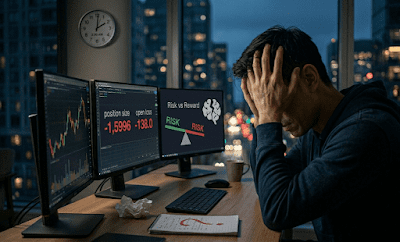
Every business has operating costs. A restaurant pays for ingredients, rent, and staff wages whether or not every customer comes back. A consultant pays for software, professional development, and time spent on proposals that do not convert. These are not failures — they are the cost of operating the business.
In trading, losses are your business expenses. A losing trade does not mean you are a bad trader. It means that specific trade, in that specific set of market conditions, did not work out. That is normal. That is expected. That is part of the business.
The psychological shift required here is significant. Most people have been conditioned to see any financial loss as a mistake — something to be avoided, regretted, and analyzed as evidence of failure. In trading, this conditioning is lethal. It causes traders to hold losing positions too long, to move stop losses, and to engage in revenge trading — all in an attempt to avoid accepting the loss.
Once you genuinely accept that losses are a line item in your trading business — not a judgment of your intelligence or worth — the fear of pulling the trigger disappears. You enter trades based on your criteria, accept the risk fully before the position is opened, and execute your plan without the emotional interference that comes from hoping the trade will not need the stop loss.
The practice: Before entering any trade, ask yourself: “Am I fully comfortable losing the exact amount I am risking on this position right now?” If the answer is not yes, your position size is too large for your current psychology. Reduce the size until the answer is genuinely yes.
4. Process Over Profits
This is the principle that separates traders who build lasting consistency from those who produce impressive weeks followed by catastrophic months.
If you follow your rules perfectly — your entry criteria, your stop placement, your position sizing — but the trade still loses money, you have had a good trade. The process was correct. The outcome was simply one of the losing instances that any edge will produce across a sample of trades.
If you break your rules — you entered without full confluence, you moved your stop, you sized up out of overconfidence — and the trade makes money, you have had a bad trade. Not because of the outcome, but because you have reinforced a behavior that will eventually produce a catastrophic loss when the same rule-breaking occurs under worse conditions.
Traders who focus on profits will optimize for individual trade outcomes. Traders who focus on process will optimize for long-term consistency. Only one of those approaches produces sustainable results.
The practice: Grade each trade in your journal not on whether it won or lost, but on whether you followed your rules completely. Track your rule-following percentage separately from your win rate. Over time, you will find that the two numbers are more correlated than you expect — and that improving your rule-following is the most direct path to improving your results.
5. Thinking in Probabilities
The human brain is hardwired to seek certainty. We are pattern-recognition machines that evolved to predict outcomes based on incomplete information. This is useful for survival. It is extremely dangerous in trading.
The market does not produce certain outcomes. Any single trade has a random result. Even the best setups, with the clearest structure and the strongest confluence, fail a meaningful percentage of the time. This is not a flaw in the system — it is simply the nature of probabilistic outcomes in complex adaptive systems.
A professional mindset understands this deeply. The question is never “Will this specific trade win?” The question is “Does my system, applied consistently across 100 trades, produce a positive expectancy?” If the answer is yes — and you have the data to support that answer — then every individual trade is simply one data point in a much larger sample.
This shift in thinking removes the emotional weight from individual trade outcomes. A loss is not a disaster — it is expected, it was budgeted for, and it is one of the necessary instances that allow the winning trades to occur. A win is not a confirmation of genius — it is one of the expected positive outcomes that your edge produces over time.
The practice: Do not evaluate your trading performance trade by trade. Evaluate it in batches of at least 20 to 30 trades. Look at your win rate, your average risk-reward ratio, and your expectancy over that sample. Individual trade outcomes are noise. The sample is the signal.
6. Building the Mental Framework: What Actually Works
The five principles above are not just concepts — they are trainable skills. Here is what the practical development of a professional trading mindset actually looks like:
- Journal everything: Not just entries and exits, but your emotional state before, during, and after each trade. What were you thinking when you entered? What were you feeling when it moved against you? What did you want to do that you did not do? This data is irreplaceable.
- Build rules and follow them unconditionally: Rules that you follow 90% of the time are not rules — they are suggestions. Define your criteria precisely and treat deviation as a serious problem to be analyzed, not a flexible allowance.
- Reduce your position size until you feel nothing: If you are emotional about your trades, you are almost always too large. Size down until the emotional noise disappears. Then gradually increase as your psychology strengthens.
- Review your data regularly: Know your actual win rate, actual average RR, and actual expectancy from real trading — not from back-testing. Real numbers from real trades are the only honest feedback the market gives you.
- Protect your mental energy: Trading is cognitively demanding. Sleep, physical health, and stress management outside of trading directly affect the quality of your decisions at the terminal. Treat your mental health as trading infrastructure.
Conclusion: Mastering the Inner Game
To succeed in trading, you must first succeed at managing yourself. Technical analysis — ICT, SMC, price action, whatever framework you choose — provides the map. But your mindset is the engine that determines whether you ever reach the destination.
The chart does not lose you money. Your reaction to the chart does. The setup does not blow your account. Your emotional response to the setup does. The market is not your enemy — your undisciplined psychology is.
Every hour you spend developing your psychological foundation — building discipline, cultivating emotional neutrality, accepting risk, following process, thinking in probabilities — is an investment that compounds directly into your trading performance.
Your greatest enemy in this game is the person looking back at you in the mirror. But so is your greatest ally. The work is the same in both cases: know yourself, manage yourself, and trust the process long enough for it to work.
1. Define your entry criteria before the market opens. If the criteria are not met, you do not trade.
2. Rate your emotional state before every trade. If it is elevated, reduce your size or step away.
3. Grade every trade on rule-following, not outcome. Process is the only thing within your control.
4. Review your performance in batches of 20+ trades. Single trade outcomes are noise.
5. Journal every session. The patterns in your psychology are more valuable than the patterns on your chart.
About the Author
Shurah Beel Hamid is an active trader and content creator who writes about trading psychology, risk management, and the mental disciplines behind consistent long-term performance in financial markets.
Disclaimer: This article is for educational purposes only and does not constitute financial advice. Trading involves significant risk of loss. Always conduct your own research before making any trading decisions.