Most amateur traders look at a 26% annual return and scoff. They want 100% in a month. They crave “moon shots” and overnight success. But here is the cold, hard financial truth: If you cannot master the mundane discipline of a steady 26%, you will never accumulate true wealth.
In the world of professional fund management and institutional wealth building, a consistent 26% compound annual growth rate (CAGR) isn’t just “good” — it is absolutely elite.
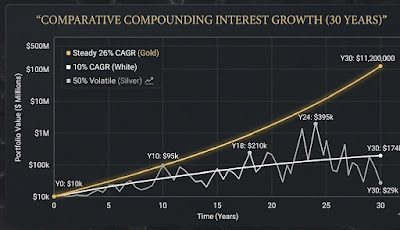
1. The Math of Patient Wealth
Let’s stop dreaming and start counting. If you invest a capital seed of $10,000 today and successfully maintain a 26% annual return through disciplined execution:
- In 10 years: You have 10x your money, turning it into roughly $100,000.
- In 30 years: That very same small seed compounds into over $10 Million.
Warren Buffett didn’t become one of the wealthiest individuals in history by being a hyperactive “fast” day trader; he achieved it through unwavering consistency, averaging roughly 20% annual returns over multiple decades. If you are constantly chasing a “double” on a single speculative asset while your overall global portfolio remains flat or bleeding, you aren’t investing — you are gambling. Moving the needle on your entire portfolio is the only performance metric that actually matters.
2. Premium Asset Retention: Why Early Profit Booking Fails
Retail market participants love to brag about “booking quick profits.” However, exiting a strategic position in a fundamentally high-performing asset simply because the market price experienced a minor upward fluctuation is a disservice to your future net worth.
Consider premier real estate as an analogy. When a major metropolitan city scales, the foundational value of the land appreciates over time. Do you sell off your kitchen today and liquidate your bedroom tomorrow just to lock in short-term gains? Absolutely not. You retain the asset because the ultimate value lies in the totality of long-term capital growth.
If a business equity or long-term trade setup is executing perfectly according to its structural macro strength, taking profit prematurely is the financial equivalent of cutting your flowers to water your weeds.
3. The Behavioral Science of Success: The “Skinner Box” Reality
Why do the majority of people fail to master compounding? Because human psychology is naturally wired for immediate gratification rather than delayed rewards. B.F. Skinner’s famous operant conditioning experiments with laboratory models prove this perfectly.
When a subject pressed a lever and received a reward immediately, the behavioral loop was reinforced instantly. However, when the reward feedback was delayed by just 30 seconds, the connection broke down. The subject could no longer link the initial Action (pressing the lever) with the eventual Result (the reward).
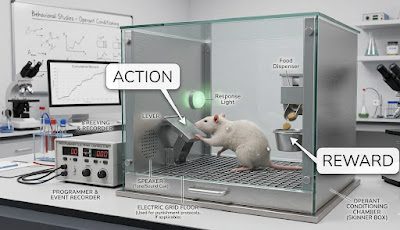
This is the exact obstacle traders face. In professional speculation and scalable entrepreneurship, the high-discipline Action occurs today, but the compounding Result manifests years down the road. Because of this temporal gap, the untrained brain struggles to internalize the process, often misinterpreting systematic success as random luck. Real wealth building requires building a mental bridge across that feedback gap.
4. The Proximity Principle: Guarding Your Inner Circle
The architects of generational wealth do not spend their finite time with chronic complainers; they operate among high-level achievers. The proximity principle is absolute: You naturally become the average of the five individuals you interact with the most.
If your immediate social circle consists of people who consistently place blame on macroeconomics, corporate structures, or personal “bad luck,” your mindset is already operating at a deficit. You require a network that conceptualizes market psychology, scalability, and the long game. Negative paradigms are highly contagious; protecting your environment is a mandatory prerequisite for protecting your portfolio.

The Verdict
Long-term market success has very little to do with raw luck or high academic IQ. It is entirely determined by Psychological Speed — your functional ability to rapidly bridge the gap between intent and disciplined action.
Stop looking for premature exits. Stop chasing low-probability quick fixes. Build your 26% compounding engine, safeguard your assets with strict risk management, and optimize your circle. If you lack the patience for the mundane process of wealth building, you are simply wasting capital in the market.
Do you prioritize overall portfolio growth, or are you still caught up in the emotional trap of chasing individual quick wins? Let’s discuss your long-term wealth strategy in the comments below!