Here is a question that sounds simple but hides something deep: how does a computer know that “car” and “automobile” mean almost the same thing, while “car” and “banana” do not? Computers do not understand words. They understand numbers. So before any AI can reason about language, images, or meaning, it has to turn those things into numbers in a very particular way. Those numbers are called embeddings, and the specialised database built to store and search them is a vector database. Together, they are the quiet engine behind a huge amount of modern AI, and once you see how they work, a lot of things suddenly make sense.
This sounds intimidating, but the core idea is genuinely intuitive. There is no advanced maths required to understand it, just a willingness to think about meaning as a location. If you have grasped how a large language model works, embeddings and vector databases are the missing piece that explains how these systems actually find and use the right information.
What Is an Embedding?
An embedding is a way of representing something, a word, a sentence, an image, as a list of numbers that captures its meaning. That list of numbers is called a vector. The magic is in how the numbers are chosen: things with similar meaning get vectors that are close together, and things with different meaning get vectors that are far apart.
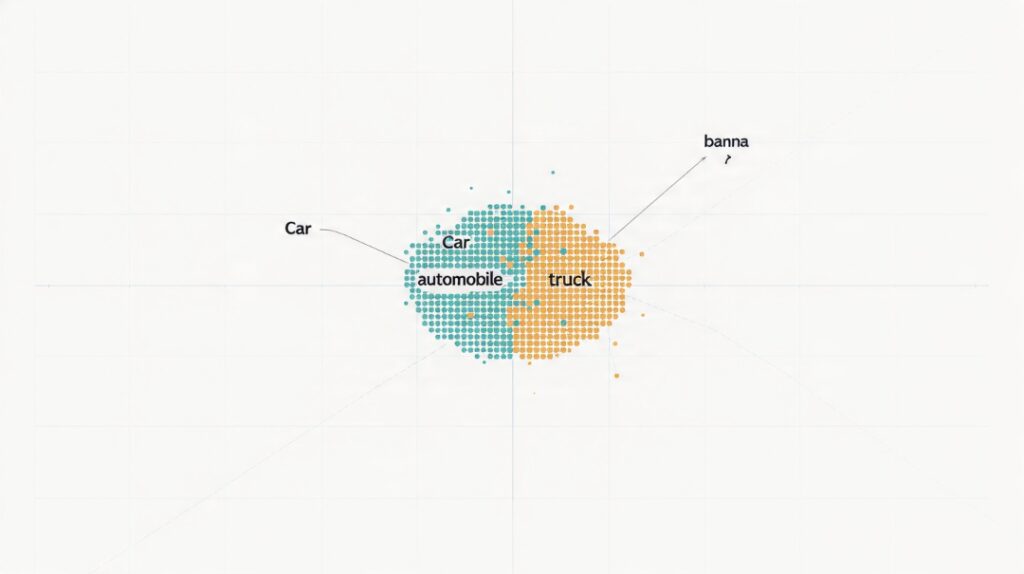
Think of it like coordinates on a map. On a real map, two nearby towns have similar coordinates, and two distant cities have very different ones. An embedding does the same thing, except instead of a two-dimensional map of the world, it places meaning in a space with hundreds of dimensions. In that space, “car” and “automobile” land right next to each other, “car” and “truck” are nearby, and “car” and “banana” are in completely different neighbourhoods. The position is the meaning. These numerical representations are produced by AI models, and they are the same kind of technology underneath generative AI more broadly.
Turning Meaning Into Numbers
So how does a jumble of numbers capture something as slippery as meaning? The embeddings are generated by AI models trained on enormous amounts of text and data. Through that training, the model learns which things tend to appear in similar contexts and which do not, and it encodes those relationships into the numbers.
Because “king” and “queen” show up in similar situations, their vectors end up close. Because “happy” and “joyful” are used similarly, they cluster together. The model is not told these rules; it discovers them by seeing how language is actually used, the same broad process described in how AI learns through training. The result is that abstract meaning becomes something concrete and measurable: a position in space that a computer can actually work with. And crucially, this is not limited to words. The same idea turns entire documents, images, and audio into vectors, which is why it powers so many different kinds of AI.
What Is a Vector Database?
Once you have turned thousands or millions of things into embeddings, you need somewhere to store them and, more importantly, a fast way to search them. That is exactly what a vector database is: a database designed specifically to store vectors and find the ones closest to a given vector, quickly.
A traditional database is brilliant at exact matches. Ask it for the customer named “John Smith” and it finds that exact record. But it has no idea that “car” relates to “automobile,” because it only matches identical text. A vector database works completely differently. Instead of looking for exact matches, it looks for closeness in meaning. You hand it a vector, and it returns the items whose vectors are nearest, which is to say, the items most similar in meaning. This is the difference between searching for a specific word and searching for an idea.

How Similarity Search Actually Works
The heart of a vector database is finding the nearest vectors to a query, often called similarity search or nearest neighbour search. Return to the map analogy. If you drop a pin somewhere and ask “what are the five closest towns?”, you are doing exactly what a vector database does, just in far more dimensions.
When you type a question, that question is turned into a vector, and the database finds the stored vectors sitting closest to it, because closeness means similar meaning. Searching millions of high-dimensional vectors fast is a genuine engineering challenge, so these databases use clever techniques to approximate the nearest results quickly rather than checking every single item, an approach related to nearest neighbour search. The practical upshot is that you can search by meaning across an enormous collection in a fraction of a second.
Why This Matters: The Killer Use Case
Here is where it all clicks into something powerful. Large language models are impressive, but on their own they only know what was in their training data, and they can confidently make things up. You cannot fit your company’s private documents, or the latest information, inside the model itself. So how do you get an AI to answer questions using your specific, up-to-date information?
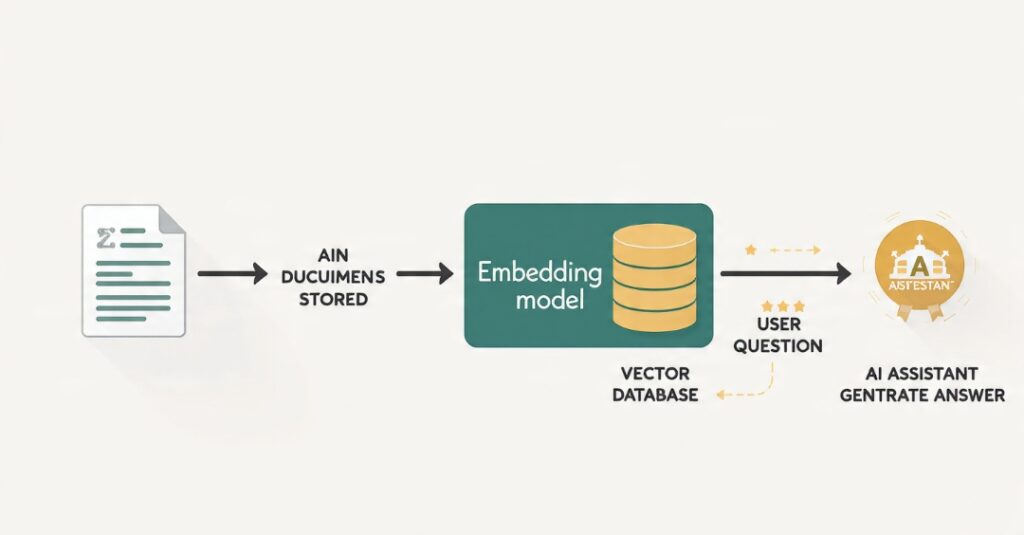
The answer is embeddings plus a vector database. You convert all your documents into vectors and store them. When someone asks a question, you turn the question into a vector, use the vector database to instantly find the most relevant chunks of your documents, and feed those chunks to the language model as context. Now the model answers using real, retrieved information instead of guessing. This technique is called retrieval-augmented generation, and it is one of the most important patterns in applied AI, precisely because it directly attacks the problem of AI hallucinations by grounding answers in actual source material. The vector database is the retrieval engine that makes it possible.
Where You Already See This
Once you know what to look for, embeddings and vector search are everywhere.
- Smart search. Search that understands what you mean, not just the exact words you typed, returning relevant results even when the wording is different.
- Recommendations. “You might also like” systems work by finding items whose vectors are close to things you already enjoyed, similar in some deep, learned sense.
- AI assistants over private data. Chatbots that answer questions about a specific company’s documents, policies, or products rely on exactly this retrieval setup.
- Finding duplicates and similar content. Detecting near-identical images or articles becomes easy when everything is a vector and similarity is just distance.
- Image and audio search. Searching by the content of a picture or a sound, rather than by a text label, works because those too can be turned into vectors.
All of these share the same foundation: convert things into embeddings, store them in a vector database, and search by meaning. It is the same core technology powering the broader shift toward capable AI agents that can pull in and act on relevant information.
Clearing Up Common Confusions
A few points trip people up, so let us settle them plainly. An embedding is not the same as a vector database, the embedding is the list of numbers representing meaning, while the vector database is the storage-and-search system that holds many embeddings. They work together but are different things.
Another confusion: vector databases do not replace traditional databases. They solve a different problem. You still use a normal database for exact records and structured data; you add a vector database when you need search by meaning. Many real systems use both side by side. And embeddings are not magic understanding, the model does not truly “know” what a car is the way a person does. It has simply learned, from vast data, how things relate to each other, and encoded those relationships as positions in space. That is a powerful trick, but it is a statistical one, which is worth remembering whenever you think about what these systems can and cannot do.
🔑 Key Takeaways
- An embedding is meaning as numbers. It represents a word, sentence, or image as a vector, positioned so similar things sit close together and different things sit far apart.
- Think of it as a map of meaning. Position equals meaning, so “car” and “automobile” land in the same neighbourhood while “banana” is far away.
- A vector database stores and searches vectors, finding the closest ones by meaning rather than matching exact text like a traditional database.
- Similarity search is nearest-neighbour search. Turn a query into a vector, find the stored vectors closest to it, and you have searched by meaning in a fraction of a second.
- The killer use case is retrieval. Embeddings plus a vector database let an AI answer using your specific documents, the foundation of retrieval-augmented generation.
- They complement, not replace, normal databases, and the “understanding” is a learned statistical pattern, not true comprehension.
Frequently Asked Questions
What is an embedding in simple terms?
An embedding is a list of numbers, called a vector, that represents the meaning of something like a word, sentence, or image. The numbers are arranged so that things with similar meaning have vectors close together and things with different meaning have vectors far apart, effectively turning meaning into a position in space.
What is a vector database used for?
A vector database stores embeddings and quickly finds the ones most similar in meaning to a given query. It is used for meaning-based search, recommendation systems, detecting similar or duplicate content, and powering AI assistants that answer questions using a specific set of documents.
How is a vector database different from a normal database?
A traditional database finds exact matches, such as a specific name or record. A vector database instead finds items that are closest in meaning to a query, even if the wording is completely different. They solve different problems, and many systems use both together rather than replacing one with the other.
What is the difference between an embedding and a vector database?
An embedding is the actual list of numbers that represents the meaning of one item. A vector database is the storage and search system that holds many embeddings and finds the closest ones. In short, the embedding is the data, and the vector database is where you keep and search that data.
How do embeddings relate to large language models?
Embeddings let a language model work with your specific information. By converting documents into vectors and retrieving the most relevant ones for a question, you can feed real source material to the model as context. This grounds its answers in actual information and is the core of retrieval-augmented generation.
Do embeddings only work for text?
No. The same idea applies to images, audio, and other data. Anything that can be turned into a vector that captures its meaning can be stored and searched in a vector database, which is why the technology powers image search, audio search, and multimodal AI, not just text.
Does a vector database actually understand meaning?
Not in the human sense. It works with embeddings produced by models that have learned, from large amounts of data, how things relate to each other. That produces very useful results, but the “understanding” is a statistical pattern encoded as positions in space, not genuine comprehension of concepts.