Key Takeaways
- AI does not learn the way humans learn from understanding — it learns by finding patterns in massive amounts of data through trial and error.
- The core loop is simple: the AI makes a guess, checks how wrong it was, adjusts its internal settings slightly, and repeats this billions of times until it gets good.
- “Training” is this whole process of feeding the AI data and letting it gradually tune itself to recognize and reproduce patterns.
- AI learns from examples, not from rules. Nobody programs in the answers — the AI figures out the patterns itself by practicing on data.
- Understanding how AI learns explains why data quality matters so much, why training is expensive, and why AI has the strengths and weaknesses it does.
An AI can write essays, recognize faces, translate languages, and answer almost any question — yet nobody sat down and programmed it with all that knowledge. So how does it actually know any of it? How does a machine go from knowing nothing to seeming almost intelligent? The answer is “training,” and it is one of the most misunderstood ideas in all of technology.
Most people imagine that AI is programmed like traditional software — that engineers write out rules and answers line by line. But that is not how modern AI works at all. AI is not told the answers. It learns them, through a process that is surprisingly understandable once someone explains it without the jargon. And understanding this process demystifies almost everything about how AI behaves.
This guide explains how AI learns, in plain language, for someone who is not a programmer. The Data Pips Team will show you what “training” actually means, the simple core loop behind it, how AI learns from examples rather than rules, and why understanding this makes you genuinely smarter about AI. No technical background needed. By the end, you will understand how machines learn. Let us get into it.
First — AI Doesn’t Learn the Way You Think
Let us clear up the biggest misconception right away, because it changes everything.
Most people assume AI is built like traditional software, where a programmer writes explicit rules: “if this, then that.” For simple programs, that is true. But you cannot program intelligence that way. Imagine trying to write out every rule for recognizing a cat in a photo — the millions of variations in lighting, angle, breed, pose. It is impossible. There are too many possibilities to ever write down as rules.
So modern AI takes a completely different approach. Instead of being given rules, it is given examples, and it figures out the patterns itself. Show it millions of photos labeled “cat” and “not cat,” and it gradually learns, on its own, what patterns distinguish cats — without anyone ever writing a single rule about whiskers or ears. This approach is called machine learning, and it is the foundation of modern AI.
This is the fundamental shift to understand: AI learns from examples, not from rules. Nobody programs in the answers. The AI is shown enormous amounts of data and discovers the patterns by itself, through the training process. As IBM describes it, machine learning enables systems to learn and improve from experience (data) without being explicitly programmed for every task. This is why AI can handle things that would be impossible to write rules for.
— Data Pips Team
The Core Learning Loop (Guess, Check, Adjust)
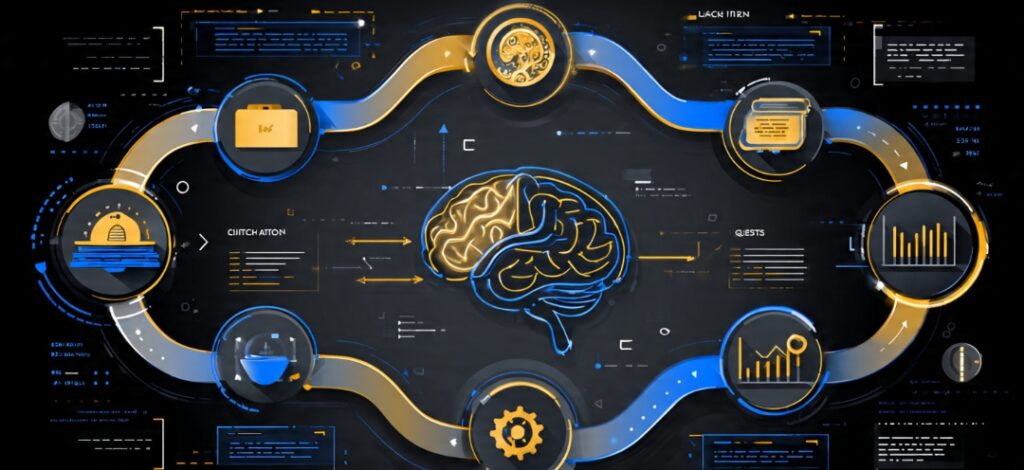
Here is the beautifully simple loop at the heart of how AI learns. Almost all AI training comes down to this cycle, repeated an enormous number of times:
Step 1: The AI Makes a Guess
The AI is given an example and asked to make a prediction. For instance, it is shown a photo and asked “is this a cat?” At the very beginning, before any training, its guess is essentially random — it has no idea. It might say “cat” for a picture of a car. That is fine; that is where learning starts.
Step 2: The Guess Is Checked Against the Right Answer
The AI’s guess is compared to the correct answer (which the training data includes). The system measures how wrong the guess was. If the photo was actually a cat and the AI said “not cat,” there is a large error. This measurement of “how wrong” is crucial — it is the signal that drives all the learning.
Step 3: The AI Adjusts Its Internal Settings
Based on how wrong it was, the AI makes tiny adjustments to its internal settings (called parameters) — nudging them in the direction that would have made its guess a little more correct. Each adjustment is small, just a slight tuning. Think of it like turning thousands of tiny dials a tiny bit, in the direction that reduces the error.
Step 4: Repeat — Billions of Times
Then it does this again with the next example. And the next. And the next — millions or billions of times. With each cycle, the guesses get a tiny bit better, the errors get a tiny bit smaller, and the internal settings get a tiny bit more tuned. Over an enormous number of repetitions, the AI gradually transforms from making random guesses to making remarkably accurate predictions. The accumulated effect of billions of tiny adjustments is what produces a capable AI.
That is the entire core of how AI learns: guess, check how wrong, adjust slightly, repeat enormously. It is trial and error at a massive scale, automated and accelerated. The “intelligence” emerges from this patient, repeated tuning — not from any single brilliant insight, but from billions of small corrections accumulating into capability.
The Student Practicing Analogy
Here is the analogy that makes AI training click. Imagine a student learning to solve a new type of math problem.
At first, the student does not know how. So they try a practice problem and get it wrong. They check the answer key, see the correct answer, and understand a little better where they went wrong. They try another problem — still wrong, but a little closer. They check again, adjust their approach slightly. They do another, and another, and another. Hundreds of practice problems, each time guessing, checking against the answer, and adjusting their understanding a little.
Slowly, through all this practice, the student gets better. Not because anyone gave them a magic rule, but because repeated practice with feedback gradually tuned their understanding. Eventually, they can solve problems they have never seen before, because they absorbed the underlying patterns through all that practice.
This is exactly how AI learns. The training data is the practice problems with their answer key. Each example is a practice problem; the AI guesses, checks against the correct answer, and adjusts. Repeated across a massive number of examples, the AI “practices” its way to capability — gradually tuning itself until it can handle even examples it has never seen before, because it absorbed the underlying patterns. The difference is just scale and speed: the AI practices on millions or billions of examples, far faster than any human could.
Interestingly, this mirrors a deep truth about how progress works in general — small, consistent improvements compounding into mastery over time. It is the same principle behind the 1% rule and daily compounding habits: tiny gains, repeated relentlessly, accumulate into something remarkable. AI training is, in a sense, compounding applied to learning.
What Is a Neural Network? (The Thing Doing the Learning)
You will often hear that AI uses a “neural network.” This sounds intimidating, but the basic idea is approachable.
A neural network is the structure inside the AI that actually does the learning. It is loosely inspired by how brains work — made up of many simple interconnected units (sometimes called “neurons”) organized in layers. Information flows through these layers, and the connections between units have adjustable strengths — those are the “parameters” or “dials” we keep mentioning.
Here is the simple way to think about it: the neural network is like a vast web of dials. When the AI makes a guess and checks how wrong it was, the training process adjusts these dials throughout the web, strengthening some connections and weakening others, so the network gets a little better at producing the right output. With enough dials (modern AI has billions) and enough training, this web of adjustable connections can learn to recognize incredibly complex patterns — faces, language, music, almost anything.
You do not need to understand the technical details of how neural networks compute. The key idea is simply this: a neural network is a large web of adjustable connections, and “learning” means tuning all those connections through the guess-check-adjust loop until the network produces good outputs. When you hear “deep learning,” it just means using neural networks with many layers — “deep” refers to the number of layers stacked up.
Example: How an AI Learns to Recognize Cats
Let us make this concrete with the classic example. Suppose we want to train an AI to recognize cats in photos.
The data: We gather millions of photos, each labeled either “cat” or “not cat.” This labeled data is the AI’s practice problems with answers.
The training: We show the AI a photo. At first, it guesses randomly — maybe it says “cat” for a photo of a dog. We check: wrong. The system adjusts the network’s dials slightly. Next photo, next guess, check, adjust. Over millions of photos, the network gradually tunes itself.
What it learns on its own: Nobody ever told the AI “cats have pointy ears and whiskers.” Instead, through all that practice, the network discovered for itself the visual patterns that distinguish cats — patterns so subtle and numerous that no human could have written them as rules. The early layers of the network might learn to detect simple edges and shapes; later layers combine these into more complex features; the final layers recognize “this combination of features means cat.”
The result: After training, you can show the AI a photo of a cat it has never seen before, and it correctly says “cat” — because it learned the general patterns, not just memorized specific photos.
Lesson: The AI learned to recognize cats not because anyone programmed the rules, but because it practiced on millions of examples and discovered the patterns itself. This same process — scaled up and adapted — is how AI learns language, speech, and almost everything else.
How Language AI (Like ChatGPT) Learns
The same core loop powers the language AI you use every day, with one specific twist. Instead of guessing “cat or not cat,” a large language model learns by guessing the next word.
Here is how it works. The AI is shown an enormous amount of text — much of the internet, books, articles. It is given a passage with the next word hidden, and asked to predict that next word. It guesses, the guess is checked against the actual word, and the network adjusts. Repeated across an almost unimaginable number of examples, the model gradually becomes extraordinarily good at predicting what word comes next in any context.
And here is the remarkable part: by learning to predict the next word really well, the AI ends up absorbing grammar, facts, reasoning patterns, writing styles, and an enormous amount of knowledge — all as a side effect of mastering next-word prediction. Nobody taught it grammar rules or facts directly; it learned them implicitly because they were necessary to predict text well. Our complete guide on what an LLM is and how it works explores this fascinating outcome in depth.
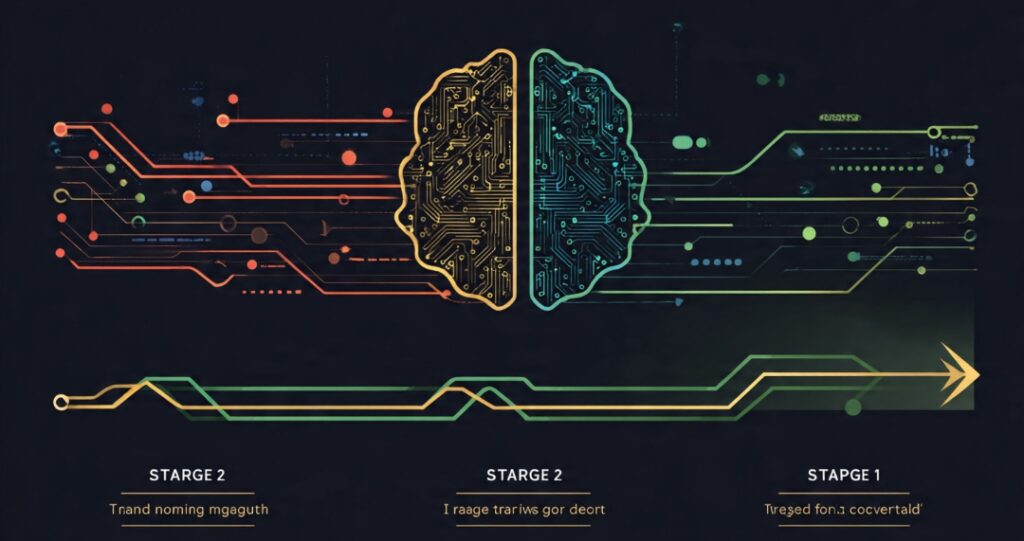
After this main “learning language” phase, the model usually goes through additional training to make it helpful and safe — often involving human feedback, where people rate responses to guide the model toward better behavior. This shapes the raw text-predictor into the polished assistant you actually interact with. So language AI learns in two broad stages: first absorbing language and knowledge from massive text, then being refined into a helpful assistant.
— Data Pips Team
Why Data Quality Matters So Much
Once you understand that AI learns from examples, a crucial implication becomes obvious: the AI is profoundly shaped by the data it learns from. This has major consequences.
Garbage In, Garbage Out
If the training data is full of errors, biases, or low-quality information, the AI will learn those flaws. It cannot learn to be more accurate than its training data allows. This is why the quality and composition of training data is one of the most important factors in how good an AI turns out to be. An AI trained on excellent data learns excellent patterns; an AI trained on flawed data learns flawed patterns.
Bias In, Bias Out
If the training data contains human biases — and human-generated text inevitably does — the AI tends to absorb and reproduce those biases. This is a serious and widely discussed challenge in AI. The model is, in a sense, a mirror of the data it learned from, reflecting both its wisdom and its flaws. Addressing bias requires careful attention to training data and additional techniques during training.
Gaps In, Gaps Out
If the training data lacks information about something, the AI will be weak in that area. This partly explains why AI can be brilliant on common topics (lots of training data) but unreliable on obscure ones (little training data) — and why it tends to hallucinate more in areas it learned little about. Our guide on why AI hallucinations happen connects directly to this: gaps in training lead to confident gap-filling invention.
The lesson is clear: AI is only as good as what it learned from. This is why so much effort in building AI goes into curating high-quality, diverse, well-balanced training data — because the data fundamentally determines what the AI becomes.
What Nobody Tells Beginners About AI Training
1. Training Is Enormously Expensive
Training a large AI from scratch requires staggering amounts of computing power, energy, and time — often costing enormous sums of money. This is why only well-resourced organizations can afford to train the largest foundational models from scratch. Most other companies and developers build on top of these existing models rather than training their own from zero. Understanding this explains the structure of the AI industry: a few organizations build the foundational models, and everyone else builds applications on top of them.
2. The Knowledge Gets “Frozen” After Training
Once training ends, the AI’s knowledge is essentially locked in place — frozen at the point training stopped. The model does not continue learning from your conversations in real time (each conversation does not permanently teach it). This is why AI has a “knowledge cutoff” and does not know recent events, and why updating an AI’s knowledge requires either retraining or connecting it to external information through techniques like RAG. The learning happens during training; after that, the knowledge is fixed.
3. The AI Doesn’t “Understand” — It Recognizes Patterns
Even after all this training, the AI has not developed human-like understanding. It has become an extraordinary pattern-recognizer, which can look like understanding, but it is mechanically different. It learned statistical patterns in data, not genuine comprehension or consciousness. This distinction matters because it explains both the AI’s surprising capabilities and its strange failures — it is pattern-matching at a vast scale, not thinking the way you do.
4. More Data and Bigger Models Generally Help — Up to a Point
A major reason AI got so much better in recent years is simply that models got bigger and were trained on more data. Generally, more high-quality data and more parameters produce more capable models. But this is not infinite — there are diminishing returns, rising costs, and growing interest in making models more efficient rather than just bigger. The trend is increasingly toward smarter training and right-sized models, not just endlessly scaling up.
5. You Can Understand This Without Any Math
The actual mathematics of how neural networks adjust their parameters is genuinely complex and is the domain of specialists. But the conceptual understanding — learn from examples, guess-check-adjust, tune the dials, data quality matters — is completely accessible without any math, and it is enough to make you genuinely knowledgeable about how AI works. You can understand the “what” and “why” of AI learning without the technical “how,” just as you can understand that a car engine burns fuel to create motion without being able to build one.
Once a model is trained, finding and using the right information inside it depends on how embeddings turn meaning into numbers — meaning as coordinates on a high-dimensional map.
Quick Action Steps
Now It’s Your Move
- Remember: AI learns from examples, not rules. Nobody programs in the answers. The AI is shown massive data and discovers the patterns itself. This is the foundational shift to understand.
- Hold onto the core loop. Guess, check how wrong, adjust slightly, repeat billions of times. All AI training comes down to this trial-and-error cycle at massive scale.
- Picture the student practicing. AI “practices” on data the way a student practices problems with an answer key — gradually tuning itself through repetition and feedback.
- Understand neural networks simply. A neural network is a vast web of adjustable dials. Learning means tuning those dials until the network produces good outputs.
- Respect data quality. AI is only as good as what it learned from. Garbage in, garbage out; bias in, bias out; gaps in, gaps out. The data shapes everything.
- Remember knowledge gets frozen. After training, the AI’s knowledge is fixed, which is why it has a cutoff and needs tools like RAG for current information.
- Know you don’t need the math. The conceptual understanding here is enough to make you genuinely knowledgeable about AI, no technical background required.
Frequently Asked Questions
AI learns by finding patterns in massive amounts of data through trial and error, rather than being programmed with rules. The core process is a simple loop repeated billions of times: the AI makes a guess (a prediction about an example), the guess is checked against the correct answer, the AI adjusts its internal settings slightly to reduce the error, and then it repeats with the next example. Over an enormous number of repetitions, these tiny adjustments accumulate, transforming the AI from making random guesses into making accurate predictions. The key insight is that AI learns from examples, not from explicit rules — it discovers the patterns itself through this practice.
Training is the whole process of teaching an AI by feeding it data and letting it gradually tune itself to recognize and reproduce patterns. During training, the AI is shown many examples, makes guesses about them, checks those guesses against the correct answers, and adjusts its internal settings (parameters) to do better next time. This guess-check-adjust cycle repeats across millions or billions of examples until the AI becomes good at its task. Think of it like a student practicing problems with an answer key — gradually improving through repetition and feedback. After training, the AI can handle new examples it has never seen, because it absorbed the underlying patterns.
Modern AI learns from examples, not from rules — this is the fundamental shift that makes it so powerful. Traditional software follows explicit rules programmed by humans (“if this, then that”), but you cannot write rules for complex tasks like recognizing a cat in any photo, since there are too many variations. Instead, AI is shown enormous amounts of labeled examples and figures out the patterns itself. Show it millions of photos labeled “cat” and “not cat,” and it gradually learns what distinguishes cats without anyone writing a single rule about whiskers or ears. This learning-from-examples approach, called machine learning, is why AI can handle things impossible to capture as rules.
A neural network is the structure inside an AI that does the learning, loosely inspired by how brains work. It is made up of many simple interconnected units organized in layers, with adjustable connection strengths between them — these are the “parameters” or “dials.” The simplest way to think about it: a neural network is a vast web of adjustable dials. When the AI makes a guess and checks how wrong it was, the training process adjusts these dials throughout the web until the network produces better outputs. With billions of dials and enough training, this web can learn to recognize incredibly complex patterns. “Deep learning” just means using neural networks with many layers.
Language AI like ChatGPT learns using the same guess-check-adjust loop, with one specific twist: instead of guessing “cat or not cat,” it learns by predicting the next word. It is shown an enormous amount of text with the next word hidden, guesses that word, checks against the actual word, and adjusts. Repeated across an unimaginable number of examples, it becomes extraordinarily good at predicting what word comes next. Remarkably, by mastering next-word prediction, it absorbs grammar, facts, reasoning patterns, and knowledge as a side effect — nobody taught these directly. After this, additional training with human feedback refines the raw text-predictor into a helpful, safe assistant.
Because AI learns from examples, it is profoundly shaped by the data it learns from — it cannot become more accurate than its training data allows. This creates three key effects: “garbage in, garbage out” (errors or low-quality data produce a flawed AI), “bias in, bias out” (human biases in the data get absorbed and reproduced by the AI), and “gaps in, gaps out” (topics missing from the data become weak spots where the AI is unreliable and more likely to hallucinate). The AI is essentially a mirror of its training data, reflecting both its strengths and its flaws. This is why so much effort goes into curating high-quality, diverse, well-balanced training data.
Generally no — once training ends, the AI’s knowledge is essentially frozen at that point. The model does not continue learning from your individual conversations in real time; each chat does not permanently teach it new things. This is why AI has a “knowledge cutoff” and does not know about events that happened after its training ended. To update an AI’s knowledge, developers must either retrain it (expensive and time-consuming) or connect it to external, current information through techniques like RAG (Retrieval Augmented Generation), which lets the AI look up fresh information at the moment it answers. So the learning happens during training, and after that the core knowledge stays fixed.
Now It’s Your Move
The mystery of how a machine goes from knowing nothing to seeming almost intelligent turns out to have a surprisingly understandable answer. AI does not learn the way most people imagine — it is not programmed with rules and answers. Instead, it learns from examples, through a simple loop repeated at massive scale: guess, check how wrong, adjust slightly, repeat billions of times. Out of this patient, automated trial and error, capability gradually emerges.
Picture the student practicing problems with an answer key, getting a little better with each attempt — that is exactly what AI training is, just at a scale and speed no human could match. The neural network is the web of adjustable dials being tuned; the training data is the practice problems; and the “intelligence” is what emerges when billions of tiny corrections accumulate into mastery of the underlying patterns.
This understanding explains so much about AI’s behavior. Why data quality matters enormously (the AI mirrors what it learned from). Why AI has a knowledge cutoff (learning freezes after training). Why it hallucinates more on obscure topics (gaps in training data). Why it recognizes patterns brilliantly but does not truly “understand.” Every one of these traces back to how AI learns. Once you grasp the learning process, the whole picture of AI snaps into focus.
And you grasped all of this without a single equation. The conceptual understanding — learn from examples, guess-check-adjust, tune the dials, data shapes everything — is completely accessible and genuinely makes you knowledgeable about how AI works. You understand the “what” and “why” without needing the specialist “how,” which is exactly the level of understanding that makes you a smarter, more capable user of every AI tool.
You now understand how machines learn — one of the most important and most misunderstood ideas in modern technology. Most people use AI every day with no idea how it came to know anything. You are no longer one of them.
For your next steps, see how this learning produces the language AI you use in our guide on what an LLM is, understand the pieces it learns to predict in AI tokens and context windows, and see how training gaps lead to errors in why AI hallucinations happen.