Have you ever reached the end of the month wondering where your entire paycheck went? You’re not alone. Most people earn decent money but still feel financially stuck — not because they earn too little, but because nobody ever taught them how money actually works.
A financial teacher once shared something with me that completely shifted my perspective. Today, I want to pass those lessons on to you — and add a powerful formula used by over a thousand highly successful people that will change the way you think about wealth management.
Let’s break it all down, step by step.
- 78% of people live paycheck to paycheck.
- 1,000+ successful people studied for the ALCHEMIST formula.
- 4 financial quadrants — which one are you in?
01. What Is Cash Flow — and Why It Matters More Than Your Salary
If you’ve never heard the term cash flow before, here’s the honest truth: your financial literacy is at zero — regardless of how many degrees you hold. That’s not an insult; it’s simply a crucial knowledge gap that modern education systems fail to fill.
Cash flow is straightforward: it’s the continuous movement of money in and out of your life. Your salary arrives, you pay bills, you spend on needs and wants, you save a portion, and then the next paycheck comes. That cycle — money in, money out — defines your cash flow.
“Your salary source is your cash flow source. And wherever you invest, that’s where your cash flow goes next.” — Core concept from financial literacy education
Here’s what’s eye-opening: an employee who works the same job for 25–30 years has exactly one cash flow source their entire career. One stream. One pipeline. If that stream dries up due to downsizing, health issues, or economic shifts — everything stops instantly.
The ultimate goal of personal finance is to understand, manage, and eventually multiply your cash flow streams to build generational wealth.

02. Robert Kiyosaki’s CASHFLOW Quadrant: Which Box Are You In?
Robert Kiyosaki, legendary author of Rich Dad Poor Dad, divides the entire working world into four distinct categories. Every individual on earth falls into at least one of these financial quadrants.
Have you ever reached the end of the month wondering where your entire paycheck went? You’re not alone. Most people earn decent money but still feel financially stuck — not because they earn too little, but because nobody ever taught them how money actually works.
A financial teacher once shared something with me that completely shifted my perspective. Today, I want to pass those lessons on to you — and add a powerful formula used by over a thousand highly successful people that will change the way you think about wealth management.
Let’s break it all down, step by step.
- 78% of people live paycheck to paycheck.
- 1,000+ successful people studied for the ALCHEMIST formula.
- 4 financial quadrants — which one are you in?
01. What Is Cash Flow — and Why It Matters More Than Your Salary
If you’ve never heard the term cash flow before, here’s the honest truth: your financial literacy is at zero — regardless of how many degrees you hold. That’s not an insult; it’s simply a crucial knowledge gap that modern education systems fail to fill.
Cash flow is straightforward: it’s the continuous movement of money in and out of your life. Your salary arrives, you pay bills, you spend on needs and wants, you save a portion, and then the next paycheck comes. That cycle — money in, money out — defines your cash flow.
“Your salary source is your cash flow source. And wherever you invest, that’s where your cash flow goes next.” — Core concept from financial literacy education
Here’s what’s eye-opening: an employee who works the same job for 25–30 years has exactly one cash flow source their entire career. One stream. One pipeline. If that stream dries up due to downsizing, health issues, or economic shifts — everything stops instantly.
The ultimate goal of personal finance is to understand, manage, and eventually multiply your cash flow streams to build generational wealth.
02. Robert Kiyosaki’s CASHFLOW Quadrant: Which Box Are You In?
Robert Kiyosaki, legendary author of Rich Dad Poor Dad, divides the entire working world into four distinct categories. Every individual on earth falls into at least one of these financial quadrants.
- E (Employee): You work for someone else. A paycheck arrives every month. Job security feels stable, but your income potential is strictly capped by corporate decisions.
- S (Self-Employed): Professionals, freelancers, and specialists. You mastered a specific skill and sell it directly. You have autonomy, but if you stop working, your income stops. You own a job, not a scalable system.
- B (Business Owner): You build scalable enterprises. A systematic structure runs the business — not the physical presence of the founder. The owner can step away, and revenue continues to scale.
- I (Investor): Your capital works for you. Stock markets, real estate, commodities, and business equity generate compound returns automatically. This quadrant is where true asset wealth and freedom live.
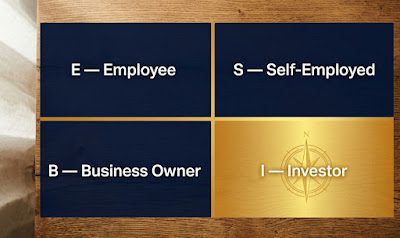
Kiyosaki’s critical observation is that most individuals spend their entire lives on the left side (E and S quadrants) without ever formulating a strategic transition to the right side (B and I quadrants). Many self-employed experts remain trapped in an active trading-time-for-money loop because they own a specific skill set rather than a self-sustaining financial framework.
“It doesn’t matter which quadrant you’re in — you can be rich or broke in any of them. What matters is your thinking.” — Robert Kiyosaki
Which financial quadrant do you currently find yourself in, and what is your immediate plan to transition toward financial freedom? Let’s discuss in the comments below!
Kiyosaki’s critical observation is that most individuals spend their entire lives on the left side (E and S quadrants) without ever formulating a strategic transition to the right side (B and I quadrants). Many self-employed experts remain trapped in an active trading-time-for-money loop because they own a specific skill set rather than a self-sustaining financial framework.
“It doesn’t matter which quadrant you’re in — you can be rich or broke in any of them. What matters is your thinking.” — Robert Kiyosaki
Ready to Change Your Financial Future?
The strategic shift from employee to sophisticated investor does not materialize overnight; however, it reliably commences with the active tracking and optimization of your current cash flow. Start small, commit to continuous market education, and look for scalable opportunities to move your capital from the left side of the quadrant to the high-leverage right side.
Which financial quadrant do you currently find yourself in, and what is your immediate plan to transition toward financial freedom? Let’s discuss in the comments below!