I spent six months building an AI agent that was supposed to automate my entire freelance client pipeline. I researched tools, watched tutorials, read documentation until my eyes burned. And then I picked the wrong framework, wasted three weeks, tore it down, and started over. That mistake cost me time I didn’t have and money I couldn’t afford to lose.
If you’re a developer building AI agents in 2026 and you don’t know which framework to use, you’re about to make the same mistake I made.
Look, the AI agent space is exploding right now. New frameworks are launching every month, each one claiming to be the “ultimate solution.” Most of them are noise. A few of them are genuinely powerful tools that will define how software gets built for the next decade. The problem is separating the signal from the garbage.
In this article, I’m breaking down the top 10 AI agent frameworks developers must know right now. Not with marketing fluff — with honest, practical assessments based on real usage, real documentation, and real limitations. If you’re building anything with autonomous AI agents, this is your starting point.

Why AI Agent Frameworks Matter More Than Ever
Here’s the thing most people don’t understand: building an AI agent from scratch using raw API calls is like building a car by forging every bolt yourself. You can do it, but you’ll spend 90% of your time on problems that someone else has already solved.
AI agent frameworks give you pre-built components for the hardest parts of agent development: memory management, tool integration, multi-step reasoning, error recovery, and orchestration. They don’t write your business logic — they handle the infrastructure so you can focus on what your agent actually does.
When I was experimenting with AI-assisted analysis for my trading workflows, I tried building everything with raw Python and API calls. It took me two weeks to get a basic agent working. When I switched to a proper framework, I rebuilt the same agent in two days with better error handling, memory, and tool use. The framework didn’t make me smarter. It stopped me from wasting time on solved problems.
How I Evaluated These Frameworks
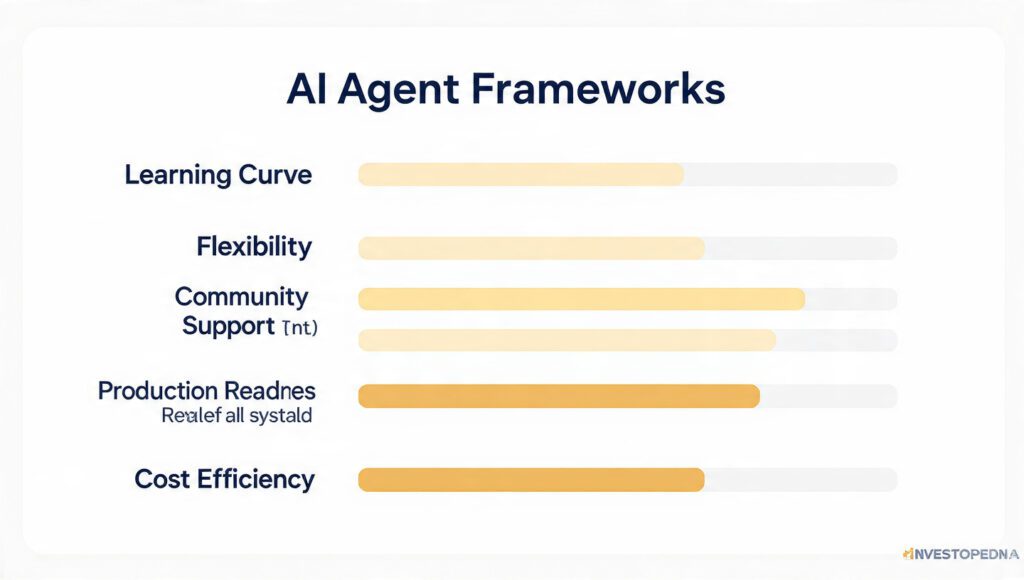
Before I give you the list, you need to know how I judged these tools. I didn’t just read their landing pages. I looked at five things:
- Learning curve: How fast can a competent developer build a working agent?
- Flexibility: Can it handle complex, multi-step workflows or is it limited to simple chains?
- Community and documentation: When you get stuck at 2 AM, can you find answers?
- Production readiness: Can you actually deploy this in a real business, or is it a toy?
- Cost: What does it cost to run at scale, including API token usage?
No framework is perfect. Every single one on this list has limitations. I’ll tell you what those limitations are because knowing what a tool can’t do is more important than knowing what it can.
1. LangChain / LangGraph
Best for: Developers who want maximum flexibility and don’t mind complexity.
LangChain is the elephant in the room. It’s the most widely adopted framework in the AI agent space, and for good reason — it can do almost anything. LangGraph, its orchestration layer, lets you build complex multi-step agent workflows as state machines with cycles, branches, and conditional logic.
But here’s the honest truth: LangChain has a steep learning curve. The documentation is massive, the abstractions are deep, and the API changes frequently. If you’re a beginner, you will feel lost for the first week. If you’re experienced, you’ll appreciate the power but curse the complexity.
I used LangGraph to build a multi-step research agent that could search the web, summarize findings, cross-reference data, and generate reports. It worked beautifully — once I understood how state management and node routing worked. Before that, I spent days debugging errors that turned out to be configuration issues.
Pro Tip: Start with LangChain’s simple chains before touching LangGraph. Understand the basics of prompts, tools, and memory first. Then graduate to graph-based orchestration when you actually need it.
2. CrewAI
Best for: Multi-agent systems where different agents have distinct roles and collaborate.
CrewAI is built around a simple but powerful idea: agents work in teams. You define agents with specific roles, goals, and tools, then assign them tasks that they execute collaboratively. Think of it like setting up a tiny company inside your code.
This framework clicked for me faster than any other. Within a few hours, I had a three-agent system: one agent researched competitors, another drafted marketing copy, and a third reviewed the output for quality. The role-based architecture made the logic intuitive.
Limitation: CrewAI is excellent for structured, role-based workflows but less flexible for highly dynamic agents that need to adapt their behavior in real time. If your agent needs to change its own strategy mid-execution, you’ll hit walls.
3. Microsoft AutoGen
Best for: Complex multi-agent conversations and research-heavy workflows.
AutoGen takes a different approach. Instead of defining rigid workflows, it lets agents have conversations with each other — and with humans — to solve problems. One agent might propose a solution, another critiques it, a third writes code, and a human approves the final output.
This is powerful for tasks that require iterative refinement. I experimented with AutoGen for generating and reviewing trading analysis reports. One agent pulled data, another wrote the analysis, and a third fact-checked the claims. The conversational pattern produced better output than a single-pass agent.
Limitation: Conversational agents can loop endlessly if you don’t set clear termination conditions. I’ve seen agents argue with each other for 20 rounds without reaching a conclusion. Always define max rounds and exit criteria.

4. OpenAI Agents SDK
Best for: Developers already in the OpenAI ecosystem who want a lightweight, official solution.
OpenAI released their Agents SDK as a streamlined way to build agents using their models. It’s intentionally simple — agents, tools, handoffs, and guardrails. No complex orchestration layers. No steep learning curve.
If you’re building agents that primarily use GPT models and you want something that works out of the box with minimal setup, this is your fastest path. The handoff mechanism — where one agent passes control to another based on context — is elegant and well-designed.
Limitation: You’re locked into OpenAI’s models. If you want to use Claude, Llama, or other models, this framework isn’t for you. Also, the simplicity that makes it easy to start also means it lacks the depth needed for truly complex enterprise workflows.
5. LlamaIndex
Best for: Data-heavy agents that need to query, retrieve, and reason over large document collections.
LlamaIndex started as a retrieval-augmented generation tool and evolved into a full agent framework. Its superpower is connecting LLMs to your data — PDFs, databases, APIs, websites — and letting agents reason over that data intelligently.
If you’re building an agent that needs to answer questions from a knowledge base, analyze documents, or pull insights from structured data, LlamaIndex is the strongest option. The indexing and retrieval pipeline is more mature than anything else in this space.
Limitation: It’s data-centric, not action-centric. If your agent needs to take real-world actions like sending emails, executing trades, or updating databases, you’ll need to integrate LlamaIndex with another framework for the action layer.
6. Dify
Best for: Non-developers and teams who want a visual, low-code approach to building AI agents.
Dify is different from everything else on this list because it’s a visual platform, not just a code library. You drag and drop components, connect them with lines, and build agent workflows without writing much code.
This is what I recommend to business owners who want to build agents but don’t have a development team. I’ve seen small business owners build functional customer service agents in Dify within a single afternoon. The barrier to entry is almost zero.
Limitation: Visual builders have a ceiling. When your workflow gets complex — conditional branching, error recovery, custom tool integration — you’ll hit the limits of what the UI can express. At that point, you need code.
7. Flowise
Best for: Rapid prototyping and teams who want open-source visual agent building.
Flowise is like Dify’s open-source cousin. It’s a drag-and-drop UI for building LLM workflows, but it’s self-hosted and fully customizable. If you want the visual builder experience but need to keep your data on your own servers, Flowise is the answer.
I’ve used Flowise to quickly prototype agent ideas before committing to building them in code. It’s excellent for testing whether an agent concept actually works before you invest weeks in development. Think of it as your sketchpad.
Limitation: Performance at scale can be an issue. Self-hosting means you manage infrastructure, and the visual abstraction can make debugging harder when things break in production.
8. Microsoft Semantic Kernel
Best for: Enterprise developers building AI agents in C# or Python within the Microsoft ecosystem.
If your company runs on Azure, uses Microsoft 365, and your team writes C#, Semantic Kernel is your natural choice. It integrates deeply with Microsoft’s cloud services, supports plugins for Office, Teams, and Azure AI, and has enterprise-grade security features.
This isn’t a hobbyist framework. It’s built for companies that need to deploy agents in regulated environments with audit trails, access controls, and compliance requirements.
Limitation: The ecosystem lock-in is real. While it technically supports other models, it’s optimized for Azure OpenAI. If you’re a startup or an independent developer, this might be overkill.
9. Haystack (by deepset)
Best for: Production-grade NLP pipelines and search-based agent systems.
Haystack is built by deepset, the team behind some of the most respected open-source NLP research. It’s designed for building production-ready search and question-answering systems that can function as the knowledge layer of an agent.
If your agent needs to search through millions of documents, rank results by relevance, and generate accurate answers grounded in real data, Haystack’s pipeline architecture is hard to beat. The component-based design means you can swap out retrievers, rankers, and generators independently.
Limitation: It’s more of a pipeline framework than a full agent framework. You’ll need to build the agent reasoning and action layer yourself or combine Haystack with another tool like LangChain.
10. Smolagents (by Hugging Face)
Best for: Developers who want a lightweight, code-first agent framework with minimal abstraction.
Smolagents is Hugging Face’s entry into the agent space, and it’s refreshingly simple. Instead of complex abstractions, it lets agents write and execute Python code directly to solve problems. The agent thinks in code, not in JSON schemas or structured outputs.
This approach is surprisingly powerful. When an agent can write code to solve a problem, it can handle tasks that would require dozens of predefined tools in other frameworks. Need to analyze a CSV? The agent writes pandas code. Need to scrape a website? It writes a requests script.
Limitation: Letting agents execute arbitrary code is a security risk. You need sandboxing, and the framework’s sandboxing is still maturing. Don’t deploy this in production without serious security review.
How to Choose the Right Framework for Your Project
Here’s the decision framework I use. It’s not complicated, but it saves you from the mistake I made — picking a tool because it was popular instead of because it fit the job.
Ask yourself these four questions:
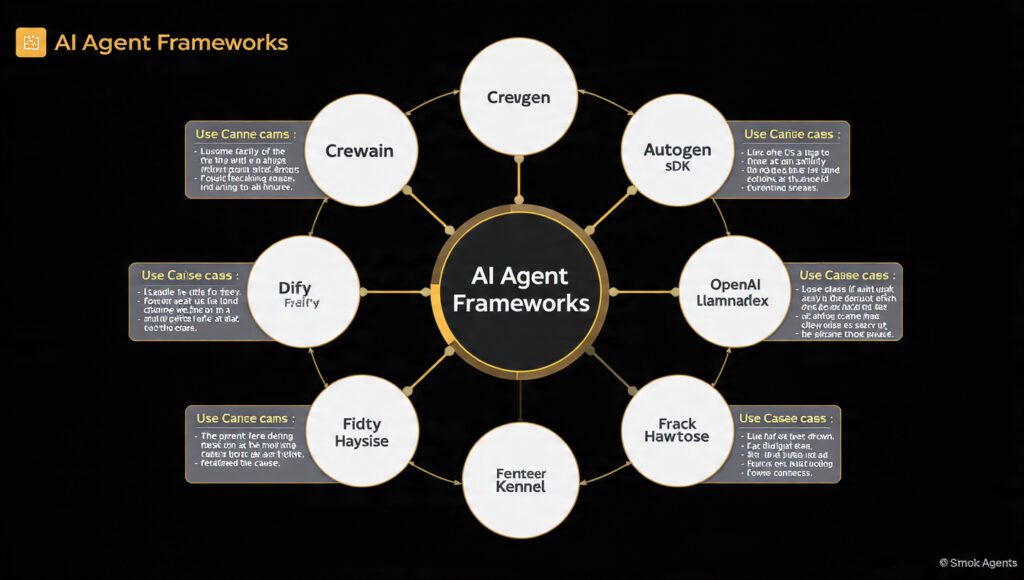
- What does my agent need to do? If it’s data retrieval, lean toward LlamaIndex or Haystack. If it’s multi-agent collaboration, look at CrewAI or AutoGen. If it’s general-purpose automation, LangChain or OpenAI SDK.
- What’s my team’s skill level? If you have experienced developers, LangGraph and Smolagents give maximum power. If you have business users or junior developers, Dify or Flowise reduce the learning curve dramatically.
- Where will this run? If you’re on Azure, Semantic Kernel is natural. If you want open-source and self-hosted, Flowise or Haystack. If cloud flexibility matters, LangChain or CrewAI are model-agnostic.
- How complex is the workflow? Simple single-agent tasks don’t need heavy frameworks. Multi-step, multi-agent, conditional workflows need LangGraph or AutoGen. Don’t over-engineer.
The biggest mistake developers make is choosing the most powerful framework when they need the simplest one that works. I’ve seen people spend weeks setting up LangGraph for a task that OpenAI SDK could handle in an afternoon. Complexity is not a feature — it’s a cost.
“The best framework is the one that lets you ship a working agent this week, not the one that promises perfection next year.” – Shurah Beel Hamid
⚡ Quick Action Steps: Start Building AI Agents This Week
- Define your agent’s job: Write down exactly what your agent needs to do in one sentence. Not “automate everything” — one specific task.
- Pick one framework from this list: Match it to your use case using the four questions above. Don’t evaluate all ten. Pick one.
- Build a prototype in 48 hours: Not a production system. A rough, working prototype that proves the concept. Imperfect is fine. Non-existent is failure.
- Test with real data: Don’t test with toy examples. Feed your agent real inputs and see how it handles edge cases, errors, and ambiguity.
- Document what broke: Every failure is data. Write down what went wrong and why. This is how you learn which framework actually fits your needs.
The Honest Truth About AI Agent Development
Nobody tells you this, so I will: building AI agents that work reliably in production is harder than any tutorial makes it look.
The demos are polished. The blog posts show happy paths. The GitHub repos have clean examples. But when you deploy an agent in the real world, it encounters messy data, ambiguous instructions, API failures, rate limits, and edge cases that no documentation prepared you for.
This is where your mindset matters more than your framework choice. When I was building my T-shirt business in Saudi Arabia, the first batch failed. The designs were ugly, the marketing was weak, and nobody bought. I could have blamed the platform, the market, or the timing. Instead, I adjusted and tried again.
The same principle applies to AI agent development. Your first agent will be mediocre. Your second will be better. Your tenth might actually be production-ready. The framework is just a tool. The discipline to iterate, test, and improve is what separates developers who ship from developers who stay stuck in tutorial hell.

Frequently Asked Questions
1. What is the best AI agent framework for beginners?
If you’re new to building AI agents, start with OpenAI Agents SDK for simplicity or Dify for a visual, low-code approach. Both let you build a working agent within hours without deep technical knowledge. Once you understand the fundamentals — prompts, tools, memory, and orchestration — you can graduate to more complex frameworks like LangGraph or CrewAI.
2. Can I use these frameworks with models other than GPT?
Most frameworks on this list are model-agnostic. LangChain, CrewAI, LlamaIndex, Haystack, and Smolagents all support multiple LLM providers including Anthropic Claude, Meta Llama, Mistral, and others. The exceptions are OpenAI Agents SDK (optimized for GPT models) and Semantic Kernel (optimized for Azure OpenAI), though both technically support other models with additional configuration.
3. Are AI agent frameworks free to use?
Most frameworks listed here are open-source and free to use — including LangChain, CrewAI, AutoGen, LlamaIndex, Haystack, and Smolagents. Dify and Flowise offer free self-hosted versions with paid cloud options. However, you still pay for the underlying LLM API calls (OpenAI, Anthropic, etc.), which is typically the largest cost in running AI agents at scale.
4. How do I choose between single-agent and multi-agent frameworks?
Start with a single agent. If one agent can handle your task with the right tools and prompts, don’t add complexity. Move to multi-agent frameworks like CrewAI or AutoGen only when your workflow genuinely requires different specialized roles that benefit from separation. Multi-agent systems are harder to debug, more expensive to run, and slower to execute. Use them only when the complexity is justified.
5. What’s the biggest risk in deploying AI agents to production?
The three biggest risks are: uncontrolled API costs (agents can loop and burn through tokens rapidly), hallucinated actions (agents taking incorrect real-world actions based on faulty reasoning), and security vulnerabilities (especially with code-executing agents like Smolagents). Always implement rate limits, human approval gates for critical actions, and sandboxed execution environments.
6. Do I need to know Python to use these frameworks?
Most code-based frameworks (LangChain, CrewAI, AutoGen, LlamaIndex, Haystack, Smolagents) are primarily Python-based. Some also support TypeScript or C#. If you don’t code, visual platforms like Dify and Flowise let you build agents without writing code. However, for production-grade agents with custom logic, Python knowledge is almost essential.
7. How do AI agent frameworks handle memory and context?
Each framework handles memory differently. LangChain offers multiple memory types (buffer, summary, entity). CrewAI maintains short-term and long-term memory per agent. LlamaIndex excels at document-based memory through retrieval. The key is understanding that memory costs tokens, and tokens cost money. Design your agent’s memory to retain only what’s necessary for the task, not everything.
Conclusion: Pick One. Build Something. Ship It.
You now know the top 10 AI agent frameworks developers must know right now. You understand their strengths, their limitations, and the types of projects they’re best suited for. The information asymmetry that separates early movers from everyone else is now in your hands.
But information without action is just entertainment. And I’ve seen too many developers — myself included — spend months researching frameworks, comparing benchmarks, and reading documentation without ever building a single working agent.
Don’t be that person.
Pick one framework from this list. Not the “best” one — the one that fits your current skill level and project needs. Build a rough prototype this week. Let it break. Fix it. Improve it. Ship it. The developers who will dominate the next decade of software aren’t the ones who chose the perfect framework. They’re the ones who started building before everyone else figured out what was happening.
Which framework are you going to try first? Drop it in the comments. I read every single one, and I want to see who’s actually building instead of just reading.

Disclaimer: This article is for educational and informational purposes only. It does not constitute technical, financial, or business advice. AI agent frameworks evolve rapidly; features, pricing, and capabilities described here may change. Always consult official documentation and conduct your own testing before deploying any framework in production. The author’s opinions are based on personal experience and publicly available information at the time of writing.