Key Takeaways
- You do not need a computer science degree to freelance as a web developer — you need a portfolio, a skill, and the ability to solve a real client problem.
- Most beginners fail at freelancing not because they lack skill but because they try to market themselves before they have anything worth marketing.
- Your first 3 clients matter more than your first 300 followers. Focus on getting real work, not building a personal brand from zero.
- Web development freelancing rewards specialists far more than generalists — the faster you niche down, the faster your income grows.
- Starting while employed is not weakness — it is intelligence. Build the income before you leave the safety net.
Everyone online makes freelance web development sound like a straight line — learn to code, build a portfolio, land clients, get paid. Three steps. Simple.
It is not three steps. It is not simple. And the version most people teach is missing the parts that actually determine whether you succeed or spend 18 months grinding with nothing to show for it.
This guide is different. The Data Pips Team is not going to tell you to “just start” and “believe in yourself.” We are going to tell you exactly what to learn, in what order, how to get your first client without a following or a reputation, what mistakes will cost you months if you make them, and how to build a freelance web development income that is actually sustainable — not just a few one-off projects that leave you starting from scratch every month.
Whether you are a complete beginner or someone with some coding knowledge who has never successfully landed a paid client — this is built for you. Let us get into it.

The Reality Nobody Tells You Before You Start
Before we get into the how, let us get honest about the what. Because most people who want to start freelancing as a web developer have a version of this plan in their head: spend a few months learning, build a portfolio, sign up on Upwork or Fiverr, and start getting clients.
Here is what actually happens for most people who follow that plan:
They spend months learning. They build 2–3 portfolio projects that look exactly like every other beginner’s portfolio. They sign up on freelancing platforms and send 50 proposals. They hear nothing back. They lower their rates. They still hear nothing. They conclude that “freelancing doesn’t work” — and go back to whatever they were doing before.
The problem was not the plan. The problem was the execution — specifically, three things that most guides skip entirely:
- They learned the wrong skills in the wrong order.
- Their portfolio solved no real problem for any real client.
- They tried to compete on platforms where thousands of experienced developers are already competing for the same jobs.
This guide addresses all three. But it requires you to be honest with yourself about where you actually are — not where you wish you were.
Step 1: Choose Your Stack — But Choose Smart
The first decision a new freelance web developer makes is what to learn. And this decision — made in the first week — determines everything that follows.
The internet will tell you to learn React. Or to learn WordPress. Or to learn full-stack development. Or to learn no-code tools. All of these answers are both correct and useless — because the right answer depends on one question that almost nobody asks: what does the market I am targeting actually need?
This is the core of value-first thinking. The world runs on mutual benefit. The scale of the value you can deliver determines the scale of the return you receive. So before you decide what to learn, decide who you want to serve — and then find out what that client segment actually needs built.
Here is a practical breakdown of the most in-demand paths in 2026 and what each one requires:
Path 1: WordPress Development
This is the fastest path to paid freelance work for most beginners. WordPress powers over 40% of the web. Millions of small businesses need WordPress websites built, customized, or maintained. The barrier to entry is lower than custom development, which means you can get to your first paid project faster — but it also means competition is fierce at the low end. The way to win here is speed, reliability, and specializing in a specific type of WordPress site (e-commerce, service businesses, local restaurants, real estate).
What to learn: HTML, CSS basics, WordPress theme customization, Elementor or similar page builders, WooCommerce basics, basic PHP understanding.
Time to first paid project: 2–4 months of focused learning.
Path 2: Frontend Development (React or Vanilla JS)
Higher earning potential, longer learning curve. Frontend developers build the visual, interactive part of web applications. If you can build clean, fast, responsive interfaces in React, you can charge significantly more than a WordPress developer — but you need more time to build the skill to that level.
What to learn: HTML, CSS, JavaScript fundamentals, React basics, REST API integration, version control with Git.
Time to first paid project: 4–8 months of focused, structured learning.
Path 3: Full-Stack Development
The highest earning path and the longest learning curve. Full-stack developers handle both frontend and backend — the complete product. This is where the largest contracts and the most interesting work live, but it requires a significant time investment before you are market-ready.
What to learn: Everything in Path 2, plus Node.js or Python backend, database management (SQL or MongoDB), authentication, deployment.
Time to first paid project: 8–18 months depending on your pace and prior experience.
Path 4: No-Code / Low-Code Development (Webflow, Bubble)
The fastest growing and most underrated path. Tools like Webflow allow developers to build sophisticated, custom websites without writing traditional code. Many businesses are actively looking for Webflow specialists — and because the tool is newer, competition is significantly lower than WordPress or React. If you want to get to paid work the fastest while still building real value for clients, this path deserves serious consideration.
What to learn: Webflow fundamentals, responsive design principles, CMS setup in Webflow, basic SEO implementation.
Time to first paid project: 6–10 weeks of focused practice.
The Data Pips Team’s recommendation: Pick one path. Not two. Not “I’ll learn WordPress AND React.” One. Commit completely. The generalist gets passed over for every specialist. The specialist commands premium rates because the client believes — correctly — that this person knows their specific tool deeply. You can expand later. Start narrow.
— Data Pips Team
Step 2: Build a Portfolio That Actually Works
Here is the most common portfolio mistake: building projects that impress other developers instead of projects that impress clients.
Other developers are not hiring you. Clients are. And clients do not care if your code is elegant. They care if the website looks professional, loads fast, works on mobile, and solves their specific business problem. Those are the only four things a client cares about when evaluating your portfolio.
What Your Portfolio Must Have
3–5 real-looking projects, not templates: Every beginner builds a portfolio project that looks like the tutorial they followed. If your portfolio looks like a YouTube tutorial output, it signals to clients that you are still learning. Build projects that solve a specific business problem — a fictional restaurant website with a real menu and booking flow, a portfolio site for a fictional photographer with real image gallery functionality, an e-commerce store for a fictional clothing brand with working product pages.
Mobile responsiveness on every project: Non-negotiable. If your portfolio projects do not work perfectly on a phone screen, you are immediately disqualified by most clients before you even get a conversation.
Fast loading speed: Use Google PageSpeed Insights to test your portfolio projects. If any of them score below 80 on mobile performance, fix it before you show anyone. Clients may not know what PageSpeed is, but they know when a site feels slow — and they will assume your work for them will be the same.
A clear description of what each project does: Do not just show the website. Write one paragraph explaining what the client’s problem was and how the project solves it. This is the single most underused portfolio element — and it is the one that makes clients understand your thinking, not just your execution.
Where to Host Your Portfolio
Your portfolio itself is a portfolio project. Build it with the same stack you are selling. If you are a WordPress developer, your portfolio should be on WordPress. If you are a Webflow developer, it should be on Webflow. If you are a React developer, build it in React. This proves your capability before a client has to take your word for it.
For free hosting while you are starting: GitHub Pages works for static sites. Vercel and Netlify offer free tiers for React projects. WordPress.com has a free tier. Webflow’s free plan allows published sites with a Webflow subdomain.
Once you land your first paid client, invest in your own domain and proper hosting. It costs very little and signals immediately that you are a professional, not a hobbyist. For more on building a professional identity from the ground up, read our piece on how to build your own name and professional reputation.
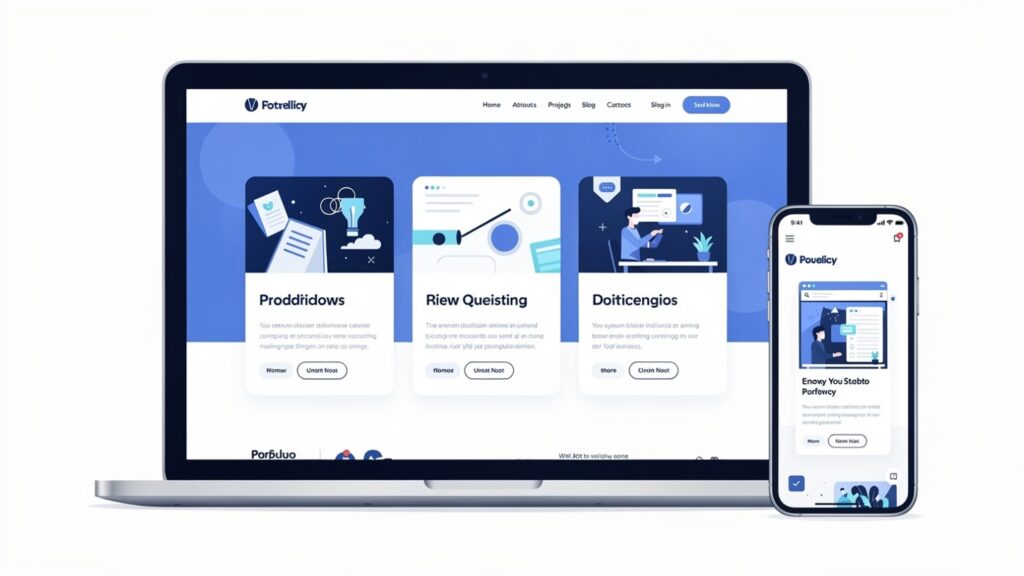
Step 3: Get Your First Client — The Right Way
This is where most guides send you straight to Upwork or Fiverr. And while those platforms have their place, they are not where most beginners should start — because on those platforms, you are competing against developers with hundreds of reviews, established profiles, and the ability to undercut your rates while still making a profit.
Your first clients should come from a different source entirely.
Your Real Network — Before Any Platform
Before you send a single proposal on any freelancing platform, talk to every person you know. Not to pitch them — to ask a question: “Do you know any small business that needs a website or has a website that is not working well?”
You will be surprised. A friend’s uncle has a restaurant with a terrible website from 2014. A colleague’s wife runs a home-based business with no online presence. A neighbour’s brother just launched a service business and needs something built from scratch. These opportunities are everywhere in your existing network — and approaching them as someone known and trusted gives you an enormous advantage over a random profile on a platform.
Your first 1–3 clients will almost certainly come from this network. And the work you do for them — even if you charge very little or nothing for the first one — gives you something no platform profile can give you immediately: real testimonials, real case studies, and real relationships.
The First Project Strategy: Charge Very Little — But Get Everything Else
For your very first project, consider charging a below-market rate — or in some cases, offering it free in exchange for a detailed testimonial, permission to use the project in your portfolio, and a referral introduction to two other businesses they know.
This feels counterintuitive. It is actually the fastest path to paid work. Because after that first project — with a real testimonial, a real case study, and potentially two warm introductions — you have assets that no amount of time on a platform can replicate in the same timeframe.
The Data Pips Team’s core principle applies here directly: if you cannot grow a small amount of capital — or in this case, a small client base — a large one will not save you. Prove your capability at the smallest scale first. Build the evidence. Then scale with confidence.
When You Are Ready for Platforms
Once you have 2–3 portfolio projects, at least one real testimonial, and a clear niche defined — then platforms like Upwork and Fiverr become viable. Not before.
On Upwork: specialize your profile around one specific type of work. Not “web developer.” Something like “Webflow developer for service-based businesses” or “WordPress e-commerce developer for small retailers.” The more specific your profile headline, the more qualified your incoming leads — and the less competition you face for each proposal.
On Fiverr: build gigs around specific, defined deliverables. Not “I will build you a website.” Instead: “I will build a 5-page WordPress website for your restaurant with menu, booking form, and Google Maps integration — delivered in 7 days.” Specific deliverable, specific timeline, specific client type. This is what gets gigs clicked.
Cold Outreach: The Underrated Channel
Once you have your portfolio ready, consider direct outreach to small businesses in specific niches. Identify businesses in your target niche that have obviously outdated or non-functional websites. Contact them directly — via email or their contact form — with a short, specific message that identifies a real problem with their current site and offers a concrete solution.
Do not send generic messages. Reference their specific business, mention a specific issue you noticed on their site, and offer a specific fix. Even a 2–3% response rate on this kind of outreach can generate real leads faster than months of platform grinding.
Real Pattern: How the First 3 Clients Actually Happen
Consider a beginner who spends 3 months learning WordPress development. Instead of immediately going to Upwork, they tell everyone in their network what they are doing. A family friend who runs a small catering business mentions she has been meaning to get a website for two years but never got around to it.
The developer offers to build it for a very small fee in exchange for a testimonial and portfolio permission. They deliver a clean, mobile-responsive 5-page WordPress site in 3 weeks. The client is thrilled. She tells two other business owners she knows. One becomes a paying client at full rate. The other refers a third.
Within 5 months of finishing their first project, this developer has 3 clients, 3 portfolio pieces, 3 testimonials, and a referral network beginning to form — all without a single Upwork proposal.
Lesson: The platform is not the only path. Your network, used correctly, is faster and warmer than any algorithm-driven marketplace — especially in the first 6 months.
Step 4: Price Your Work Without Underselling Yourself
Pricing is where most beginner freelancers make a mistake in one of two directions: they either price too low (hoping volume will compensate) or they price based on what they want to earn rather than what the market can bear at their current level.
Here is a practical pricing framework for beginner to intermediate web developers:
| Project Type | Beginner Range | Intermediate Range |
|---|---|---|
| Basic 5-page WordPress site | $200 – $500 | $500 – $1,200 |
| WordPress e-commerce (WooCommerce) | $500 – $1,000 | $1,000 – $3,000 |
| Webflow site (5–10 pages) | $400 – $800 | $800 – $2,500 |
| React frontend app | $800 – $2,000 | $2,000 – $6,000+ |
| Website maintenance retainer (monthly) | $50 – $150/month | $150 – $400/month |
| Hourly rate (general) | $15 – $35/hr | $35 – $80/hr |
Important pricing rules:
- Never price based on what you need. Price based on what the work is worth to the client.
- Always quote project rates, not hourly rates, for fixed-scope work. Hourly rates penalize you for getting faster as you improve.
- Add a 20–30% buffer to your time estimate before quoting. Beginner projects always take longer than planned.
- Never discount your rate to win a client who questions your price. If they cannot afford your rate, they are not your client. Raise your value instead of lowering your rate.
The fastest way to increase your rates is not more time in the market — it is a clearer specialization and better portfolio case studies. A developer who can show “I built this e-commerce site and the client’s online sales increased by X%” commands rates that a developer who “built a website” cannot. Outcomes beat outputs every time.
Step 5: Work for Someone First — Then Freelance
This is advice that almost no freelancing guide gives — and it is one of the most valuable things a new web developer can do before going fully independent.
Spending 1–2 years working inside a digital agency, a web development studio, or even a company with an in-house web team compresses your learning timeline dramatically. In an agency environment, you see real client projects, real scope creep, real revision cycles, real deadlines, and real client communication — all in a context where someone more experienced is guiding the process. What would take you 4–5 years of solo freelancing to learn through trial and error, you can learn in 6–12 months inside a functioning operation.
You also build a network of colleagues, ex-colleagues, and client contacts who will become your earliest freelance referral sources when you do go independent. The Data Pips Team has observed this pattern consistently: the freelancers who build sustainable income fastest are not the ones who went straight from learning to freelancing — they are the ones who had even one or two years of real working experience first.
If a full-time agency job is not available in your area, look for part-time contract work, internships, or junior positions — even remote ones. The goal is real exposure to real projects under real constraints. Anything that gives you that exposure is more valuable than another month of tutorial-watching.
For a broader look at how to build multiple income streams while you are still employed, read our guide on how to build multiple income streams without quitting your job — the principles apply directly to transitioning from employment to freelancing.
Step 6: Build Systems That Make You Scalable
Most freelancers stay stuck at a ceiling not because they lack skills or clients — but because they have no systems. Every project starts from scratch. Every proposal is written from scratch. Every client communication is reactive. Every invoice is manually tracked. The result is a business that is entirely dependent on the freelancer’s direct time — with no leverage and no ability to grow.
From your very first client, build these systems:
A Client Onboarding Template
A simple document — or even a Google Form — that collects everything you need from a client before you start: website goals, target audience, brand colors, fonts, existing assets, login credentials needed, timeline expectations, and revision policy. This one document eliminates 80% of the back-and-forth that wastes time at the start of every project.
A Proposal Template
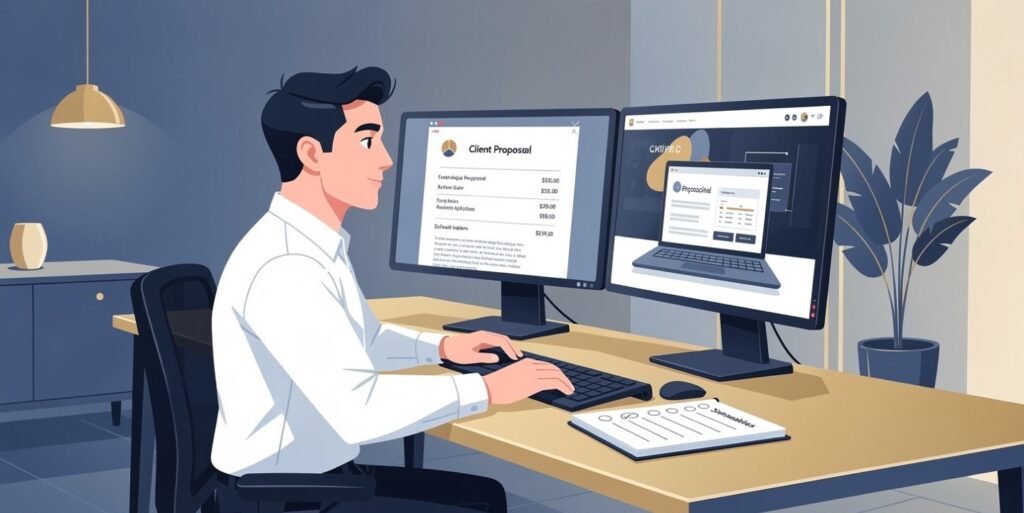
A reusable proposal structure that covers: the client’s problem as you understand it, your proposed solution, timeline, deliverables, price, revision policy, and payment terms. Customize 20% for each client. Keep 80% the same. This reduces proposal time from hours to minutes.
A Contract — Always
Never start work without a signed contract. Even a simple one-page contract that specifies deliverables, timeline, payment schedule, revision rounds, and what happens if the client disappears mid-project. Clients who refuse to sign contracts are clients who will cause you problems later. The contract is not about distrust — it is about clarity. Both parties knowing exactly what was agreed protects both of you.
A Payment Schedule
Always collect a deposit before starting. For projects under $500, 50% upfront is standard. For larger projects, 30–50% upfront, 50–70% on delivery. Never deliver the final files or transfer the site to the client’s hosting until the final payment is received. This protects you from the most common freelancer nightmare — a completed project and an unresponsive client.
A Maintenance Offer for Every Client
After every project delivery, offer a monthly maintenance package. Site updates, plugin updates (for WordPress), security monitoring, small content changes. Even at $75–$150 per month per client, three maintenance clients add $225–$450 in recurring monthly income that requires minimal time. This is the beginning of passive income for a developer — and it is the most overlooked opportunity in freelance web development.
For a deeper look at how to build recurring income streams as a freelancer, our guide on passive income assets and monthly cash flow covers the exact principles behind building income that does not require constant active selling.
What Nobody Tells You About Freelancing as a Web Developer
1. Your Biggest Competition Is Not Other Developers — It Is Client Inertia
Most small businesses that need a website do not end up getting one — not because they could not find a developer, but because the process felt too complicated and they kept putting it off. Your job as a freelancer is not just to be a better developer than your competition. It is to make the process so simple and low-friction for the client that they actually follow through. Make it easy. Make it clear. Make them feel safe. That is what converts more than technical skill.
2. Slow Months Are a System Failure, Not Bad Luck
Every freelancer experiences slow months. But a slow month in January is almost always caused by something you did — or did not do — in October. Freelancing income has a lag. The business development you do today produces clients 6–8 weeks from now. Most beginners stop marketing when they are busy with a project, then wonder why they have no work when the project ends. Marketing is not something you do when you have no clients. It is something you do every single week, regardless of how busy you are.
3. Clients Do Not Buy Code — They Buy Confidence
When a small business owner hires a freelance web developer, they are not evaluating your technical ability — they cannot. They do not know enough to judge your code. What they are evaluating is whether they trust you to handle their project professionally, communicate clearly, deliver on time, and not disappear. Confidence, communication, and professionalism matter more than technical excellence in the client acquisition stage. Technical excellence is what keeps clients coming back and referring others.
4. The $500 Client and the $5,000 Client Require the Same Amount of Sales Effort
This is one of the most important realizations in freelancing — and it takes most people too long to get there. The effort required to find, pitch, close, and manage a $500 project is almost identical to a $5,000 project. Which means if you are taking $500 projects out of fear, you are spending the same energy for one-tenth the return. Raise your prices. Specialize deeper. Produce stronger case studies. Target larger clients. The effort ceiling does not change much — but the income ceiling rises dramatically.
5. AI Is Not Your Enemy — It Is Your Upgrade
The rise of AI coding tools — GitHub Copilot, Claude, ChatGPT — makes many beginner developers anxious about the future of the profession. The correct response is the opposite of anxiety. AI makes a skilled developer dramatically more productive. What used to take 2 hours takes 30 minutes. What used to require Googling for an hour is now resolved in seconds. The developer who learns to use AI tools as a force multiplier will outproduce — and out-earn — the developer who refuses to adapt. The developers being replaced by AI are the ones whose entire value was writing boilerplate code. The ones who understand client problems, architect solutions, and communicate clearly — they are not going anywhere.
— Data Pips Team
Learning Resources: Where to Actually Build the Skill
There is no shortage of web development learning resources. The problem is not access — it is direction. Here is what actually works, by path:
For HTML, CSS, and JavaScript Fundamentals
MDN Web Docs — free, comprehensive, written by the people who build the web. This is the reference every professional developer uses. Start here before any paid course.
For WordPress Development
WordPress.org’s own documentation combined with free YouTube tutorials from established channels covers 90% of what you need. Focus on building real projects — not watching tutorials. The ratio should be 20% watching, 80% building.
For React and JavaScript
The official React documentation (react.dev) is exceptionally well written. JavaScript.info is one of the best free JavaScript resources available. For paid options, courses on platforms like Udemy (look for courses with 50,000+ students and recent updates) provide structured learning paths.
For Webflow
Webflow University — Webflow’s own free learning platform — is genuinely excellent. Combined with the Webflow community forum, it provides everything you need to go from zero to client-ready in Webflow.
The rule: Pick one learning resource per skill. Follow it completely. Then build. Do not learn-hop. Jumping from course to course without building is the most common reason people spend 12 months “learning” web development without ever producing a project they are proud to show.
For broader perspective on how skill compounds into financial freedom over time, our guide on compounding skill into a wealth-building system is worth reading alongside this one.
The Freelance Web Developer’s First 12 Months: A Realistic Timeline
| Month | Focus | Expected Milestone |
|---|---|---|
| 1–2 | Core skill fundamentals | Complete foundational learning path |
| 3–4 | Portfolio building | 3 portfolio projects live |
| 5 | First client outreach | First client conversation |
| 6 | First project delivery | First testimonial + case study |
| 7–8 | Platform presence + referrals | 2–3 paid clients |
| 9–10 | Rate increase + niche clarity | Consistent monthly income starting |
| 11–12 | Systems + maintenance retainers | Repeatable income model established |
Quick Action Steps
Start Here — This Week
- Choose your path — today. WordPress, Webflow, React, or full-stack. One only. Write it down. Commit to it for a minimum of 6 months before reconsidering.
- Set a learning schedule and protect it. Minimum 1 hour daily, 5 days per week. Learning in bursts and then stopping for weeks is the number one reason beginners stay beginners. Consistency beats intensity.
- Start building your first portfolio project by week 3. Do not wait until you feel “ready.” Build something imperfect now. Improve it later. A finished project that is 70% good teaches you more than a planned project that is 100% perfect in your head.
- Tell 10 people in your network what you are building. Not a pitch — just a conversation. “I am learning web development and looking for my first small project to build real experience.” You will be surprised what comes back.
- Get your portfolio live before month 4. Even if it only has 2 projects. A live URL is worth more than a local file on your computer. Show it to real humans and listen to their feedback.
- Sign up for one platform only after your portfolio is ready. Upwork or Fiverr — pick one to start. Build the profile completely before sending a single proposal. An incomplete profile is worse than no profile.
- Create a simple contract before your first paid project. Free contract templates for freelance developers are widely available online. Use one. Modify it. Have it ready before you need it — not after.
Frequently Asked Questions
Most beginners who follow a structured learning path and actively pursue clients can land their first paid project within 4–6 months of starting from zero. However, building a consistent, reliable monthly income typically takes 9–18 months. The timeline compresses significantly for those who niche down early, build strong portfolio case studies, and actively pursue clients through their personal network instead of waiting for platform leads to arrive.
No. Most freelance clients do not ask about your educational background. What they evaluate is your portfolio, your communication, and your ability to understand and solve their problem. Many of the most successful freelance web developers are self-taught. What matters is demonstrable skill — can you build what the client needs, deliver it on time, and communicate professionally throughout? A degree does not answer those questions. Your portfolio and your track record do.
For complete beginners, your personal network and direct outreach will outperform any platform in the first 3–6 months. Once you have at least one testimonial and 2–3 portfolio projects, Upwork is generally better than Fiverr for web development because projects tend to be larger and longer-term. Fiverr works best for clearly defined, packaged deliverables at fixed prices. Start with one platform only, build a complete and specialized profile, and focus on quality proposals rather than volume.
For your very first project, prioritize getting the testimonial and portfolio piece over maximizing income — charge a below-market rate or even complete it free in exchange for a detailed testimonial and referral introduction. Once you have that first case study, charge based on the value of the work to the client, not based on your hourly time. A basic 5-page WordPress site for a small business is typically worth $300–$600 at the beginner level, rising to $800–$1,500 as your portfolio and reputation develop.
For the fastest path to paid work, WordPress wins — the market is larger, the learning curve is shorter, and small business clients are actively looking for WordPress developers at every price point. For higher long-term earning potential, React and full-stack development lead to larger contracts and more technical work. If your goal is income in the next 6 months, start with WordPress or Webflow. If you are playing a 2–3 year game and want to build toward enterprise-level contracts, invest in React and full-stack skills from the beginning.
Yes — and this is actually the recommended approach. Starting your freelance business while still employed eliminates the financial pressure that causes most new freelancers to take bad clients, undercharge, or make desperate decisions. Use your employment income to cover your living expenses while you build your portfolio, land your first clients, and grow your freelance income. When your freelance income consistently matches or exceeds your employment income for 3–4 consecutive months, that is when the transition to full-time freelancing makes sense. Not before.
AI is replacing specific tasks within web development — not web developers. It is replacing repetitive boilerplate coding, basic debugging, and template generation. What it cannot replace is client communication, problem diagnosis, creative problem-solving, project management, and the judgment required to translate a client’s business need into a technical solution. Developers who learn to use AI tools as productivity multipliers will produce better work faster and command higher rates than developers who compete with AI on repetitive tasks. Adapt to it early — it is a career advantage, not a threat.
Conclusion: The Developer Who Executes Wins Over the Developer Who Learns Forever
There is a version of you that spends the next two years learning — consuming courses, watching tutorials, keeping up with every new framework, every new tool, every new trend — and never building a real client relationship.
And there is a version of you that spends the next two years building — imperfect projects, uncomfortable client conversations, a few mistakes, a few lessons, a growing portfolio, a growing rate, and a growing income.
The second version wins. Every time.
Web development is one of the most accessible high-income skills available in the world today. The tools have never been more powerful, the learning resources have never been more available, and the demand from small and medium businesses for web development services has never been higher. The opportunity is real. What stands between you and that opportunity is not more learning — it is execution.
Pick your path. Build the portfolio. Talk to real humans about real projects. Charge what the work is worth. Build the systems that make you scalable. Come back better on every project.
The freelance web development career you are imagining is available to you. But it is not waiting for you to feel ready. It is waiting for you to start.
If you want to understand how other freelancing paths compare to web development, our guides on starting freelance content writing with no experience and how to become a freelance video editor in 2026 give you the full picture of where web development sits in the broader freelancing landscape.