Key Takeaways
- Training a foundation model is a multi-stage journey, not a single event — it moves from gathering data, to pre-training, to refinement, to evaluation.
- The first and most underrated stage is data — collecting and cleaning an enormous amount of high-quality information, which shapes everything that follows.
- Pre-training is the heavy phase: the model learns broad patterns from massive data, requiring huge computing power and time.
- After pre-training, the model is refined through fine-tuning and human feedback to make it helpful, safe, and aligned with how people want it to behave.
- The whole process is enormously expensive and complex, which is why only well-resourced organizations build foundation models from scratch.
A finished foundation model can feel like it appeared out of nowhere — one day a powerful new AI exists, ready to answer questions and write essays. But behind that finished model lies a long, demanding, multi-stage journey that takes enormous data, computing power, time, and human effort. Understanding that journey reveals what these models actually are, why they behave the way they do, and why so few organizations can build them.
This is not a vague overview. The Data Pips Team is going to walk you through the actual stages of building a foundation model, in order, from the very first step of gathering data to the final step of evaluating the finished model. You will see what happens at each stage, why it matters, and how each stage shapes the AI you eventually interact with. Plain language, no technical background assumed.
By the end, you will understand the full pipeline that turns raw data into a working foundation model — and you will see why these models are among the most resource-intensive things humans build. Let us walk through it, stage by stage.
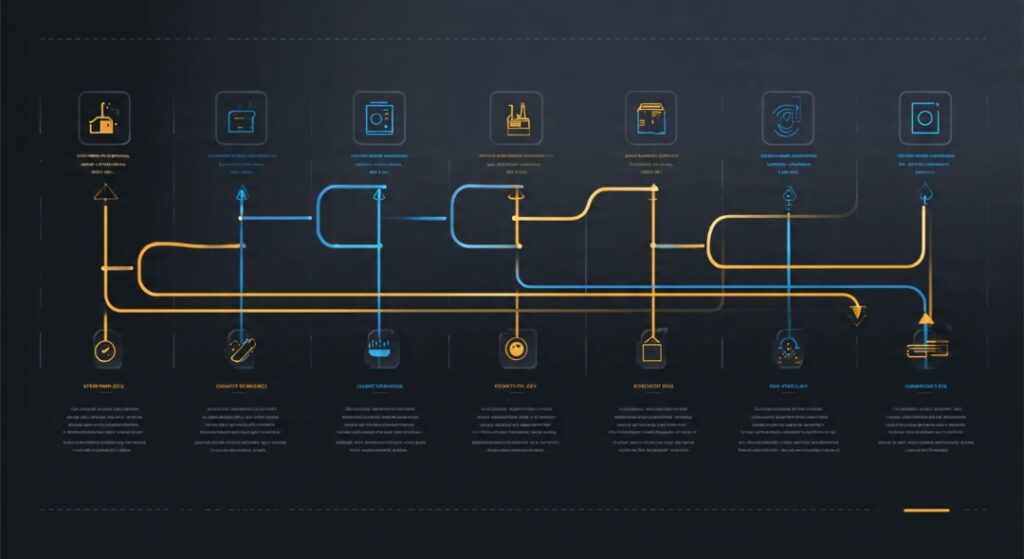
Before We Start: What Training Actually Means Here
Quickly, so we are on the same page. “Training” a foundation model means teaching it by feeding it enormous amounts of data and letting it adjust itself, over and over, until it becomes capable. If you want the underlying mechanics of how an AI learns through repeated guess-and-adjust cycles, our guide on how AI learns through training covers that core loop in depth. This article zooms out from that loop to show the full journey around it — the whole assembly line that produces a foundation model.
Think of it like building a car. The engine’s combustion cycle is one thing (that is the core learning loop), but building the actual car involves sourcing materials, assembly, tuning, testing, and quality control. We are walking through that whole assembly line now, for foundation models. Let us begin at the very first stage.
Stage 1: Gathering the Data (The Most Underrated Step)
Everything begins with data, and this stage matters far more than most people realize. A foundation model learns entirely from the data it is trained on, so the quality, quantity, and variety of that data shapes everything the model will eventually become.
In this stage, builders gather an enormous amount of data appropriate to the model’s purpose. For a language foundation model, this means vast quantities of text — a huge portion of publicly available writing, books, articles, and more. For an image foundation model, it means massive collections of images. The scale is almost incomprehensible: far more information than any human could read or view in many lifetimes.
But raw quantity is not enough. The data also has to be cleaned and prepared, which is a massive, often-underestimated effort. Raw data is messy — full of duplicates, errors, irrelevant junk, and problematic content. Builders must filter, clean, and organize it, because feeding the model bad data produces a bad model. The principle is iron-clad: garbage in, garbage out. A foundation model cannot become better than the data it learned from, which is exactly why this stage is so crucial despite being the least glamorous.
The composition of the data also determines the model’s strengths, weaknesses, and biases. If the data is heavily weighted toward certain topics or viewpoints, the model will reflect that. If important areas are missing, the model will be weak there. This is why careful, thoughtful data curation is one of the most important parts of the entire process — and why the people who build foundation models invest so heavily in getting the data right before any actual “learning” begins.
— Data Pips Team
Stage 2: Pre-Training (The Heavy Lifting)
Now comes the stage most people think of as “training the AI” — and it is the most resource-intensive part of the entire journey. This is called pre-training, and it is where the model develops its broad, general capabilities.
During pre-training, the prepared data is fed to the model, and the model works through it using the core learning loop: it makes predictions, checks how wrong they were against the actual data, and adjusts its internal settings slightly to do better. For a language model, this often takes the form of predicting the next word in countless passages of text. Repeated across an almost unimaginable number of examples, the model gradually tunes its billions of internal settings until it becomes an extraordinary pattern-recognizer.
The remarkable thing about pre-training is what the model learns as a side effect. By getting good at its prediction task across massive data, it absorbs grammar, facts, reasoning patterns, writing styles, and an enormous amount of general knowledge — none of it explicitly taught, all of it learned implicitly from the patterns in the data. This is how a foundation model develops the broad capabilities that let it later be adapted to so many different tasks. Our guide on what an LLM is explores this fascinating emergence of capability in more depth.
This stage is staggeringly expensive. Pre-training a large foundation model requires enormous computing power — vast numbers of specialized processors running for extended periods, consuming significant energy and costing large sums of money. This is precisely why building foundation models from scratch is limited to well-resourced organizations: the pre-training stage alone demands resources beyond what most can muster. After pre-training, you have what is sometimes called a “base model” — powerful at predicting and pattern-matching, but not yet the polished, helpful assistant you actually interact with. That refinement comes next.

Stage 3: Fine-Tuning and Refinement
After pre-training, the base model is powerful but raw. It can predict and generate, but it does not yet reliably behave like a helpful, well-mannered assistant. The next stage refines it into something genuinely useful.
The first part of refinement often involves fine-tuning the model on more focused, higher-quality data to shape its behavior. For example, it might be trained on examples of well-structured, helpful responses to instructions, teaching it to actually follow instructions and respond in useful ways rather than just continuing text. This builds on the broad capabilities from pre-training, sharpening them toward being a helpful assistant. The same fine-tuning concept is also used later to specialize models for particular tasks — our guide on fine-tuning vs RAG explores that application.
This stage transforms the model’s usability dramatically. A base model fresh out of pre-training might respond to a question by rambling or continuing the text in unhelpful ways. After fine-tuning on examples of good responses, it learns to actually answer the question clearly and helpfully. The raw capability was built in pre-training; fine-tuning channels that capability into useful behavior.
Fine-tuning is far less resource-intensive than pre-training, because it builds on the already-trained base rather than starting from scratch. It uses smaller, more carefully chosen data focused on shaping behavior rather than building broad knowledge. This is the stage where the model starts to feel like the assistant you recognize, but there is still one more crucial refinement to make it safe and aligned with human preferences.
Stage 4: Alignment (Teaching It to Behave)
A capable, instruction-following model still needs to be made safe, helpful, and aligned with what people actually want. This stage is called alignment, and it is essential for turning a powerful model into a responsible one.
A common approach involves human feedback. People review the model’s responses and rate them — indicating which responses are more helpful, more accurate, safer, or better in various ways. The model is then adjusted to produce more of the responses people preferred and fewer of the ones they did not. Essentially, human judgment guides the model toward better behavior, refining not just what it knows but how it responds.
This alignment stage is what shapes a model’s “personality” and values — making it more helpful, more honest, more harmless. It teaches the model to decline harmful requests, to avoid certain problematic outputs, to be more truthful, and to respond in ways people find genuinely useful. Without this stage, even a highly capable model could be unhelpful, unsafe, or behave in undesirable ways. Alignment is what makes a foundation model not just powerful, but responsibly usable.
It is worth noting that alignment is an ongoing area of intense effort and research, because making AI reliably helpful and safe is genuinely difficult. The model’s behavior is shaped by the feedback it receives, so this stage requires careful human judgment about what good behavior actually looks like. The quality of alignment significantly affects how trustworthy and useful the final model is.
Following One Capability Through the Whole Journey
To see how the stages work together, let us follow a single capability — the ability to helpfully answer a question — through the entire process.
Data stage: The model’s training data includes vast amounts of text containing questions and answers, explanations, and discussions. The raw material for answering questions is gathered and cleaned.
Pre-training: By learning to predict text across all that data, the model absorbs how questions relate to answers, how explanations are structured, and an enormous amount of factual knowledge. It develops the raw capability to produce relevant text, but does not yet reliably “answer” in a helpful way — it might just continue the text.
Fine-tuning: Trained on examples of good question-answering, the model learns to actually respond to a question with a direct, helpful answer rather than rambling. The capability is now channeled into useful behavior.
Alignment: Through human feedback, the model learns to make its answers more accurate, clearer, safer, and more genuinely helpful — and to handle questions it should not answer appropriately.
Result: The finished model can take your question and give a helpful, well-structured, reasonably safe answer. That single capability was built progressively across all four stages, each one adding something essential.
The point: No single stage produces the finished capability. It emerges from the whole journey — data provides the raw material, pre-training builds raw capability, fine-tuning channels it, and alignment refines it into responsible, helpful behavior.
Stage 5: Evaluation and Testing
Before a foundation model is released or deployed, it must be thoroughly evaluated. This stage checks whether the model actually works well, where its weaknesses are, and whether it behaves safely.
Builders test the model against a wide range of tasks and challenges to measure its capabilities — how well it answers questions, reasons, handles different topics, and performs on various benchmarks. Importantly, this testing uses data the model has not seen before, to check whether it genuinely learned general capabilities rather than just memorizing its training data. Using separate test data is a fundamental principle, because a model that only memorized would fail on new examples.
Evaluation also probes for problems: Does the model produce harmful content? Does it reflect concerning biases? Does it make things up (hallucinate) excessively? Where does it fail? These weaknesses must be identified, because no model is perfect, and understanding its limitations is essential for using it responsibly. The evaluation stage is where builders develop a clear, honest picture of what the model can and cannot do.
Often, evaluation reveals issues that send builders back to earlier stages — more fine-tuning, more alignment work, sometimes adjustments to data. Building a foundation model is rarely a clean straight line; it involves cycles of training, evaluating, and refining. Only when the model meets the necessary standards for capability and safety is it considered ready. And even after release, models are often monitored and updated, because real-world use reveals things no internal testing fully captures.
Why the Whole Process Is So Demanding
Stepping back, you can now see why building a foundation model is one of the most demanding undertakings in technology. Let us name the reasons clearly, because they explain a lot about the AI world.
It requires enormous data. Gathering and cleaning the massive, high-quality datasets needed is a huge effort in itself, demanding significant resources and expertise.
It requires staggering computing power. The pre-training stage especially needs vast computational resources — specialized hardware running for extended periods, at enormous expense and energy cost. This is often the single biggest barrier.
It requires deep expertise. Every stage, from data curation to alignment, requires specialized knowledge and skilled people. Building a good foundation model is not just about resources but about expertise applied carefully at each stage.
It requires significant time. The full journey, from data gathering through evaluation and refinement, takes considerable time, often involving multiple cycles of improvement.
Add these together, and the cost of building a capable foundation model from scratch is immense — which is exactly why only well-resourced organizations do it, and why most companies and developers build applications on top of existing foundation models rather than creating their own. Understanding this process explains the structure of the entire AI industry: a small number of organizations capable of this demanding journey build the foundations, and a vast ecosystem builds on top of them. It also connects to the broader reality that foundation models are built using machine learning at the largest scales humans currently achieve.
— Data Pips Team
What This Process Reveals About AI Behavior
Why models reflect their training data
Since everything starts with data and the model learns its patterns, the model inevitably reflects what was in that data — including its strengths, gaps, and biases. When you notice a model is great at common topics but weak on obscure ones, that traces directly back to what was and was not in the training data. The data stage shapes the finished behavior more than almost anything.
Why models have a knowledge cutoff
Because the model’s knowledge is built during pre-training on data gathered up to a certain point, its knowledge is essentially frozen at that point. It does not automatically know about events after its training data was collected. This is a direct consequence of how the process works — the model learns during training, and that learning has an end date.
Why a model’s “personality” exists
The helpful, polite, careful behavior you experience from a well-built AI assistant is not accidental — it was deliberately shaped during the fine-tuning and alignment stages through human feedback. The model’s tendencies to be helpful, decline harmful requests, and respond in useful ways were trained into it. Understanding this explains why different models can feel different in personality: they were aligned differently.
Why no model is perfect
The evaluation stage exists precisely because every model has weaknesses, biases, and failure modes. Building a foundation model involves managing imperfections, not eliminating them. This is why even the best models make mistakes and require careful, critical use. The process is sophisticated, but it does not produce flawless results, which is important to remember whenever you rely on AI output.
Why a few organizations dominate
The sheer resources required — data, computing power, expertise, time — mean only well-funded organizations can complete this journey from scratch. This explains the concentration in AI: a handful of foundation-builders at the base, with everyone else building on top. The demanding nature of the training process is the direct cause of this industry structure.
Quick Recap: The Journey in Order
The Foundation Model Training Pipeline
- Gather and clean the data. Collect enormous amounts of high-quality data and prepare it carefully. This underrated stage shapes everything that follows — garbage in, garbage out.
- Pre-training. Feed the data to the model so it learns broad patterns and general capabilities through the core guess-check-adjust loop. The most resource-intensive stage, requiring massive computing power.
- Fine-tuning. Refine the base model on focused, high-quality data to channel its raw capability into helpful, instruction-following behavior.
- Alignment. Use human feedback to make the model helpful, honest, and safe — shaping its behavior and values toward what people actually want.
- Evaluation and testing. Thoroughly test the model on unseen data to measure capabilities, find weaknesses, and check safety before release, often cycling back to earlier stages.
- Ongoing monitoring. Even after release, models are watched and updated, because real-world use reveals things internal testing misses.
Frequently Asked Questions
Foundation models are trained through a multi-stage journey. First, builders gather and clean an enormous amount of high-quality data. Second, pre-training feeds that data to the model so it learns broad patterns and general capabilities — the most resource-intensive stage. Third, fine-tuning refines the base model on focused data to channel its capability into helpful, instruction-following behavior. Fourth, alignment uses human feedback to make the model helpful, honest, and safe. Fifth, evaluation thoroughly tests the model on unseen data to measure capabilities and find weaknesses before release. The process often cycles back through earlier stages for refinement, and models are typically monitored and updated even after release.
Pre-training is the stage where a foundation model develops its broad, general capabilities, and it is the most resource-intensive part of the process. During pre-training, prepared data is fed to the model, which works through it using the core learning loop — making predictions, checking how wrong they were, and adjusting its internal settings slightly, repeated across an enormous number of examples. For a language model, this often means predicting the next word in countless passages. As a side effect of getting good at this prediction task, the model absorbs grammar, facts, reasoning patterns, and broad knowledge. After pre-training, you have a powerful “base model” that still needs further refinement to become a helpful assistant.
Data is critically important because a foundation model learns entirely from the data it is trained on, so the quality, quantity, and variety of that data shapes everything the model becomes. The principle is iron-clad: garbage in, garbage out — a model cannot become better than the data it learned from. The data must be not just gathered in enormous quantities but also carefully cleaned and prepared, removing duplicates, errors, and problematic content. The composition of the data also determines the model’s strengths, weaknesses, and biases. This is why data curation is one of the most important parts of the entire process, even though it is the least glamorous stage.
Alignment is the stage that makes a capable model safe, helpful, and aligned with what people actually want. A common approach uses human feedback: people review the model’s responses and rate them — indicating which are more helpful, accurate, or safer — and the model is then adjusted to produce more of the preferred responses. This shapes the model’s behavior and “personality,” teaching it to decline harmful requests, avoid problematic outputs, be more truthful, and respond usefully. Without alignment, even a highly capable model could be unhelpful or unsafe. Alignment is what turns a powerful model into a responsibly usable one, and it remains an area of intense ongoing research because making AI reliably safe and helpful is genuinely difficult.
Training a foundation model is expensive because of the combined demands of the whole process. It requires enormous, high-quality data that takes significant effort to gather and clean. It requires staggering computing power, especially during pre-training, where vast numbers of specialized processors run for extended periods at enormous cost and energy use — often the single biggest barrier. It requires deep expertise at every stage, from data curation to alignment. And it requires considerable time, often with multiple cycles of refinement. Together, these make building a capable foundation model from scratch immensely costly, which is exactly why only well-resourced organizations do it, while most companies build applications on top of existing foundation models instead.
A foundation model has a knowledge cutoff because its knowledge is built during pre-training on data that was gathered up to a certain point in time. Once that training is complete, the model’s knowledge is essentially frozen at that point — it does not automatically know about events that happened after its training data was collected. This is a direct consequence of how the training process works: the model learns during the training stages, and that learning has an end date determined by when the data was gathered. To give a model access to newer information, developers must either retrain it on updated data or connect it to external, current information sources through additional techniques.
Training a foundation model from scratch is realistically out of reach for individuals and most companies, because it requires enormous data, staggering computing power, deep expertise, and considerable time — resources that only well-funded organizations possess. However, you do not need to build one from scratch to work with foundation models. Most developers and businesses build applications on top of existing foundation models by adapting them — through prompting, fine-tuning on smaller task-specific data, or connecting them to external information. These adaptation methods are far more accessible and are how the vast majority of AI applications are actually built. So while building a foundation model is reserved for a few organizations, building useful things on top of one is widely achievable.

The Bottom Line
A foundation model never simply “appears.” Behind every capable AI lies a long, demanding pipeline that we have now walked through end to end: gathering and cleaning enormous data, pre-training to build broad capability, fine-tuning to channel that capability into useful behavior, aligning it through human feedback to make it safe and helpful, and rigorously evaluating it before release. Each stage adds something essential, and the finished model is the product of the entire journey, not any single step.
Understanding this process does more than satisfy curiosity — it explains the AI you use every day. It is why models reflect their training data, why they have a knowledge cutoff, why they have the personalities they do, why no model is perfect, and why only a few organizations build foundations while everyone else builds on top of them. The behavior of every AI tool traces back to how its underlying foundation model was trained.
Perhaps the biggest takeaway is appreciation for both the power and the cost of these systems. Foundation models are among the most resource-intensive things humans build, demanding massive data, staggering computing power, deep expertise, and significant time. That demanding nature shapes the entire structure of the AI industry, and it is the reason the foundation-model approach — build once, adapt many times — became so dominant. Building the foundation is hard; building on it is accessible to many.
You now understand how foundation models are actually made — the full journey from raw data to a finished, working AI. That understanding lets you see the real machinery behind the AI revolution, rather than treating these models as magic that simply appeared.
For your next steps, revisit the core learning mechanics in our guide on how AI learns through training, understand what the finished product is in what a foundation model is, and see the most famous type in foundation models vs LLMs.