Key Takeaways
- Waiting for “one more confirmation” is not caution — it is fear wearing a professional mask.
- The strongest market moves rarely offer a clean re-test. If you wait for perfect, you wait forever.
- Freezing before a big move is a psychological problem, not a strategy problem — and it has a direct fix.
- Revenge trading after a missed move destroys more accounts than any bad setup ever will.
You saw it. The setup was clean. Your analysis was right. The market did exactly what you predicted — and you made zero pips from it.
You were watching the chart. You spotted the breakout. You identified the zone. Your setup was there. And then something happened — something invisible, something that had nothing to do with the market. Your finger hovered over the button. Your brain started asking questions. “What if it pulls back? What if this is a fake-out? Let me wait for one more candle.”
Then the candle closed. Then another. Then the market moved 800 pips without you.
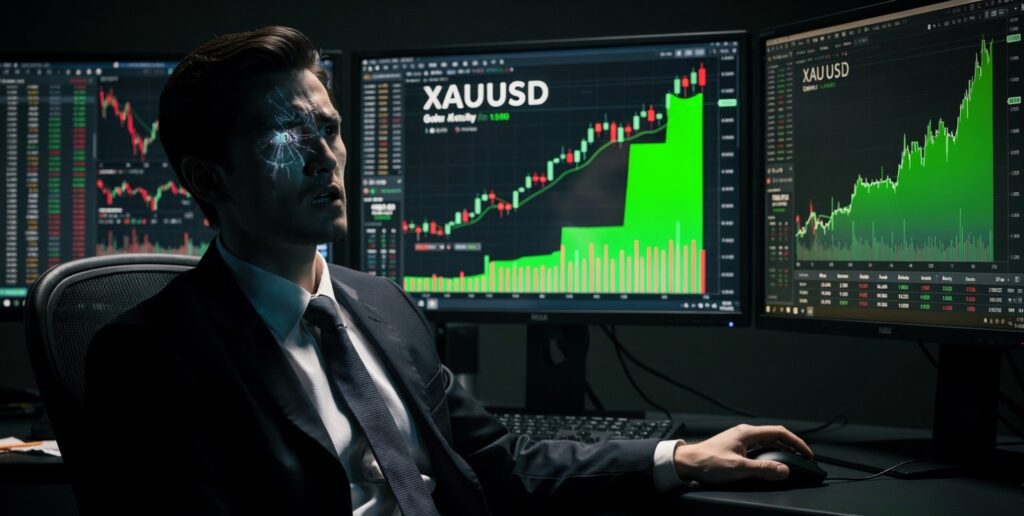
If you have ever said the words “I knew it would go there” — while your account sat empty — then this article is written specifically for you. Because the problem is not your strategy. The problem is not the market. The problem is the freeze that happens in the 3 seconds between seeing the setup and pressing the button.
This is one of the most damaging — and most ignored — patterns in trading psychology. Today, the Data Pips Team is breaking it down with zero sugarcoating.
The Silent Killer That Nobody Talks About
Most trading content focuses on what to do when you are in a trade — manage your stop loss, move to breakeven, take partial profits. Almost nobody talks about what happens before you enter. That 3-second moment of hesitation that turns a 600-pip winner into a missed trade.
The industry calls it analysis paralysis. Psychologists define it as decision-making breakdown under perceived threat. But for traders, it has a simpler name: the freeze.
And the freeze does not come from stupidity. It does not come from laziness. It comes from a brain that is doing exactly what it was designed to do — protect you from loss. The problem is, a brain designed to protect you from physical danger in the wild is terrible at making split-second financial decisions in a fast-moving market.
Understanding this is the first step to fixing it. Because you cannot fight something you do not understand. According to Psychology Today, fear-based decision avoidance activates the same neural pathways as physical danger response — your brain literally treats a potential losing trade the same way it treats a physical threat to your survival.
That is not a character flaw. That is biology. But biology can be managed — if you are disciplined enough to do the work.
Why the Freeze Happens: 4 Root Causes
1. The “One More Confirmation” Trap
This is the most common version of the freeze, and the most dangerous because it feels responsible. You have your setup. Price is at your zone. The structure looks perfect. But your brain says — wait, let me check the RSI. Let me wait for the EMA crossover. Let me see if the candle closes above this level first.
And by the time all your boxes are ticked, the move is already 40% done — and now it feels “too late” to enter.
Here is the truth most trading educators will not say directly: indicators are lagging tools. They confirm what already happened. They do not predict what will happen next. When you chain yourself to indicator confirmation, you are essentially waiting for the past to validate your future trade. That logic is broken.
Your analysis — your reading of structure, your identification of the zone, your understanding of context — that is the leading information. The indicator is trailing behind you, not guiding you. Stop letting a piece of code override your own read of the market.
This connects directly to a pattern the Data Pips Team has observed across years of trading: traders who rely heavily on indicator stacking almost never catch the high-momentum moves. They catch the slow, grinding, corrective moves — the ones with lower R:R and higher emotional strain. The big moves? Those go to traders who trust their read and pull the trigger on structure alone.
— Data Pips Team
2. The Myth of the Perfect Re-test
Every beginner is taught the same thing: wait for the breakout, then wait for the re-test, then enter. Clean. Safe. Textbook.
Here is the problem: the market does not read textbooks.
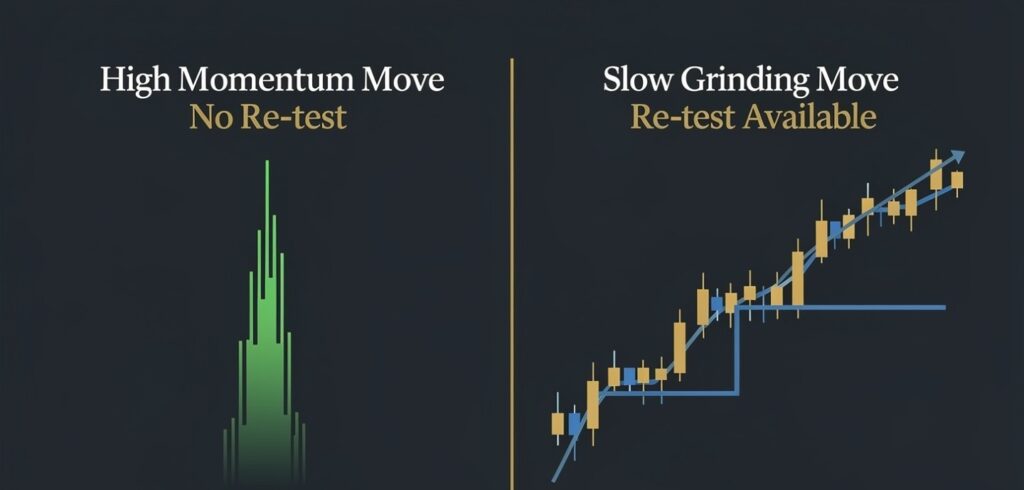
The strongest, most powerful moves — the ones that go 500, 800, 1,000 pips — almost never re-test cleanly. And the reason is structural, not random. When smart money — institutional players, algorithms, large liquidity providers — wants to move price, they need retail traders on the wrong side of the move to fuel it. If the market politely re-tests every breakout, retail traders get easy entries, and the move dies because there is no liquidity imbalance left to exploit.
The big moves are designed to leave people behind. That is not conspiracy — that is how liquidity works in any market. The pain of those left out is the fuel of the move. If you are always waiting at the re-test station, you will always be watching the train leave.
This does not mean you never wait for re-tests. On slower, grinding moves in lower momentum environments — yes, re-tests come. But when you see a high-momentum breakout with expanding volume, strong structure, and a clear catalyst? That train does not come back for you. You either board it, or you do not.
The ability to read the difference between a “re-test move” and a “no-look-back move” is one of the most valuable skills in trading. If you need to go deeper on this, our breakdown of why traders miss the big move waiting for confirmation covers the exact market structure signals to look for.
3. Position Size Fear
Sometimes the freeze has nothing to do with the setup and everything to do with how much you have at risk. If the thought of hitting your stop loss makes your stomach drop, your lot size is too big. Full stop.
This is something the Data Pips Team learned directly through years on the charts — particularly in Gold trading (XAUUSD), where volatility can be brutal. When your position size is calibrated correctly to your account, a stop loss is just a cost of doing business. When your position size is too large, a stop loss feels like a personal attack — and your brain will do everything in its power to avoid the trigger, including making you freeze before entry.
The fix is not mental strength. The fix is math. Risk only what you can lose without emotional reaction. If a 1% risk on your account makes you sweat, drop to 0.5%. Trade sizes that let you breathe — because a trader who can breathe can execute, and a trader who can execute compounds over time.
For a deeper look at how position sizing connects to psychological stability, read our guide on patience, risk management, and discipline in trading.
4. The Ghost of the Last Loss
The fourth root cause of the freeze is the most invisible one: your previous losses are sitting on your shoulder, whispering in your ear.
The last time you entered on a breakout, it was a fake-out. The last time you “trusted your analysis,” it went against you. And now, even though this setup is textbook, even though the conditions are completely different, your brain has catalogued that pain and is applying it as a filter over everything you see.
This is called loss aversion, and Investopedia describes it as one of the most powerful cognitive biases in financial decision-making — humans feel the pain of a loss approximately twice as intensely as the pleasure of an equivalent gain.
Which means every trader is psychologically wired to avoid loss more than they pursue gain — and the market exploits this every single day.
The only antidote is a journal. Write down every missed trade. Write down exactly what caused the freeze. Over time, you will see the pattern — and patterns that you can see, you can break.
The Cycle That Destroys Accounts
Here is what happens when a trader misses a big move — and this cycle is more predictable than any chart pattern:
Step 1: You identify a clean setup. You freeze. The market moves without you.
Step 2: You watch the move develop. Every pip it goes feels like a personal failure. The frustration builds.
Step 3: You tell yourself you will catch the next one. The next one comes. You freeze again — because now there is even more emotional pressure on this trade to “make up” for the last miss.
Step 4: After missing two or three in a row, the frustration reaches a breaking point. You start looking for trades — any trades — to “get in the game.” You enter setups that are not in your plan. You increase your lot size to recover the “missed profits” faster.
Step 5: You blow up. Not on a bad setup, but on emotional decisions made under frustration.
This is the cycle. And the entry point into this cycle — the thing that starts the whole chain — is the initial freeze. Revenge trading does not begin with revenge. It begins with a missed trade and an unchecked emotional response.
The Data Pips Team has seen traders with genuinely excellent strategies blow their accounts in this exact sequence. The strategy was never the problem. The execution — or lack of it — was everything.
The Experience That Changed Everything
One of the core lessons from years of trading Gold and Silver — instruments known for their sudden, violent moves — is this: the market does not owe you a comfortable entry.
There is a pattern the Data Pips Team observed repeatedly in XAUUSD trading: the cleanest technical setups, the ones with the most obvious structure, the zones that every trader can see on the chart — those are exactly the setups that either move before most people enter, or fake out long enough to shake the impatient out before moving.
The market is not random. The biggest moves tend to come when the maximum number of traders are on the sideline — either too scared to enter, or just stopped out from a fake move in the other direction. This is not conspiracy. This is how liquidity works. And once you understand it, you stop feeling victimized by missed moves and start reading them as information.
A missed move tells you: the market had conviction. There was real order flow behind that move. That is actually useful information for the next setup.
The traders who grow — the ones who compound — are the ones who extract a lesson from every missed trade instead of carrying emotional weight from it. If you want to understand how discipline compounds over time, our article on mechanical discipline — from gambler to professional trader is required reading.
Real Pattern: The Gold Breakout That Nobody Caught
Consider a scenario that plays out repeatedly in Gold markets: Price consolidates in a tight range for 6–8 hours during Asian session. Volume is low. Most traders are watching, waiting for a “confirmation.” Then the London session opens and price breaks the range with a single 80-pip candle. No re-test. No pullback. Just continuation.
Who got this trade? The traders with pre-planned entries — limit orders already set at the breakout level, or traders who executed on the breakout candle without waiting for close. Who missed it? Everyone waiting for “one more candle to close above the level.”
The trade was obvious in hindsight. It was available in real time. The only thing that separated the winners from the spectators was the willingness to act on a plan already made — not a new decision under pressure.
Lesson: Your best trading decisions are made when the market is closed. Set your levels, set your plan, and let the plan execute — not your emotions.
How to Fix the Freeze: A Practical System
Understanding the psychology is step one. But understanding without a system changes nothing. Here is what actually works:
Build Your Trade Plan Before the Market Opens
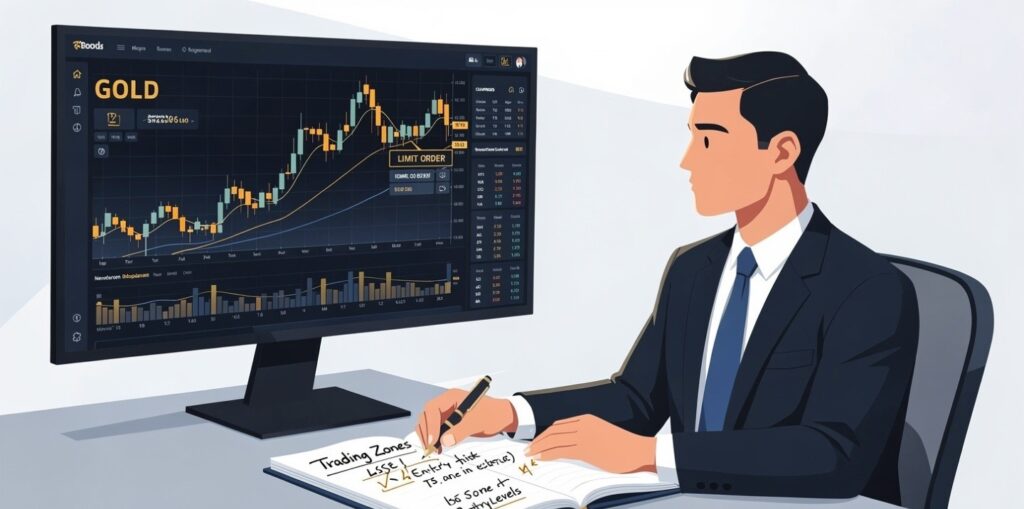
Every night or early morning — before the market session you trade — identify your key zones, your setups, and your exact entry triggers. Write them down. If price reaches Zone A with X condition, I enter. No thinking required in real time. The decision is already made.
This eliminates the freeze because there is no decision to make in the moment. You are simply executing a pre-made plan. Execution is mechanical. Decision-making is emotional. Remove the decision from the moment of execution, and you remove the freeze.
Use Limit Orders, Not Market Orders
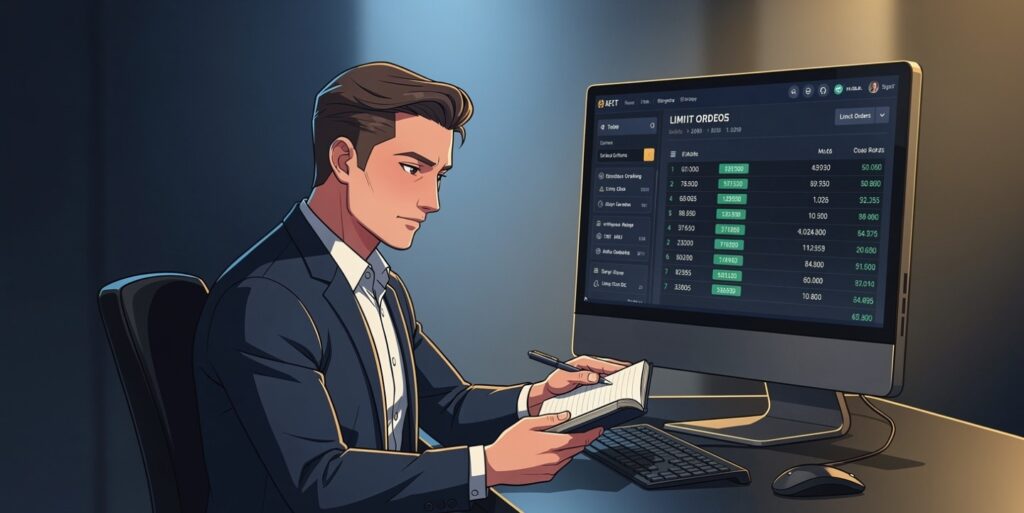
If your entry trigger is a specific level — a zone, a breakout point, a re-test area — place a limit order in advance. Let the market come to you. When price hits your level, the order executes whether your emotions cooperate or not.
This is how professionals trade. Not staring at charts, finger on the button, trying to time the exact moment. They do the analysis, set the levels, and let the system work. For an overview of how smart money actually approaches the market, our guide on why traders confuse being right with being profitable is essential.
Size Down Until Execution Feels Mechanical
If you are currently unable to execute without emotional hesitation, you are trading too large. Drop your position size by 50%. Trade at a size where a stop loss feels like a rounding error. Rebuild the habit of clean execution first — then scale the size back up as the behavior becomes automatic.
This is counterintuitive because traders think smaller size means less learning. The opposite is true. You learn more from 100 clean small trades than from 10 emotionally tortured large ones.
Accept That You Will Miss Some Moves
This is the hardest one. You will not catch every move. Not ever. Not even the best traders in the world do. The goal is not to catch every move — it is to execute your plan every time your conditions are met, and let the probabilities work in your favor over a large sample of trades.
One missed move is irrelevant over 200 trades. One emotional meltdown after a missed move can wipe out months of consistency. Guard your psychology harder than you guard your capital — because your psychology is your capital.
Read our breakdown of why traders exit too early — it connects directly to this same fear-based execution problem.
What Nobody Tells You
1. The Freeze Is Worse After a Winning Streak
Everyone expects the freeze after a losing streak. But it hits just as hard — sometimes harder — after a winning streak. You have been on a run. You do not want to ruin it. The ego gets involved. The fear of breaking the streak causes the same paralysis as the fear of another loss. This is why professionals track processes, not streaks.
2. Watching Missed Trades Is Actively Damaging Your Psychology
After you miss a move, stop watching it. Seriously. Watching every pip the missed trade gains is programming your brain for regret and frustration. Close the chart. Log the missed trade in your journal. Move on. Continuing to watch it is emotional self-harm with zero benefit.
3. Strategy-Hopping After a Missed Move Is the Biggest Trap
When a trader misses a big move, their first instinct is often to question their strategy. “Maybe I need a different system. Maybe this approach does not work for me.” This is the trap. The strategy was not the problem — the execution was. Changing your strategy because of an execution failure is like throwing away a good car because you were afraid to drive it. Most pre-built strategies work when paired with proper risk management and disciplined execution. The Data Pips Team has observed traders cycling through strategies for years, never profiting — not because the strategies were bad, but because they kept misdiagnosing execution problems as strategy problems.
4. Scalpers Freeze More Than Swing Traders
The faster the time frame, the worse the freeze gets. Scalping requires decisions in seconds — and that compressed timeline is a psychological nightmare for most people. Swing trading gives a setup hours or even days to develop, which means there is more time for calm, rational execution. The Data Pips Team’s direct experience: swing trading in Gold produces more consistent results for most traders than scalping, not because the setups are better, but because the emotional environment is more manageable. One loss does not shatter a swing trader’s session the way it shatters a scalper’s.
5. The Market Does Not Care About Your Feelings
This sounds harsh. It is meant to. The market does not pause for you to feel ready. It does not re-test just because you need another candle. It moves when the conditions are right — for institutional players, for algorithms, for the mechanics of supply and demand. Your emotional state is not a variable in that equation. The sooner you internalize this, the sooner you stop expecting the market to be fair — and start building systems that work regardless of how you feel on any given day.
— Data Pips Team
The Discipline of Swing Trading: A Direct Observation
The Data Pips Team’s experience in Gold and Silver trading has produced one clear observation that is worth stating plainly: swing trading beats scalping for most traders — not because of pip counts, but because of psychological sustainability.
A scalper’s emotional state is fragile. One bad trade at 8:00 AM can poison the entire day. The decisions come too fast for the brain to reset between them. A losing scalp triggers the freeze on the next setup — or worse, triggers rage entry. And in scalping, both of those outcomes compound quickly.
In swing trading, a stop loss hit at 8:00 AM is a controlled, expected cost. The next setup does not come for hours. The brain has time to reset. The position size is calculated. The plan was made the night before. Execution is calm because there is no urgency — only process.
This does not mean scalping cannot work. It means it requires an exceptionally high level of emotional control that most traders — including experienced ones — underestimate. If you are currently scalping and freezing before entries, consider moving up one or two time frames. The quality of your execution will improve immediately.
For a full breakdown of how to build structured trading discipline over time, the 12-month trader roadmap from beginner to professional gives you the complete framework.
Scalping vs. Swing Trading: Psychological Comparison
| Factor | Scalping | Swing Trading |
|---|---|---|
| Decision Speed Required | Seconds | Hours / Days |
| Freeze Risk | Very High | Low to Medium |
| Emotional Reset Time | None | Hours |
| Revenge Trading Risk | Extremely High | Moderate |
| Pre-Planning Possible | Difficult | Fully Possible |
| Suitable for Most Traders | No (requires elite psychology) | Yes |
Quick Action Steps
Start These Today — Not Tomorrow
- Build a pre-session plan. Every trading day, before the market opens, write your key levels, your entry conditions, and your invalidation point. Make the decision before the pressure starts.
- Use limit orders for zone entries. If your edge is zone-based, set limit orders in advance. Stop trying to manually time the entry in real time.
- Reduce your position size by 50% for 30 days. Focus only on execution quality. Did you follow your plan? That is the only metric that matters this month.
- Start a missed-trade journal. Every time you miss a setup because of a freeze, write down exactly what happened in your head. After 10 entries, you will see the exact trigger pattern — and then you can fix it.
- Stop watching missed trades develop. Once you log the miss, close the chart. Move on. Watching missed profits is psychological damage with no upside.
- Test your strategy on 50 more trades before changing it. If you freeze and miss trades, the problem is execution — not the strategy. Give it 50 more before you even consider changing anything.
Frequently Asked Questions
Missing big moves despite correct analysis is almost always an execution problem, not an analysis problem. The root cause is typically fear-based hesitation — waiting for one more confirmation, one more candle, one more signal. By the time all conditions feel “safe,” the move is already partially done. The fix is pre-planned entries with limit orders, so execution is mechanical rather than emotional.
No. Re-tests are common on slower, lower-momentum moves. But high-conviction, high-momentum breakouts — especially in Gold (XAUUSD) and major forex pairs — frequently do not re-test. If you always wait for a re-test, you will miss the most powerful moves in the market. Learn to read momentum context to know when to board the breakout directly versus when to wait for a re-test.
Caution means having pre-defined rules and following them — for example, not entering if a key condition is not met. Analysis paralysis means your conditions ARE met, but you keep inventing new reasons to hesitate. Real caution is systematic. Paralysis is emotional. If you can clearly describe why you are waiting and it matches a rule in your plan, that is caution. If you are just scared — that is paralysis.
The most effective method is a hard daily loss rule combined with a forced break period after a missed trade or a losing trade. Set a rule: if you miss a setup or hit a stop loss, you take a 30-minute break before looking at charts again. Close the platform. Physically step away. This interrupts the emotional escalation cycle before it reaches the revenge trading stage. Track your emotional state in your trading journal, not just your trades.
Almost certainly not. Missed moves are an execution problem, not a strategy problem. Switching strategies is the classic misdiagnosis that keeps traders unprofitable for years — they cycle through systems, never realizing the problem is inside them, not inside the system. Most pre-built strategies work if paired with disciplined execution and proper risk management. Fix the execution first. Give your current strategy a minimum of 50 clean, properly executed trades before even considering a change.
Swing trading is significantly more manageable psychologically for most traders. Scalping requires split-second decisions with zero reset time between trades — which means one freeze or one bad trade can poison the entire session. Swing trading allows for pre-planned entries, hours of reset time between setups, and calm, pre-market decision making. Unless you have elite emotional control and years of screen time, swing trading is the more sustainable approach.
Limit orders remove the real-time emotional decision entirely. Instead of staring at the chart and trying to press the button at the exact right moment — which is when fear and hesitation strike — you set your entry level in advance when the market is calm and your plan is clear. When price reaches your level, the order executes automatically. The decision was made without pressure. This single habit alone transforms execution quality for most traders who implement it consistently.
Conclusion: The Market Belongs to Those Who Execute
Every trader who has ever sat in front of a chart has felt the freeze. The setup was there. The analysis was correct. And the body refused to move.
This is not weakness. It is biology. But biology without management is failure — in trading and in life.
The traders who freeze before big moves and then blame the market, blame the strategy, blame the indicators — they will cycle through this frustration for years. The traders who recognize the freeze as an execution problem, build a system to remove emotion from the trigger point, and trade with pre-planned mechanical discipline — those are the traders who compound.
You do not need a new strategy. You need to execute the one you have. You do not need more confirmation. You need to trust the analysis you already did. You do not need the market to give you a comfortable entry. You need to be prepared for the uncomfortable one.
The big move belongs to those who dare to act while others are still looking for one more reason to wait. Be the trader who acts — not the one who watches.
If you are building the mental infrastructure to trade professionally, our guide on managing fear and greed in trading is your next read. And if you want to understand how psychological discipline connects to long-term account growth, explore mechanical discipline for traders — it covers exactly how to build the execution habits that separate professionals from gamblers.
Stop spectating your own success. Execute.