Key Takeaways
- Budgets fail the same way diets fail — through restriction, willpower depletion, and an all-or-nothing trap that makes one slip feel like total failure.
- Tracking every expense is unsustainable friction. Any system that depends on daily logging eventually gets abandoned.
- Budgets assume a predictable life you don’t have. Irregular expenses break the plan and convince you that you’re the problem.
- The real goal was never to track money — it was to not have to. Automation beats discipline every time.
- The system that works flips the order: automate savings and bills off the top first, then spend whatever’s left freely, with no guilt and no tracking.
- You don’t need more discipline. You need a structure that works while you do nothing.
You’ve done this before. You sat down, full of resolve, and built a budget. Every category neatly labelled, every dollar assigned, a spreadsheet or an app glowing with good intentions. For a week, maybe two, you logged every coffee and every fuel stop. And then life happened — a surprise bill, a busy week, one “I’ll catch up on the tracking later” that became never. The budget quietly died, and you were left with the familiar conclusion: “I’m just bad with money. I don’t have the discipline.”
Stop. That conclusion is wrong, and it’s costing you. You are not bad with money. The budget was bad with humans. The traditional way of budgeting — track everything, restrict every category, rely on willpower to stay inside the lines — is built on a model of human behavior that doesn’t exist. It fails for almost everyone who tries it, not despite their effort, but because of how it’s designed. The failure was baked in from the start.
So this isn’t another article telling you to try harder with a better app. It’s the explanation of why budgeting fails at a structural level — and the system that quietly works without requiring you to become a different person.
Budgets Fail the Same Way Diets Fail
Here’s the comparison that explains everything. Think about why crash diets fail. It’s not that the dieter doesn’t know what to do — eat less, eat better, everyone knows. They fail because the diet relies on constant restriction and willpower, and human willpower is a limited fuel tank that empties through the day. The dieter white-knuckles it for a while, then one stressful evening the resolve runs out, they “break” the diet, feel like a failure, and abandon the whole thing. Then they blame themselves instead of the unsustainable method.
A traditional budget is a crash diet for your money. Same restriction. Same reliance on willpower. Same all-or-nothing collapse. You deny yourself, track obsessively, hold the line through sheer effort — and then one overspend, one chaotic week, and the whole structure breaks. You feel like you failed, so you quit, and you carry the same toxic story a failed dieter carries: that the problem is your character, when the problem was always the method. Nobody can white-knuckle their finances forever, any more than they can white-knuckle their eating forever.
“A budget that depends on your willpower is a diet that depends on your hunger. Both work until the exact moment you need them most — and then they break, and blame you for it.”
Once you see budgeting as a diet, the fix becomes obvious. The people who stay in shape long-term don’t survive on willpower and constant restriction. They build sustainable habits and systems that work automatically, so staying healthy doesn’t require a daily battle. The same is true for money. The answer to a failed budget isn’t a stricter budget — it’s a system that doesn’t depend on your willpower in the first place. It’s the same principle behind why small automatic habits beat dramatic bursts of effort: sustainability wins, intensity quits.

The Four Reasons Budgets Collapse
Let’s name the specific design flaws, because seeing them clearly is what frees you from blaming yourself. Traditional budgeting methods — from rigid category limits to exhaustive zero-based budgeting — fail for four structural reasons, and not one of them is about your character.
1. Restriction Triggers Rebellion
The moment you tell yourself a category is limited — “only $200 for fun this month” — you create a feeling of deprivation, and deprivation breeds rebellion. It’s the same psychology as being told you can’t have a food: suddenly it’s all you want. Restrictive budgets make you feel poor and controlled even when you’re not, and eventually a part of you revolts against the constant “no” with an impulsive, defiant “yes.” The tighter the budget, the harder the eventual rebound. You don’t overspend because you’re weak — you overspend because relentless restriction guarantees a backlash.
2. Tracking Everything Is Unsustainable
Logging every transaction is friction, and friction is the enemy of any habit that has to run for years. In the motivated first week, tracking feels empowering. By week three it feels like a chore. By week six you’re behind, the data is incomplete, the picture is useless, and the whole thing quietly stops. This isn’t laziness — it’s the predictable result of building a system that demands constant manual effort. Every part of your financial life that depends on you remembering to do something is a part that will eventually fail, because attention is the most depletable resource you have. This constant low-grade drain is a cousin of the decision fatigue that wears down every willpower-based system.
3. Budgets Assume a Predictable Life
Traditional budgets are built on a fantasy: that every month looks the same. But real life is lumpy. The car needs tyres in March, a wedding gift lands in June, the kids need new everything in September. These irregular, unpredictable expenses don’t fit the tidy monthly grid, so they blow holes in the budget again and again. And each time the budget “fails,” you take it personally — when really, the budget simply never accounted for the irregular reality every human actually lives. A plan that only works in a perfectly average month is a plan that works in no month at all.
4. One Slip Feels Like Total Failure
This is the killer, and again it’s pure diet psychology: the all-or-nothing trap. You overspend in one category, the budget is now “broken,” and a voice says “well, I’ve already blown it, might as well give up.” One imperfect day becomes a reason to abandon the entire month — the financial version of eating one biscuit and then finishing the whole packet because the diet’s “ruined” anyway. A system where a single mistake triggers total collapse isn’t a system. It’s a trap waiting for the human moment when you’re inevitably not perfect.
“Any money system that breaks the first time you’re human isn’t a system you failed. It’s a system that was designed to fail you.”
What Nobody Tells You: The Goal Was Never to Track Money
Here’s the realization that changes everything. The entire point of getting good with money was never to spend your life tracking it. Nobody dreams of a future where they lovingly categorize every transaction forever. The goal was always freedom — to have your finances handled so you can stop thinking about them. Traditional budgeting gets this exactly backwards: it tries to achieve financial peace through constant financial attention, which is like trying to achieve calm by never stopping to breathe.
The people who are quietly winning with money are not the ones with the most detailed spreadsheets. In fact, many of them barely budget at all in the traditional sense. They’ve done something smarter: they built a structure once, set it to run automatically, and then stopped paying attention to the day-to-day. Their money behaves itself not because they watch it constantly, but because they removed the need to watch it. The aim isn’t to track your money better. It’s to build a system so good you don’t have to track it at all.
This is the same lesson at the heart of Parkinson’s Law of Money: you don’t beat your spending tendencies by fighting them with attention and willpower every single day. You beat them by changing the structure once, so the right thing happens automatically and the fight disappears. Discipline is what you reach for when your system is broken. A good system makes discipline almost unnecessary. It’s also the quiet defense against lifestyle creep: when your savings rate is automated and rises with every raise, your spending simply can’t expand to swallow your income the way it does for everyone running on willpower alone.
The System That Actually Works: Spend What’s Left, Not What’s Tracked
The working system flips traditional budgeting completely on its head. Instead of spending first and trying to save whatever survives, you save and handle the essentials first, automatically, and then spend whatever’s left over with zero guilt and zero tracking. It’s sometimes called reverse budgeting or the “anti-budget,” and it works because it puts the important things on autopilot and frees you from policing the rest. Unlike rigid frameworks such as the 50/30/20 rule that still demand you sort and track every category, this version asks almost nothing of you after setup. Here’s how to build it.
1. Pay yourself first, automatically, off the very top. The instant your income lands, a fixed share moves automatically into savings and investments — before you can see it or spend it. This is the unkillable principle of paying yourself first, and it’s the foundation of the entire system. Your wealth-building is now done for the month, guaranteed, in the first second — not dependent on willpower, leftovers, or you remembering anything.
2. Automate every fixed bill. Rent, utilities, loan payments, subscriptions — anything predictable and recurring should pay itself on schedule with no manual action from you. These costs don’t need to be “budgeted” because they don’t change; they just need to be automated so they leave your hands without a decision. Every bill you automate is one less thing your willpower has to manage.
3. Whatever’s left is yours to spend — freely, no tracking. This is the part that feels almost illegal after years of restrictive budgeting. Once your savings and bills are handled automatically, the money remaining in your spending account is genuinely, guilt-free yours. You don’t track it. You don’t categorize it. You spend it on whatever you want, knowing the important things are already done. When the account gets low, you naturally slow down — not through willpower, but because the limit is real and visible. The account is the budget.
4. Give irregular expenses their own home. The lumpy, unpredictable costs that destroy traditional budgets get solved with separate savings buckets that fill automatically — a small amount each month set aside for the car, for gifts, for annual fees, for the things you know are coming but can’t predict the month of. When the irregular expense finally hits, the money is already waiting, and it never blows a hole in anything. This is the same buffer logic behind the emergency fund blueprint — money positioned in advance so surprises stop being emergencies.
5. Review monthly at altitude, not daily in the weeds. Instead of obsessive daily logging, you glance at the whole picture once a month for a few minutes: did the automations run, is the spending account roughly on track, do the savings buckets need adjusting? That’s it. High-level, low-effort, sustainable forever. You’re a pilot checking instruments, not an accountant auditing receipts.
Notice what this system does: it makes the right financial behavior the default, requiring effort to break rather than effort to maintain. Your savings happen whether you’re motivated or not. Your bills get paid whether you remember or not. And the only money you can “overspend” is money that was already yours to enjoy. There’s nothing to rebel against, nothing to track, and no single slip that can collapse the whole thing. The structure holds even on your worst, most human day. Over time, that rescued, automated share is what quietly builds real wealth — the seed capital for income-producing assets, the fuel for building extra income streams without quitting your job, and the bridge toward turning active income into passive wealth.
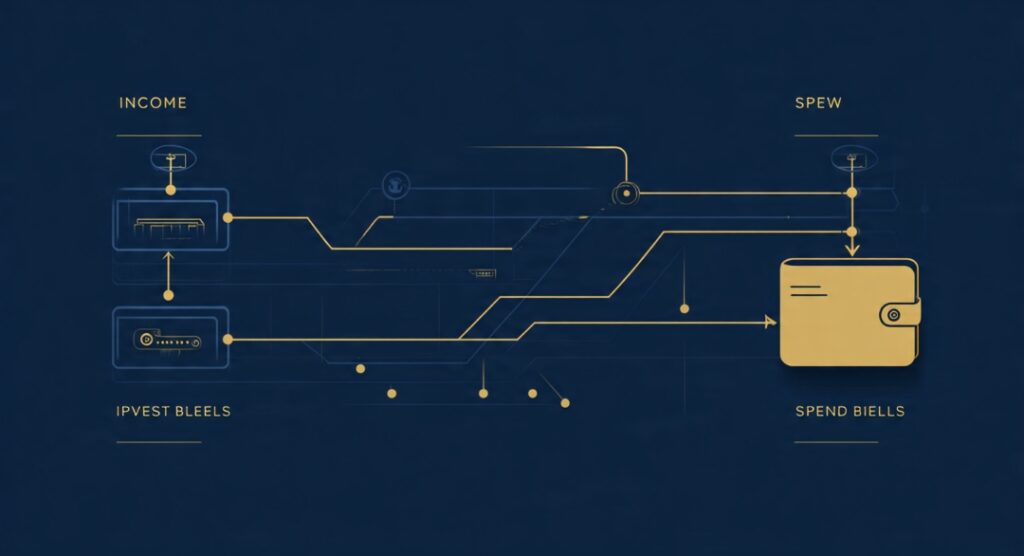
Traditional Budget vs The System That Works

| Traditional Budget (fails) | Reverse / Automated System (works) |
|---|---|
| Spend first, save the leftovers | Save first, spend the leftovers |
| Track every transaction manually | Track nothing; the account is the limit |
| Runs on willpower and restriction | Runs on automation and structure |
| One slip collapses the whole month | No single slip can break it |
| Irregular costs blow holes in it | Irregular costs pre-funded in buckets |
| Demands daily attention forever | Needs a few minutes a month |
To see the power of the automated approach over a lifetime, take one illustrative number — pure arithmetic, not a promise. Automating just 20% of a $4,000 monthly income means $800 disappears into investments every month without a single budgeting decision. At a steady 7% return, that quiet, hands-off habit grows to roughly $648,000 over 25 years. No tracking. No restriction. No willpower. Just a structure you built once and then forgot about — doing in the background what a lifetime of failed budgets never could.
Now It’s Your Move
You don’t need to become more disciplined. You’ve already proven, five failed budgets in, that white-knuckle discipline doesn’t last — and that’s not a flaw in you, it’s a fact about every human being. The move isn’t to try harder at a broken method. It’s to build a structure that works while you do nothing, so your finances run themselves and you get your attention back.
- Set up your “pay yourself first” transfer. Pick a percentage — even a small one to start — and automate it to move into savings or investments the day your income lands. This single step is most of the system.
- Automate every fixed bill you can. Go through your recurring costs and put each one on autopay. Remove them from your mental load entirely.
- Create one separate “irregular expenses” bucket. Start auto-funding a small monthly amount for the lumpy costs you know are coming. Watch how it kills the surprises that used to break your budget.
- Let the rest be free. Whatever’s left in your spending account is yours, guilt-free, no tracking. Trust the structure and let the account itself be your limit.
- Schedule one monthly five-minute review. Glance at the whole picture once a month. Adjust if needed. Then close it and go live your life.
The failed budgets were never proof that you’re bad with money. They were proof that the method was bad for humans. Build the system that works without you, and the thing you could never force through willpower starts happening on its own — quietly, automatically, every single month, for the rest of your life.
Budgets fail mainly because they rely on willpower and restriction, which deplete over time exactly like a crash diet. Tracking every expense creates unsustainable friction, irregular real-life costs break the tidy monthly plan, and an all-or-nothing mindset makes a single overspend feel like total failure, prompting people to quit. The problem is structural, built into how traditional budgeting works, rather than a flaw in the person’s discipline or character.
Reverse budgeting, sometimes called the anti-budget, flips the traditional order. Instead of spending first and saving whatever is left, you automatically move savings and investments off the top the moment income arrives, automate your fixed bills, and then spend whatever remains freely without tracking. It works because it puts the important financial actions on autopilot and removes the need for constant willpower and manual logging.
No. Detailed tracking is one of the biggest reasons budgets get abandoned, because the manual effort becomes unsustainable. A better approach is to automate your saving and bills so the crucial decisions are handled, then use the balance in your spending account as your natural limit. When that account runs low you slow down automatically, which means the account itself acts as the budget without any logging required.
Both depend on constant restriction and willpower, both create a feeling of deprivation that eventually triggers rebellion, and both collapse through an all-or-nothing mindset where one slip leads to giving up entirely. In each case people blame their own discipline when the real issue is an unsustainable method. The solution in both is the same: replace restriction and willpower with sustainable habits and automatic systems that work without daily effort.
Give irregular expenses their own dedicated savings buckets that fill automatically with a small amount each month. Costs like car maintenance, gifts, and annual fees are predictable in the sense that you know they are coming, even if you don’t know the exact month. By pre-funding them steadily, the money is already waiting when the expense hits, so it never blows a hole in your regular spending or makes you feel like the budget failed.
Far less than traditional budgeting, because it makes the right behavior the default rather than something you must choose every day. Once savings and bills are automated, they happen whether you feel motivated or not, and the only money you can overspend is money that was already meant to be enjoyed. Discipline is mostly what you need when a system is broken; a well-built automatic system makes ongoing discipline almost unnecessary.
There is no single correct figure, and starting with a smaller percentage you can sustain is better than a large one you abandon. A common starting framework is to save around 20% of income, but the key is to automate whatever amount you choose so it leaves before you can spend it. You can then increase the percentage over time, especially raising it with every pay increase so your saving grows alongside your income.
Disclaimer: This article is for educational and informational purposes only and does not constitute financial, investment, or legal advice. The numerical examples shown are simplified arithmetic illustrations of how saving and compounding work, not predictions, promises, or guarantees of any specific return. All investing involves risk, including the potential loss of capital, and individual circumstances vary. Always do your own research and consult a qualified financial professional before making money decisions.