There is a piece of mental math that every serious saver, investor and business owner eventually picks up, and once you own it you never look at a rate of return the same way again. It answers one deceptively simple question: how long until this doubles? No spreadsheet, no calculator, no finance degree. You need a single number, and that number is 72.
This one shortcut turns the abstract idea of compounding into something you can feel in your gut in about five seconds. And feeling it matters, because the human brain is genuinely bad at exponential growth. We think in straight lines, so we consistently underestimate how compounding behaves over time. The Rule of 72 is the cheat sheet that fixes that blind spot.
What the Rule of 72 Actually Is
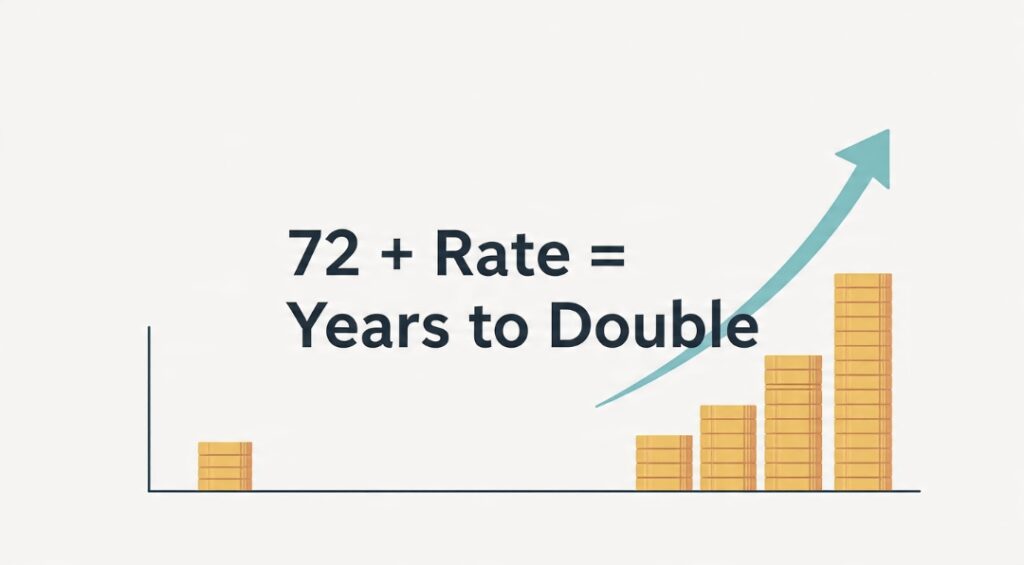
The rule is one line of arithmetic:
Years to double ≈ 72 ÷ annual rate of return
That is the whole thing. If an investment grows at 8% a year, it doubles in roughly 72 ÷ 8 = 9 years. At 6% it takes about 12 years. At 12% it takes about 6 years. You plug in the interest rate as a whole number (8, not 0.08), divide it into 72, and you have a shockingly accurate estimate of the doubling time. Investopedia describes it as one of the fastest ways to gauge the impact of compound interest without any complex tools, and it holds up remarkably well in the real world. You can read their full breakdown of the Rule of 72 for the technical detail.
A Quick Reference Table You Can Memorise
Here is what the rule looks like across the rates most people actually encounter, from a cautious savings account to an aggressive equity return:
| Annual Return | 72 ÷ Rate | Years to Double |
|---|---|---|
| 2% | 72 ÷ 2 | 36 years |
| 4% | 72 ÷ 4 | 18 years |
| 6% | 72 ÷ 6 | 12 years |
| 8% | 72 ÷ 8 | 9 years |
| 9% | 72 ÷ 9 | 8 years |
| 10% | 72 ÷ 10 | 7.2 years |
| 12% | 72 ÷ 12 | 6 years |
| 24% | 72 ÷ 24 | 3 years |
Notice how brutal the top and bottom of that table are. Money sitting at 2% takes a human generation to double. Money at 10% doubles more than four times over that same 36-year stretch. That gap is exactly why the slow, boring early years of investing feel like nothing is happening. If you have ever wondered why your account seems frozen at the start, that is the lag phase of compounding in action, and the Rule of 72 quietly explains it.
Where Does the Number 72 Come From?
The rule is not magic and it is not a marketing invention. It is a rounded-off version of the real formula for doubling time, which comes straight from the mathematics of compound interest. The exact answer uses the natural logarithm of 2, which works out to about 0.693. Expressed as a percentage, the true “rule” is closer to 69.3.
So why do we use 72 instead of the mathematically precise 69.3? One reason: convenience. The number 72 divides cleanly by 2, 3, 4, 6, 8, 9 and 12, which are exactly the interest rates you tend to care about. That divisibility lets you do the whole calculation in your head. The trade-off in accuracy is tiny, and 72 is actually at its most accurate right around the 8% mark, which happens to be a realistic long-run return assumption for a diversified portfolio. The full derivation, including the variants some people prefer, is laid out on the Rule of 72 reference page.
You will sometimes see the Rule of 70 or the Rule of 69.3 used instead. Those are slightly more precise for continuous compounding, but harder to divide in your head. For everyday estimation, 72 wins on practicality every single time.
Run It in Reverse: The Rate You Need
Here is where the rule becomes a planning tool rather than a party trick. Because it is just division, you can flip it around. Instead of asking “how long to double at this rate?”, ask “what rate do I need to double in this many years?”
Required rate ≈ 72 ÷ target years
Want to double your money in 10 years? You need roughly 72 ÷ 10 = 7.2% a year. Want it done in 5 years? You need about 14.4% a year, which is aggressive and should immediately make you ask what risk you are taking to chase it. This reverse calculation is a fantastic reality check. It stops you from setting fantasy goals and forces an honest conversation about what return is actually plausible for your situation. If you are building a plan on an ordinary income, pairing this with some real wealth-building math keeps your expectations grounded.

The Dark Side: When 72 Works Against You
The Rule of 72 is neutral. It does not care whether the doubling is in your favour or someone else’s. That makes it just as useful for spotting danger as for spotting opportunity, and this is the part most people never think to apply.
Inflation: the doubling you never asked for
Inflation is compounding in reverse on your purchasing power. If prices rise at 6% a year, the Rule of 72 tells you the general price level roughly doubles in 12 years, which is another way of saying the money in your pocket loses half its buying power over that stretch. At 3% inflation it takes about 24 years; at a punishing 10% it takes only around 7. Understanding this is the whole reason cash “sitting safe” is not actually safe. Investopedia’s primer on inflation is worth reading alongside this, because the Rule of 72 turns that abstract percentage into a concrete countdown on your savings.
Fees: the quiet subtraction
Every percentage point you hand over in fees is a percentage point shaved off your effective growth rate, which directly lengthens your doubling time. An investment earning 8% but charging 2% is really compounding at 6% for you, and the table above already showed what that costs: your doubling time jumps from 9 years to 12. That is three extra years of your life to reach the same milestone, lost to a number that looked small on paper. This is precisely how fees quietly eat your compounding without you ever feeling the individual cut.
Debt: the rule turned into a weapon
Now look back at the bottom row of the table. A credit balance charging 24% a year doubles what you owe in about 3 years if you let it run. High-interest debt is the Rule of 72 operating at full speed in the wrong direction, which is why it can bury people so fast. The same force that patiently builds wealth for the disciplined investor destroys the person who ignores a balance.
Where the Rule Starts to Bend
No shortcut is perfect, and it is worth knowing the edges. The Rule of 72 is most accurate for rates in the roughly 6% to 10% band. As you push into very high returns, say 20% and above, the estimate drifts and starts to overshoot slightly; a number like 74 becomes more accurate up there. At very low rates the reverse happens. A common refinement is to nudge the number: for every three percentage points your rate sits above or below 8%, adjust the 72 up or down by one. So at 11% you might use 73, and at 5% you might use 71. For 95% of real decisions, plain 72 is close enough that the adjustment is not worth the mental effort.
Two honest caveats. First, the rule assumes a single, steady annual rate. Real markets do not deliver a smooth 8% every year, so treat the output as a planning estimate, not a promise. Second, it assumes you leave the growth to compound and do not withdraw it. The moment you interrupt the process, the timeline changes.
How to Actually Use This
The value of the Rule of 72 is not in the arithmetic; it is in the instinct it builds. Once the number lives in your head, you start evaluating every financial claim through it automatically. Someone promises to double your money in two years? That implies a 36% annual return, and now you know to ask exactly how, and what could go to zero in the process. A “boring” 9% index return suddenly reveals itself as a doubling roughly every 8 years, which over a working life is several doublings stacked on top of each other. That reframing is how small, consistent contributions quietly turn into serious wealth over time.
Treat 72 as a filter. It will not make your investment decisions for you, but it will instantly separate the plausible from the fantasy, expose the real cost of fees and inflation, and remind you why patience is the actual engine here. The math is timeless, but the habit of applying it is what compounds. In that sense it fits neatly beside the idea that tiny, repeated actions win, which is the whole premise behind the 1% rule of daily compounding.

🔑 Key Takeaways
- The core rule: Years to double ≈ 72 ÷ your annual rate of return. At 8%, money doubles in about 9 years.
- Run it backwards: To find the return you need, divide 72 by your target number of years. Doubling in 10 years requires about 7.2% a year.
- It cuts both ways: The same rule shows how inflation halves your purchasing power and how high-interest debt doubles what you owe.
- Fees steal time: A 2% fee on an 8% return pushes your doubling time from 9 years out to 12, three years lost to a “small” number.
- It is an estimate: Most accurate between 6% and 10%. Above 20%, lean toward 74. It assumes a steady rate and uninterrupted compounding.
- The real payoff: The rule builds instinct. It instantly separates realistic returns from fantasy promises.
Frequently Asked Questions
Is the Rule of 72 accurate or just a rough guess?
It is a well-grounded approximation, not a guess. It is derived from the real compound interest formula and is most accurate for annual returns between about 6% and 10%, where its error is usually a fraction of a year. For extreme rates it drifts slightly, but for everyday planning it is close enough to trust.
Why is it 72 and not the exact number 69.3?
The mathematically precise figure is roughly 69.3, based on the natural logarithm of 2. The number 72 is used instead because it divides evenly by 2, 3, 4, 6, 8, 9 and 12, which makes the mental math effortless. The small loss in precision is a fair trade for being able to calculate it in your head.
Can I use the Rule of 72 for inflation?
Yes, and it is one of the most useful applications. Divide 72 by the inflation rate to estimate how many years it takes for prices to double, which is the same as your money losing half its purchasing power. At 6% inflation, that is roughly 12 years.
How do I find the return I need to double in a set time?
Flip the formula: divide 72 by your target number of years. If you want to double your money in 8 years, you need about 72 ÷ 8 = 9% a year. This reverse method is a quick sanity check on whether a goal is realistic.
Does the rule work for credit card debt?
It works exactly the same way, just against you. A balance at 24% interest doubles in about 3 years if left unpaid. Applying the rule to debt is a stark way to see why high-interest balances are so dangerous.
What is the difference between the Rule of 72 and the Rule of 70?
Both estimate doubling time; they just use a different constant. The Rule of 70 (and the even more precise 69.3) is marginally more accurate for continuous compounding, while 72 is easier to divide mentally. For most people, 72 is the practical choice.
Are there rules for tripling or quadrupling money?
Yes. The same logic gives the “Rule of 114” for tripling and the “Rule of 144” for quadrupling. Divide those numbers by your rate of return the same way. At 8%, money triples in roughly 14 years and quadruples in about 18.
⚠️ Disclaimer: This article is for educational and informational purposes only and does not constitute financial, investment or tax advice. The Rule of 72 is a simplified estimation tool; it assumes a constant rate of return and uninterrupted compounding, and real-world investment returns vary and are not guaranteed. All investing carries risk, including the possible loss of principal. Figures used here are illustrative. Always do your own research and consider consulting a qualified financial professional before making any investment or debt decision.