Imagine this: You have the best trading strategy in the world. Your charts are clean. Your analysis is solid. Every indicator is flashing a clear entry signal. You enter the trade with confidence.
And then the market moves against you.
In that split second, your heart starts racing. The rational part of your brain — the part that did the analysis, that identified the setup, that placed the trade — goes quiet. Something else takes over. Something faster, louder, and far less rational.
You panic. You close the trade at a loss. And then, almost immediately, you watch the price reverse and move exactly where you predicted it would go.
If this sounds familiar, you are not alone. This pattern plays out in trading accounts around the world every single day. And it has almost nothing to do with strategy.
Most traders spend years chasing the perfect system. The magic indicator. The holy grail setup that never fails. They believe the secret to consistent profitability is hidden somewhere in the charts — if they can just find the right combination of tools and timeframes, everything will click.
Here is the hard truth that the majority of traders learn too late: the biggest enemy you will ever face in the market is not the banks, the algorithms, or the volatility. It is the person looking back at you in the mirror.
This is what trading psychology fear and greed actually means in practice — and this article is about understanding it clearly enough to do something about it.

The 99% vs. The 1% — What Actually Separates Them
The statistics around retail trading failure are well-documented and consistently sobering. The overwhelming majority of retail traders do not survive their first year with their capital intact. Most blow their accounts. Most quit. Most conclude that the market is rigged, that the odds are impossible, that success belongs to institutions and insiders.
But here is what that narrative misses: the failure is almost never technical.
The traders who fail are not failing because they do not understand candlestick patterns or market structure. They are failing because they cannot control their own emotional responses when real money is on the line and the market is moving against their position.
The 1% of traders who achieve consistent, lasting profitability are not necessarily smarter. They have not found a better indicator or a more sophisticated strategy. What they have developed — often through years of painful experience — is a fundamentally different relationship with the market.
They treat trading as a business of discipline and patience. They understand that their job is not to predict the market perfectly but to execute their edge consistently over a large sample of trades. They have internalized something that most traders never fully accept: that losses are not failures. They are the cost of doing business in an environment where no edge works 100% of the time.
The gap between the 99% and the 1% is not strategy. It is psychology. Specifically, it is the management of the two forces that destroy more trading accounts than any bad setup ever could.
The Two Biggest Enemies — Fear and Greed in Trading Psychology
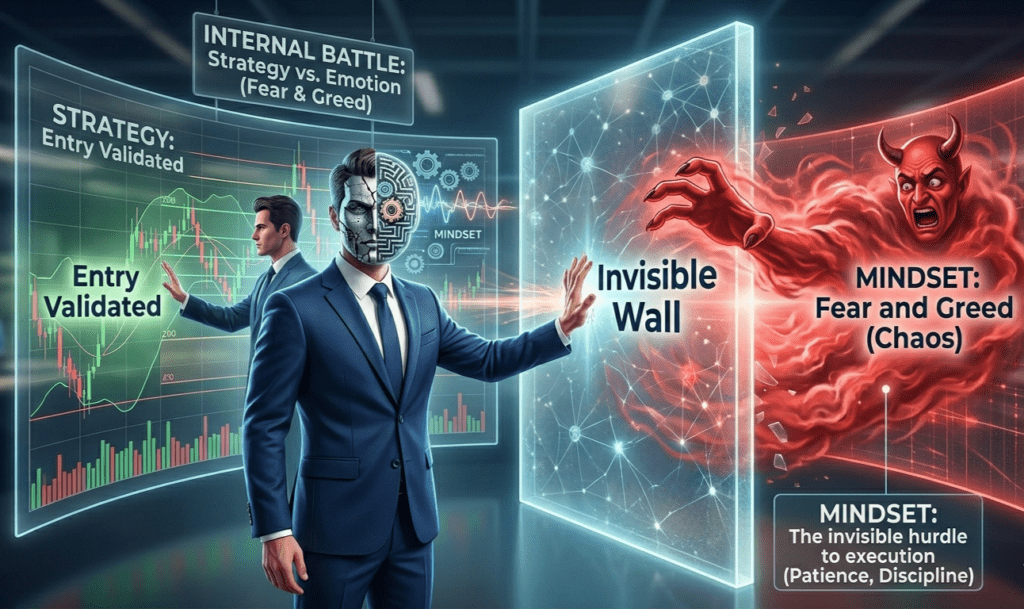
Every trader — regardless of experience level, account size, or strategy — operates within the influence of two primary emotional forces. Understanding how each one works is the first step toward managing them.
Greed — The Silent Account Killer
Greed does not always announce itself loudly. It often arrives disguised as confidence, as ambition, as the reasonable conviction that this particular trade is going to be a big winner.
In practice, greed looks like this: you are in a trade that has hit your target. The position is profitable. Your plan says to close. But the candles keep moving in your direction, and the thought arrives — what if I hold just a little longer?
So you move your target. You hold past your plan. And then the market reverses, retraces past your original target, and you close at breakeven or at a loss — on a trade that should have been a win.
Greed also manifests in position sizing. After a run of winning trades, the temptation to increase size — to capitalize on the momentum, to make the most of a hot streak — leads to an oversized position at precisely the moment when a normal loss will produce an abnormally large drawdown.
Greed blinds you to risk by focusing your entire attention on reward. It makes you hold too long, size too large, and enter setups that do not fully meet your criteria because the potential profit is too compelling to ignore.

Fear — The Edge Destroyer
Fear operates in the opposite direction but produces equally destructive outcomes.
Fear makes you hesitate on a valid setup — the entry is clean, the confluence is there, your system says enter, but the memory of the last loss is still fresh and your finger will not click the button. The trade runs without you. Then you chase it. Then it reverses. Then you have taken a bad entry on a good setup and turned a potential winner into a loss.
Fear makes you exit winning trades too early. Price is moving in your direction, approaching your target, and then pulls back slightly. The immediate interpretation is that the trade is turning — get out now, protect the small profit. You exit. Price resumes, hits your original target, and moves beyond it. You captured a fraction of what your plan entitled you to.
Fear also produces the most expensive behavior in all of trading: widening stop losses when price approaches them. Instead of accepting the planned loss and exiting, the stop gets moved further away — “just to give the trade more room.” The loss that was supposed to be $50 becomes $150. The loss that was supposed to be $150 becomes an account-altering event.
To join the 1%, you must learn to recognize both of these forces — in real time, while they are happening — and return to your plan regardless of how loud they are.
Patience — The Ultimate Trading Superpower
If you had to distill professional trading into a single sentence, it would be this: trading is 90% waiting and 10% executing.
Most retail traders have this ratio inverted. They are active when they should be patient, and they are paralyzed by fear when a genuine setup finally arrives. They confuse activity with productivity — believing that more trades means more opportunity, that more screen time means more edge, that sitting out means falling behind.
The professional trader operates from a completely different framework. They have identified their specific Points of Interest — the price levels, the structural confluences, the conditions that their strategy requires before a trade is valid. And they wait for the market to come to those points. Not the other way around.
When the market is not at a Point of Interest, they do not trade. When conditions are unclear, they do not trade. When they have already hit their daily loss limit, they do not trade. They understand, at a genuine level, that “no trade” is itself a position — often the most profitable one available on a given day.
The impatient trader forces setups that do not exist. They enter because they are bored, because they have been watching the screen for hours and feel they should have something to show for it, because their friends are posting winning trades and they want to participate. Every one of these is an emotional entry — and emotional entries consistently produce emotional exits, which consistently produce losses.
Patience is not passive. It is an active, daily discipline — the choice to protect your capital by doing nothing when the conditions to deploy it are not present.
Consistency Through Discipline — The Only System That Actually Works
A strategy is only as good as the person executing it.
This sounds obvious. It is profound in practice.
You can have a genuinely profitable edge — a system that, across hundreds of trades, produces positive expectancy — and still lose money consistently if you break your rules when the emotional pressure is highest. And the emotional pressure is always highest precisely when the rules matter most: when you are in a losing streak, when a position is at maximum drawdown, when the market is moving fast and your plan feels suddenly inadequate.
Consistency means executing the same process on trade number fifty as you did on trade number one. It means following your risk management rules not when it is comfortable but when every emotional signal is pushing you to abandon them. It means accepting a loss — fully, cleanly, without revenge trading — and returning to your process for the next setup.
Most traders improve their strategy repeatedly and never improve their execution. They identify what is wrong technically, refine their entry criteria, tighten their rules — and then break those rules the very next time real money and real pressure are involved. The strategy was never the problem. The gap between the strategy on paper and the strategy in execution is always a psychological gap.
How to Build the Psychological Foundation — Practical Steps
Understanding the problem is not the same as solving it. Here are the specific practices that move trading psychology from theory into daily execution:
Keep a Detailed Trading Journal
Every trade — win or loss — gets logged with the emotional state at entry, at maximum drawdown, and at exit. Not just the technical details. The psychological ones. Over weeks and months, patterns emerge: the conditions under which you break rules, the emotional states that precede your worst decisions, the times of day or account states that correlate with your most undisciplined behavior. You cannot fix what you have not observed. The journal is your observation tool.
Define Rules for Every Scenario in Advance
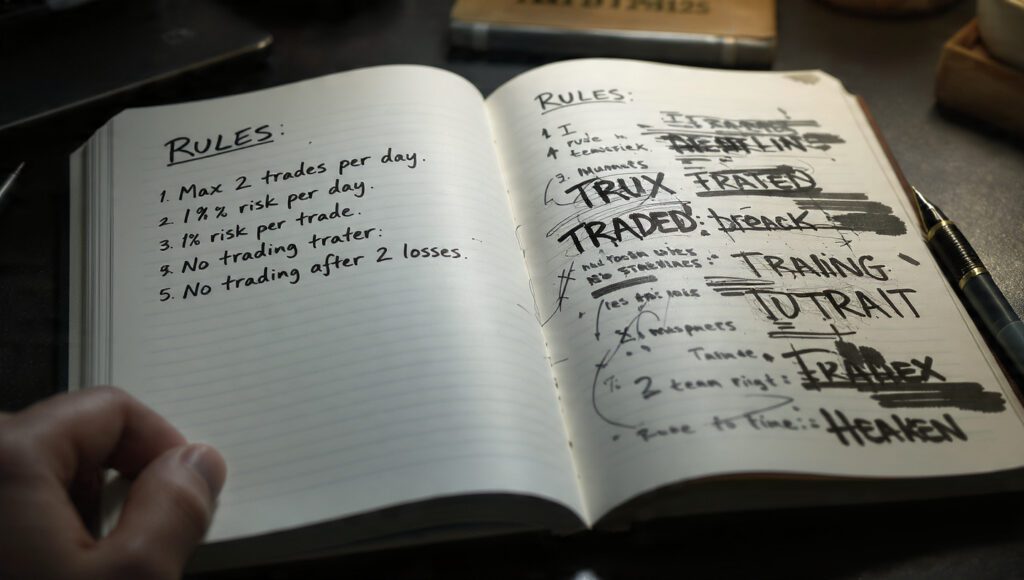
Emotional decisions are made in the moment. Disciplined decisions are made in advance. Before the trading session begins, know exactly what you will do if price gaps against you, if your stop is hit, if you have two consecutive losses. Write it down. The goal is to remove as many real-time decisions as possible — because real-time decisions in a live market are almost always emotional ones.
Implement Hard Daily Loss Limits
When your daily loss limit is hit, the session ends. Not “I will be more careful now.” Not “one more trade to recover.” The platform closes. This single rule prevents the majority of account-destroying loss spirals — because those spirals almost always begin with a loss, followed by an emotional trade to recover it, followed by a bigger loss, followed by more emotional trading.
Treat Every Trade as One of a Thousand
No single trade matters. Every trade is one data point in a sample of hundreds. When you genuinely internalize this — when the outcome of any individual trade stops feeling like a referendum on your competence — the emotional intensity drops dramatically. You execute the plan. You accept the result. You move to the next one. This is what consistency actually looks like from the inside.
Trading Psychology Fear and Greed — Final Thought
If you want to change your results, you must first change your thinking. Stop chasing the perfect strategy and start mastering your own discipline.
The market is a mirror. It reflects your strengths and weaknesses with complete accuracy and without mercy. It rewards patience and punishes impatience. It rewards consistency and destroys erratic behavior. It does not care about your intelligence, your analysis, or your conviction. It only responds to how you behave when the pressure is on.
- The real enemy is internal — not the market, not the institutions, not the algorithms
- 99% fail because of emotions — the 1% succeed because of systems and discipline
- Greed makes you hold too long and size too large — recognize it before it acts
- Fear makes you exit early and hesitate on valid setups — recognize it before it acts
- Trading is 90% waiting — patience is not a soft skill, it is your primary edge
- Consistency is the only system that works — not the strategy, the execution
- Journal everything, pre-define your rules, and implement hard daily limits
Fix the person behind the screen, and the numbers on the screen will follow.
That is not motivational language. That is the most accurate technical analysis available to any trader.