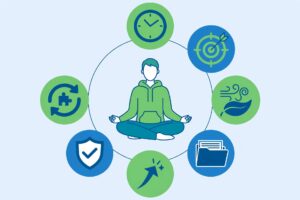
In an era of constant distractions and emotional volatility, the difference between a high-performer and the average individual lies not in talent, but in Mental Endurance. Building a mind that is unbreakable — much like a stone that withstands the strongest tides — requires a strategic integration of ancient physical wisdom and modern neurological insights.
The good news: this is not a gift some people are born with. It is a trainable state, built through specific daily practices that rewire the brain over time. Here is how to build it.

1. The Power of Breath: Kumbhaka and Amygdala Regulation
The first step to emotional sovereignty is controlling the biological response to stress. Before you can command your decisions, you must command your nervous system — and the nervous system is directly accessible through the breath.
In Yoga, Kumbhaka — the practice of breath retention — is used to harness internal energy and develop control over the body’s stress response. From a neuroscientific perspective, this practice directly impacts the Amygdala, the brain’s alarm system that triggers the fight-or-flight response.

- The Mechanism: By practicing breath retention daily, you train your nervous system to remain calm under stress. This increases your CO2 tolerance and tones the Vagus Nerve — the primary communication channel between the brain and the body’s stress response system.
- The Result: Professional athletes and elite military personnel use controlled breathing protocols to maintain clear-headed decision-making under extreme pressure. When the world is in chaos, a regulated breath ensures your brain remains in a state of logic rather than panic.
Research published in Frontiers in Human Neuroscience confirms that slow, controlled breathing directly reduces Amygdala reactivity and increases prefrontal cortex activity — essentially shifting the brain from emotional reaction to rational response.
How to practice Kumbhaka: Inhale for 4 counts. Hold for 4 counts. Exhale for 4 counts. Hold for 4 counts. Repeat for 5 minutes before any high-pressure situation — a difficult meeting, a trading session, an important decision. The cumulative effect over weeks rewires your default stress response permanently.
![Kumbhaka box breathing technique — 4-4-4-4 method for amygdala regulation and stress control]](https://datapips.net/wp-content/uploads/2026/06/clean-infographic-showing-4-4-4-4-box-breathing-te-1-1024x576.jpeg)
2. Intentional Visualization and the Reality Loop
Neuroscience confirms that the brain often struggles to distinguish between a vivid imagination and a physical experience. When you close your eyes and visualize a goal with absolute clarity — seeing it, feeling it, experiencing the sensations of achieving it — your brain fires the same neural pathways as if you were actually performing the task.
This is not motivational fluff. It is documented neuroscience. A landmark study at Psychology Today reviewed research showing that mental rehearsal activates the same motor cortex regions as physical practice — and that athletes who combined physical training with visualization outperformed those who only practiced physically.
- The Execution: Elite competitors visualize the win long before the race begins. Surgeons mentally rehearse complex procedures before entering the operating room. Traders who visualize disciplined execution before a session are less likely to deviate from their rules when under pressure. By visualizing your goals and immediately following up with decisive action, you bridge the gap between thought and reality — hardening your focus into a precision instrument.
How to apply it: Spend 5 to 10 minutes before your most important daily task in quiet, eyes-closed visualization. See yourself executing with precision. Feel the focus. Experience the successful outcome in detail. Then open your eyes and begin immediately — no delay, no phone, no distraction. The brain is primed. Use that window.
The critical distinction: visualization that is not followed by action trains the brain to prefer fantasy over friction. The moment your eyes open, you move. That transition is where the power lives.
Visualization is a real tool, but it has a documented failure mode — the research on why goal visualization backfires explains when mental rehearsal helps and when it quietly replaces the work.
3. Seeking Discomfort: Building the Hardened Mind
Mental endurance is not a gift. It is a muscle built through the deliberate pursuit of Voluntary Hardship. The brain becomes capable of handling high-pressure situations in exact proportion to the difficulty of situations it has already survived.

Whether it is cold exposure, grueling physical workouts, extended fasting, or long-distance endurance training — putting the body in a genuinely tough situation forces the brain to adapt. It learns that discomfort is survivable. That panic is not necessary. That the “stop” signal from the body is often just a suggestion, not a command.
- Anti-Fragility: Nassim Taleb’s concept of anti-fragility applies directly here. When you subject yourself to controlled discomfort consistently, you do not just become resilient — you become stronger because of the difficulty. Each session of voluntary hardship increases your baseline tolerance for pressure in every area of life.
- Emotional Detachment: True power comes from holding the key to your own emotional state and refusing to give it to anyone else. When you have trained your body and mind to endure discomfort without breaking, external provocations lose their power over you. Someone’s opinion, a market downturn, a business setback — none of these can take you off your foundation if your foundation has been tested and strengthened deliberately.
Research from Harvard Medical School confirms that regular physical challenge — particularly high-intensity exercise — restructures the brain’s stress response system, reducing baseline anxiety and improving emotional regulation over time.
Practical starting points: Cold showers — begin with 30 seconds at the end of your normal shower and extend gradually. Daily exercise that genuinely challenges you — not comfortable movement, but effort that requires mental override of the body’s resistance. Silence and solitude for extended periods — most people are uncomfortable alone with no stimulation for even 20 minutes. That discomfort is exactly the point.
4. The Sovereign Mind: Emotional Autonomy in Practice
The ultimate goal of all three practices above is a single outcome: a mind whose internal state is not determined by external events.
Most people live in a state of constant reactivity. Something happens — a loss, a criticism, a disappointment — and their emotional state collapses in proportion. They have, without realizing it, handed the key to their internal peace to every person and circumstance they encounter.
The sovereign mind operates differently. It receives the external event. It acknowledges the impact. And then it chooses its response deliberately — from its own values and goals, not from the urgency of the emotion.
This gap between stimulus and response — described by Viktor Frankl in his work on human freedom — is the space where genuine personal power lives. It cannot be faked. It cannot be performed. It is built, slowly and systematically, through the practices described above: breath control that calms the nervous system, visualization that primes the mind for intentional action, and voluntary discomfort that expands the range of conditions under which you remain functional.

5. Building the Daily Architecture of an Unbreakable Mind
These principles are not a weekend project. They are a daily architecture — a structure of small, consistent practices that compound over weeks and months into a fundamentally different relationship with pressure, discomfort, and uncertainty.
Here is a practical daily framework:
- Morning (10 minutes): 5 minutes of Kumbhaka breathing followed by 5 minutes of visualization of the day’s most important task. Do this before any screen, any news, any conversation.
- Daily discomfort practice: One physically or mentally challenging activity that you do not want to do but choose to do anyway. This is non-negotiable. The day you skip it is the day you tell your brain that comfort wins.
- Evening reflection (5 minutes): Review one moment where you reacted rather than responded. What triggered you? What would a sovereign response have looked like? Write it down. The pattern recognition that emerges from this practice over months is one of the most powerful tools for psychological development available.
Frequently Asked Questions
Q: How long does it take to see results from these practices?
Most people notice meaningful changes in their stress response within 4 to 6 weeks of consistent daily practice. The breath work tends to produce the fastest results — many people notice a difference within the first week. The deeper changes in emotional reactivity and mental endurance take 3 to 6 months of consistent application.
Q: Can I build mental endurance without physical discomfort practices?
You can make progress through breath work and visualization alone. But physical discomfort practices accelerate the process significantly because they create the actual neurological conditions — elevated heart rate, muscular fatigue, adrenaline — under which mental control is most needed and most effectively trained. Mental endurance built under physical challenge transfers to every other area of life.
Q: Is visualization effective for trading or business performance specifically?
Yes — and the research strongly supports this. Traders who visualize disciplined execution before sessions make fewer impulsive decisions. Entrepreneurs who mentally rehearse difficult conversations handle them more effectively in reality. The neural priming effect is domain-independent — it works wherever disciplined execution under pressure is required.
Q: What is the difference between mental toughness and emotional numbness?
Mental toughness means you feel the emotion, acknowledge it, and choose your response deliberately. Emotional numbness means you suppress or disconnect from the emotion — which creates different problems over time including delayed psychological stress and poor empathy. The goal is not to stop feeling. It is to feel without being controlled by what you feel.
Q: How do I maintain these practices when life gets busy?
Reduce the time requirement rather than skipping entirely. A 2-minute breathing session is infinitely better than no session. A 10-minute walk that genuinely challenges you counts as your discomfort practice. The most important variable is consistency, not duration. A 5-minute daily practice maintained for a year produces more change than a 60-minute practice maintained for two weeks.
Conclusion: The Sovereign Existence
Becoming unbreakable means reaching a state where your internal peace is not contingent on external events. Not because nothing affects you — but because you have built the internal architecture to receive difficulty without collapsing under it.

By mastering your breath, your vision, and your discipline — consistently, daily, without exception — you stop reacting to the world and start commanding your response to it.
That is not a small shift. That is the shift that changes everything.
About the Author
Shurah Beel Hamid is a business enthusiast, active trader, and content creator who transformed his life by training his brain from an electrician’s mindset to an entrepreneur’s mindset. His expertise lies in practical brain training for entrepreneurship, trading psychology, compounding strategies, and elite mindset development. He shares his raw, unfiltered journey — from suicidal thoughts to strategic patience, from blowing trading accounts to consistent profitability — to provide actionable insights for those tired of theoretical advice and ready for real change. His writing combines hard-won experience, neuroscience-backed techniques, and relentless optimism.
Disclaimer: This article is for educational and informational purposes only and does not constitute medical advice. Always consult a qualified professional before beginning any new physical or mental health practice.