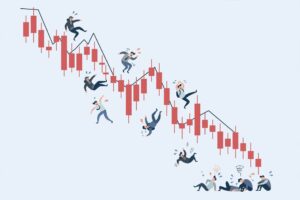
Most honest accounts of the path to consistent trading skip the part that actually matters most: persistence alone doesn’t get anyone there. A rigorous academic study that tracked nearly 20,000 traders who persisted in day trading for at least 300 sessions — well past the point where most people quit — found that 97% of them still lost money, and found no measurable evidence of learning across the years they kept trading. Time in the market, on its own, isn’t the mechanism that produces skill.
- A study of nearly 20,000 Brazilian day traders who persisted for 300+ sessions found 97% still lost money, with no detectable improvement over time — persistence without a structural change produced no learning curve.
- Only about 0.4-0.5% of persistent traders in that study earned more than an entry-level bank teller’s wage, and even the top performer carried extreme volatility relative to the return.
- The years that separate failure from consistency, when they do produce a real result, are almost always defined by a shift away from prediction-focused effort and toward risk-focused systems.
- The honest version of this roadmap has more traders in the “still failing after years” category than the “reached mastery” category — which is itself the most useful piece of information for anyone starting the journey.
What the Research Actually Shows About Persistence
A study by economists Fernando Chague, Rodrigo De-Losso, and Bruno Giovannetti tracked every individual who began day trading Brazilian equity index futures between 2013 and 2015, then isolated those who persisted for at least 300 trading sessions — a group that had already survived well past the point where most retail traders quit. Within that already-selected, persistent group, 97% still lost money. Only 0.4% earned more than the daily wage of a bank teller, and the single best-performing individual in the entire dataset earned an average of $310 per day carrying a standard deviation of $2,560 — meaning even the top result came with volatility roughly eight times the average daily return itself. The researchers explicitly found no evidence of learning across the years these traders continued trading.
This finding matters because it directly contradicts the assumption embedded in most “roadmap” content: that years of screen time and repeated attempts naturally produce improvement. For the vast majority of persistent traders in this dataset, they didn’t. Whatever separates the rare traders who do improve from the much larger group who simply keep repeating the same pattern for years isn’t time itself.
What Actually Seems to Separate the Rare Exceptions
Given that persistence alone shows essentially no correlation with improvement, the traders who do eventually cross into consistency appear to change something structural, not just accumulate more hours. The pattern that shows up across the research already covered in trading psychology is consistent: a shift away from focusing energy on prediction (finding the next winning entry) and toward focusing energy on risk (surviving the sequence of trades an edge requires to actually play out).
- From sizing trades emotionally to sizing them mechanically. See Why Profitable Traders Still Blow Accounts — a strategy with genuine statistical merit still requires a survivable position size, and this is one of the most common places years get lost without changing the underlying outcome.
- From trading on volume to trading on a written, testable process. The overtrading research covered in Overtrading: How It Empties Trading Accounts shows trading frequency itself, not strategy quality, predicting a large share of the return gap between traders — a shift toward fewer, more deliberate trades is one of the more reliably observed changes in traders who improve.
- From reacting to the disposition effect to correcting for it structurally. The pattern covered in Trading Patience and Risk Management — selling winners early, holding losers long — has to be actively corrected through fixed rules rather than simply hoped away with more experience, since the research shows losses can reinforce the bias rather than teach discipline against it.
- From outsourcing entries to understanding them. A trader relying on unverified signals, covered in Trading Signals vs. Financial Suicide: A Reality Check, has no mechanism for improvement because there’s no personal decision-making process to refine in the first place.
Why “6 Years” Is a Realistic Timeline, Not a Guarantee
The honest framing has to hold two things at once: reaching real consistency in trading often does take years for the people who eventually get there, and the years themselves are not what produce the result — the structural changes made during those years are. Someone who spends six years repeating the same undisciplined pattern the Brazilian study documented will very likely land in the same place as someone who spent six months doing the same thing, just with more accumulated losses along the way. Someone who spends a fraction of that time deliberately rebuilding position sizing, trade frequency, and exit discipline around the research above can plausibly move faster than the multi-year timeline suggests.
This is why a genuinely honest roadmap resists giving a specific number of months or years as a guarantee. The variable that matters is whether the specific behaviors above are being deliberately changed and tested, not how much calendar time has elapsed.
The Uncomfortable Part Worth Sitting With
Most people reading a “roadmap to mastery” piece are implicitly hoping to be told they’re on the right track. The most useful thing this research actually offers is closer to a warning: persistence, on its own, is not evidence of progress. A trader who has been trading for years without deliberately changing position sizing, trade frequency, or exit discipline is, according to this data, statistically no more likely to be approaching consistency than a trader who started last month with the same undisciplined habits. The number of years isn’t the credential — the specific, verifiable changes made during those years are.
This connects to the broader case for moving toward an understood, personally-owned method rather than a borrowed or habitual one — see Why I Switched From Indicators to Smart Money Concepts for what that structural shift can look like in practice.
A Realistic Sequence, Not a Guaranteed Timeline
- Audit trade frequency and position sizing honestly before anything else — most of the return gap between improving and non-improving traders traces back to these two variables specifically.
- Build and test a written process that can be evaluated and refined, rather than a habit that simply repeats.
- Track outcomes against the process, not against calendar time. A monthly review of whether the rules were actually followed is more informative than a yearly review of the account balance alone.
- Treat a lack of improvement as a signal to change the structural variables above, not to simply keep going. The Brazilian study’s central finding — years of persistence with no learning — is exactly the outcome this step is designed to prevent.
For a more granular version of this sequence, see 12-Month Trader Roadmap: Beginner to Professional.
This article is for general educational purposes and summarizes published academic research on trading outcomes. It is not personalized trading or investment advice. Trading carries a high risk of loss — consult a qualified financial advisor before making trading decisions.
FAQs
Does this research mean trading skill can’t be learned?
Not exactly — it means the specific population studied showed no measurable learning over years of persistence under their existing habits. It doesn’t rule out improvement through deliberately restructured behavior; it specifically challenges the assumption that time and repetition alone produce it.
Is day trading fundamentally different from longer-term trading in this respect?
The specific study covered day traders competing against high-frequency trading firms in a fast, highly competitive market, which the researchers noted makes consistent profitability especially difficult. The underlying behavioral findings (position sizing, overtrading, the disposition effect) apply more broadly across trading styles, even if the specific 97% figure is tied to that particular market structure.
Next step: for the specific mindset research that determines whether these structural changes actually get made and sustained, see Risk Management in Trading Psychology: Beyond the Basics.
About the Author
Shurah writes and maintains DataPips independently, drawing on hands-on experience in trading and entrepreneurship. Articles are shaped by personal research, real trading lessons, and the process of building this publication from scratch — not by a formal financial credential.