Key Takeaways
- Generative AI is artificial intelligence that creates new content — text, images, audio, video, code — rather than just analyzing or classifying existing data.
- The key word is “generative”: it generates something new that did not exist before, based on patterns it learned from massive amounts of data.
- It works by learning the deep patterns of its training data so thoroughly that it can produce brand-new examples that fit those patterns.
- Tools like ChatGPT (text), image generators, and AI voice tools are all forms of generative AI — each generating a different kind of content.
- Understanding generative AI explains both its incredible creative power and its real limitations, like making things up and lacking true understanding.
A few years ago, the idea of typing a sentence and having a computer produce a photorealistic image, write a complete essay, or compose music sounded like science fiction. Today it is ordinary. The technology that made this leap possible has a name — generative AI — and it represents one of the most significant shifts in computing history.
You have almost certainly used it. If you have asked ChatGPT a question, created an AI image, or used an AI writing tool, you have used generative AI. But there is a real difference between using it and understanding what it actually is — and that understanding changes how effectively and wisely you can work with these remarkable tools.
This guide explains what generative AI is in plain language, for a complete beginner. The Data Pips Team will show you what it is, how it differs from older AI, how it actually creates new things, the main types, and why understanding it matters. No technical background needed. By the end, you will understand the technology that is reshaping creativity, work, and communication. Let us get into it.
What Is Generative AI — In Plain English?
Let us define it simply.
Generative AI is artificial intelligence that creates new content — like text, images, audio, video, or code — rather than just analyzing or sorting existing data.
The key word is right there in the name: generative. It generates. It produces something new that did not exist before. This is what makes it different from most earlier AI, and that difference is worth understanding clearly.
Think about what older AI typically did. It analyzed and classified. It would look at an email and decide “spam or not spam.” It would look at a photo and identify “cat or dog.” It would look at a transaction and flag “fraud or normal.” These are incredibly useful tasks, but notice what they have in common: the AI was analyzing existing things and sorting them into categories. It was not creating anything new.
Generative AI flips this. Instead of looking at an image and labeling it, generative AI creates a brand-new image from a description. Instead of sorting text, it writes new text. Instead of analyzing music, it composes new music. According to Wikipedia, generative AI refers to systems capable of generating text, images, or other media in response to prompts. The shift from analyzing to creating is what makes generative AI feel so revolutionary — computers went from sorting our world to producing new content within it.
— Data Pips Team
Generative vs Analytical AI: The Core Difference
To really understand generative AI, it helps to contrast it clearly with the analytical AI that came before it. Both are valuable; they simply do different things.
Analytical AI (sometimes called discriminative AI) looks at existing data and makes a judgment about it — classifying, predicting, or detecting. Its job is to analyze input and produce a decision or label. “Is this spam?” “What number is this?” “Will this customer churn?” It is a sorting and judging machine. This kind of AI has powered useful tools for years and remains enormously important.
Generative AI looks at a request and produces new content in response. Its job is to create output that did not exist before. “Write me a poem about the ocean.” “Create an image of a mountain at sunset.” “Compose a melody.” It is a creating machine. This is the newer, headline-grabbing form of AI driving the current boom.
A simple way to remember the distinction: analytical AI answers “what is this?” while generative AI answers “make me something new.” One judges what already exists; the other produces what does not yet exist. Both are built on the same underlying foundation of machine learning — learning patterns from data — but they apply that learning toward opposite goals: understanding versus creating.
It is worth noting these are not rivals. Both types are widely used, often together. A complete AI system might use analytical AI to understand a situation and generative AI to respond to it. But the explosion of public excitement about AI in recent years has been driven overwhelmingly by the generative kind, because creating content feels far more magical than sorting it.

How Does Generative AI Actually Create New Things?
This is the part that seems almost magical. How can a computer create a brand-new image or write an original essay? The answer builds on how AI learns, and it is more understandable than you might expect.
Generative AI works by learning the deep patterns of its training data so thoroughly that it can produce brand-new examples that fit those patterns. Let us unpack that.
During training, a generative AI is shown an enormous amount of content — for a text generator, vast quantities of writing; for an image generator, huge numbers of images with descriptions. It learns the patterns of that content incredibly deeply: how words flow into sentences, how sentences build arguments, what visual features make up objects and scenes, how light and texture work. Our guide on how AI learns through training explains this learning process in detail.
Once it has learned these patterns deeply enough, something remarkable becomes possible: the AI can generate new content by applying those learned patterns. When you ask a text generator to write a poem, it produces words that fit the patterns of poetry it learned — generating one piece at a time, each fitting what came before. When you ask an image generator for a mountain at sunset, it produces an image whose features match the patterns it learned about mountains, sunsets, light, and composition.
The crucial insight is that the AI is not copying and pasting existing content. It learned the underlying patterns so well that it can produce genuinely new combinations that follow those patterns — a poem nobody wrote before, an image nobody created before. As IBM describes it, generative AI models learn the patterns and structure of their training data and then generate new data with similar characteristics. It is pattern-learning turned toward creation: absorb the patterns deeply, then produce new things that fit them.
The Master Chef Analogy
Here is the analogy that makes generative AI click. Imagine a master chef who has cooked and tasted thousands upon thousands of dishes over a lifetime.
Through all that experience, the chef has absorbed deep patterns — how flavors combine, how textures balance, what makes a dish work, the structure of different cuisines. They did not memorize specific recipes to copy; they internalized the underlying principles of cooking so thoroughly that they understand, at a deep level, how good food works.
Now you ask this chef to create a brand-new dish — something they have never made before, with ingredients you specify. They can do it, beautifully, because they are not recalling a memorized recipe. They are applying their deeply learned patterns of how cooking works to generate something entirely new that still follows the principles of good food. The dish is original, yet it makes sense, because it fits the deep patterns the chef absorbed.
Generative AI is that chef. It “tasted” an enormous amount of content during training and absorbed the deep patterns of how that content works. When you give it a prompt, it does not retrieve a memorized answer — it applies its learned patterns to generate something new that fits them. This is why generative AI can produce original content rather than just regurgitating its training: it learned the principles, not just the examples, and can apply those principles to create.
Example: How a Text Generator Writes Something New
Consider what happens when you ask an AI to “write a short story about a lighthouse keeper who discovers a message in a bottle.” The AI has never seen this exact story — so how does it write one?
During training, the AI absorbed the patterns of countless stories: how narratives are structured, how characters are introduced, how tension builds, how lighthouse settings are described, how discoveries unfold. It learned the deep patterns of storytelling, not specific stories to copy.
When you give your prompt, the AI generates the story one piece at a time, each word fitting the patterns it learned and the context of your specific request. It produces a lighthouse keeper character because it learned what such characters are like; it builds tension around the message because it learned how discoveries create narrative tension; it structures the whole thing as a coherent story because it deeply absorbed story structure. The result is an original story that never existed before, yet reads coherently because it follows the deep patterns of good storytelling.
This is the same underlying technology as large language models — the AI generating text by predicting what fits best, one piece at a time, based on deeply learned patterns.
Lesson: Generative AI creates new content not by copying, but by applying deeply learned patterns to produce original combinations that fit those patterns — exactly like the master chef inventing a new dish.
The Main Types of Generative AI
Generative AI comes in several forms, each generating a different kind of content. Here are the main ones you will encounter.
Text Generation
The most well-known type, powering AI chatbots and writing assistants. These tools generate written content — answers, essays, emails, stories, code, and more. They are built on large language models, which learned the patterns of language from massive amounts of text. This is the form of generative AI most people interact with daily.
Image Generation
Tools that create images from text descriptions. You describe what you want, and the AI generates a brand-new image matching your description. These learned the patterns connecting language to visual features from huge collections of images and their descriptions. They can produce everything from photorealistic scenes to artistic illustrations, all generated fresh.
Audio and Music Generation
AI that generates speech, sound effects, or music. This includes realistic voice generation (text-to-speech that sounds human), as well as tools that compose original music. These learned the patterns of audio and music from large collections of sound.
Video Generation
A rapidly developing area where AI generates video content from descriptions or other inputs. This is more complex than images because video adds the dimension of motion and time, but the underlying principle is the same — learning patterns deeply enough to generate new examples.
Code Generation
AI that writes computer code from descriptions of what you want the program to do. These learned the patterns of programming from vast amounts of code, and can generate working code, making them powerful tools for developers and even helping non-programmers create simple programs.
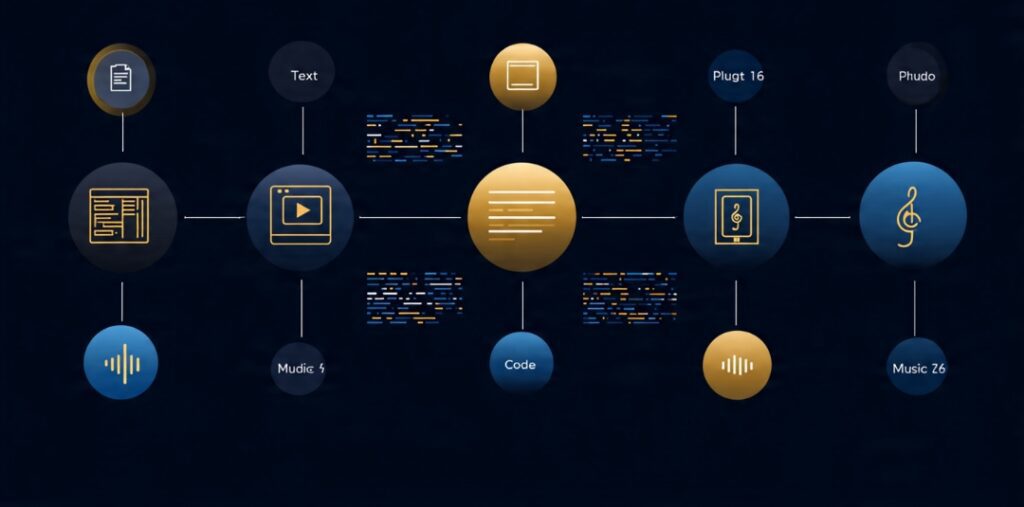
What unites all these types is the same core principle: each learned the deep patterns of its particular kind of content (text, images, audio, video, code) and can generate new examples that fit those patterns. The medium differs; the fundamental approach is the same.
— Data Pips Team
What Nobody Tells Beginners About Generative AI
1. It Generates Plausible Content, Not Necessarily True Content
Because generative AI creates content that fits learned patterns, it produces output that is plausible and well-formed — but not necessarily accurate. A text generator can write a confident, fluent paragraph containing false information, because its job is to generate plausible text, not verified truth. This is the root of “hallucinations.” Always remember: generative AI is optimized to produce content that looks right, which is not the same as content that is right. Our guide on why AI hallucinations happen explores this crucial limitation.
2. It Doesn’t “Understand” What It Creates
Generative AI produces remarkable content, but it does not understand its creations the way a human does. It is applying learned patterns, not consciously comprehending meaning. An AI can write a moving poem about grief without feeling or understanding grief; it generated words that fit the patterns of grief poetry. This distinction matters because it explains why generative AI can produce both brilliant and bizarrely flawed output — it is pattern-generation, not genuine understanding.
3. The Quality of Your Prompt Hugely Affects the Output
Because generative AI responds to your input by generating matching content, the clarity and detail of your request dramatically shape what you get. Vague prompts produce vague results; clear, specific, well-structured prompts produce far better output. This is why “prompt writing” has become a genuine skill — learning to communicate clearly with generative AI gets dramatically better results from the same tool.
4. It Reflects Its Training Data, Including the Flaws
Generative AI learned from human-created content, which means it absorbed and can reproduce the biases, errors, and limitations present in that data. The content it generates reflects the patterns of what it learned from — including the problematic patterns. This is why generated content should be reviewed thoughtfully rather than assumed to be neutral or perfect, and why the quality and composition of training data is such an important issue.
5. It’s a Tool That Amplifies the User
Generative AI is most powerful as a tool that amplifies human capability, not replaces human judgment. It can generate a draft, an image, or a starting point at incredible speed, but the human who directs it, refines it, and judges its quality remains essential. The people who benefit most are those who learn to use it skillfully as a collaborator — directing it well and applying their own judgment to its output. This kind of practical AI skill is exactly the sort of capability that compounds into real opportunity as these tools spread across every field.
Quick Action Steps
Now It’s Your Move
- Remember the core definition. Generative AI creates new content — text, images, audio, video, code — rather than just analyzing or sorting existing data. The key word is “generative.”
- Understand the shift from analyzing to creating. Older AI judged “what is this?” Generative AI answers “make me something new.” That shift is the whole revolution.
- Grasp how it creates. It learned the deep patterns of its training data so thoroughly that it can generate brand-new examples that fit those patterns — like a master chef inventing a new dish.
- Know the main types. Text, image, audio/music, video, and code generation. Different mediums, same underlying principle of learning patterns and generating new examples.
- Remember it generates plausible, not guaranteed-true, content. It produces output that looks right, which is not the same as right. Verify important factual content.
- Write better prompts. Clear, specific, detailed requests dramatically improve what generative AI produces. Learning to communicate with it well is a real skill.
- Use it as an amplifier. Generative AI is most powerful as a tool that amplifies your capability, with your judgment directing and refining its output.
Frequently Asked Questions
Generative AI is artificial intelligence that creates new content — like text, images, audio, video, or code — rather than just analyzing or sorting existing data. The key word is “generative”: it generates something new that did not exist before. This is different from older AI that mainly analyzed and classified things (like deciding if an email is spam or identifying whether a photo shows a cat). Instead of judging existing content, generative AI produces brand-new content in response to your request. Tools like ChatGPT (which generates text) and AI image generators (which create images from descriptions) are common examples of generative AI.
Generative AI works by learning the deep patterns of its training data so thoroughly that it can produce brand-new examples that fit those patterns. During training, it is shown an enormous amount of content and learns the underlying patterns — how words flow into sentences, what visual features make up objects, how music is structured. Once it has learned these patterns deeply enough, it can generate new content by applying them. Crucially, it is not copying and pasting existing content; it learned the principles so well that it can produce genuinely new combinations. Think of a master chef who absorbed the deep patterns of cooking and can invent an original dish that still follows the principles of good food.
The main difference is creating versus analyzing. Regular (analytical) AI looks at existing data and makes a judgment about it — classifying, predicting, or detecting, like deciding “is this spam?” or “what number is this?” It judges what already exists. Generative AI looks at a request and produces new content in response — writing text, creating images, composing music. It creates what does not yet exist. A simple way to remember: analytical AI answers “what is this?” while generative AI answers “make me something new.” Both are built on machine learning and both are valuable, but the recent explosion of public excitement about AI has been driven mostly by the generative kind, because creating content feels more revolutionary than sorting it.
Generative AI comes in several forms, each creating a different kind of content. Text generation powers AI chatbots and writing assistants that produce answers, essays, and stories. Image generation creates brand-new images from text descriptions. Audio and music generation produces realistic speech or original music. Video generation creates video content from descriptions, a rapidly developing area. Code generation writes computer programs from descriptions of what you want. What unites all these is the same principle: each learned the deep patterns of its particular content type and can generate new examples that fit those patterns. The medium differs, but the fundamental approach of learning patterns and generating new content is the same across all of them.
No — generative AI does not simply copy and paste existing content. Instead, it learned the underlying patterns of its training data so deeply that it can produce genuinely new combinations that follow those patterns. When it writes a story or creates an image, it is generating something original by applying learned principles, not retrieving a memorized copy. This is like a master chef who internalized the deep principles of cooking and can invent a brand-new dish, rather than just reproducing a memorized recipe. That said, because it learned from existing content, its output reflects the patterns and styles of its training data, and questions about originality and training data are important ongoing discussions in the field.
No. Generative AI creates content that fits learned patterns, which means it produces output that is plausible and well-formed but not necessarily accurate or true. A text generator can write a confident, fluent paragraph containing false information, because its job is to generate plausible-looking content, not verified truth. This is the root cause of “hallucinations,” where AI confidently states something false. The important takeaway is that generative AI is optimized to produce content that looks right, which is not the same as content that is right. For any important factual matters, you should independently verify what generative AI produces rather than assuming it is accurate just because it sounds confident and well-written.
Your prompt matters enormously because generative AI responds to your input by generating content that matches it. The clarity, detail, and structure of your request directly shape what you get back. Vague prompts produce vague, generic results, while clear, specific, well-structured prompts produce far better and more useful output. This is why “prompt writing” has become a genuine and valuable skill — learning to communicate clearly and specifically with generative AI gets dramatically better results from the exact same tool. Providing context, being specific about what you want, and structuring your request thoughtfully are simple ways to significantly improve the quality of what generative AI creates for you.
Now It’s Your Move
The technology that lets you type a sentence and receive a finished essay, a striking image, or working code — now you understand what it actually is. Generative AI is artificial intelligence that creates new content rather than just analyzing existing data. The key word is “generative”: it produces something new that never existed before. That shift, from computers sorting our world to computers creating within it, is the heart of the revolution you are living through.
You now understand the essential pieces: the difference from older analytical AI (which judged “what is this?” while generative AI answers “make me something new”); how it creates by learning the deep patterns of its training data so thoroughly that it can generate original examples that fit them; and the main types, from text to images to audio to video to code, all sharing that same core principle. Like the master chef who absorbed the principles of cooking and can invent a new dish, generative AI learned the patterns and applies them to create.
And just as importantly, you understand its real limits: it generates plausible content, not guaranteed-true content; it does not genuinely understand what it creates; and it reflects the data it learned from, flaws included. This balanced understanding — appreciating both the remarkable power and the genuine limitations — is exactly what makes you a wise, effective user rather than someone who either over-trusts or dismisses these tools.
Remember the core definition. Understand the shift from analyzing to creating. Grasp how it generates through learned patterns. Know the main types. Verify its factual output. Write clear prompts. And use it as an amplifier of your own capability, with your judgment guiding it.
You now understand the technology reshaping creativity, work, and communication across the world. Most people use generative AI without ever understanding what it is or how it works. You are no longer one of them — and that understanding is a real advantage in a world increasingly shaped by these tools.
For your next steps, deepen your understanding with our guides on what machine learning is (the foundation generative AI is built on), what an LLM is (the technology behind text generation), and how AI learns through training (the process that makes generation possible).