Key Takeaways
- The sunk cost trap is letting money already spent dictate future decisions — keeping things you should quit because of what you’ve already put in.
- Money that’s gone is gone. Past costs can’t be recovered, so they should have zero weight in what you do next.
- The brain hates admitting waste, so it keeps paying to avoid the feeling of having lost — which only deepens the loss.
- “Throwing good money after bad” is escalation — pouring more in to justify what you already poured in.
- The trap doesn’t just waste money — it traps your future, charging an ongoing opportunity cost for honoring the past.
- The only question that matters is: knowing what I know now, would I start this today?
The gym membership you haven’t used in eight months, but won’t cancel because you’ve “already paid so much.” The investment that’s bleeding, that you refuse to sell because you’re “waiting to at least break even.” The course you’re slogging through and hate, but have to finish because you paid for it. The car that needs another expensive repair, on top of the last three, because “I’ve already put so much into it.” The business or project that’s clearly failing, that you keep funding because “I can’t quit after everything I’ve invested.”
Every one of these is the same trap wearing a different costume. In each case, you’re making a decision about the future based on money that’s already gone — money you can never get back no matter what you do next. And that single logical error, repeated across a lifetime, quietly drains fortunes and traps people in things they should have walked away from years ago. It’s called the sunk cost trap, and it might be the most counterintuitive money mistake there is, because escaping it requires doing the one thing your brain screams against: walking away from money you’ve already spent.
So let’s break it down — why your brain clings to what’s already lost, why “I’ve come too far to quit” is a lie, and how to finally stop paying for things you should have left behind.
What the Sunk Cost Trap Actually Is
A sunk cost is any money, time, or effort you’ve already spent and cannot recover. The sunk cost fallacy is the trap of letting those unrecoverable past costs drive your future decisions — continuing something purely because of what you’ve already invested, rather than because it makes sense going forward.
Here’s the logic that exposes it. When you’re deciding what to do next, only two things should matter: the future costs and the future benefits from this point onward. What you’ve already spent is identical no matter what you choose now — it’s gone in every possible version of the future. So it is, by definition, irrelevant to the decision. Whether you keep going or quit, the past money stays spent. The only real question is whether continuing from here is worth it on its own merits. But the brain refuses to think this way. It drags the dead, spent money into the decision and lets it vote — and that vote is almost always “keep going, so it wasn’t wasted.”
“The money you already spent is gone in every version of the future. Letting it decide what you do next is letting a ghost run your finances.”
This is why the sunk cost trap is so insidious: the very thing your brain treats as the strongest reason to continue — “I’ve put so much in” — is actually the one piece of information that should carry no weight at all. The more you’ve sunk, the louder the fallacy screams, and the deeper the hole gets.
Why Your Brain Can’t Let Go of What’s Already Gone
If sunk costs are so obviously irrelevant, why does almost every human fall for this? Because the trap isn’t about logic — it’s about a feeling your brain desperately wants to avoid: the pain of admitting waste.
The moment you quit, you’re forced to face the loss head-on. Cancelling the gym membership means admitting the money was wasted. Selling the losing investment means locking in the loss and conceding you were wrong. Walking away from the failing project means accepting that everything you poured in is gone. So the brain does something sneaky: it keeps the thing alive to avoid that painful admission. As long as you don’t quit, you can tell yourself it might still work out, that the money isn’t really wasted yet. Continuing becomes a way to dodge the feeling of loss — even though continuing usually makes the loss bigger.
This is closely tied to how powerfully humans hate losing, an instinct so strong it deserves its own discussion — the pain of a loss looms far larger than the pleasure of an equal gain, a force known as loss aversion. The sunk cost trap is loss aversion in action: you keep paying not because continuing is wise, but because stopping would force you to feel the loss you’ve been avoiding. There’s also ego in it — quitting means admitting a mistake, and the brain protects its self-image by refusing to concede error. Together, the fear of feeling the loss and the fear of admitting the mistake keep you chained to things long past the point where any rational person would have walked.
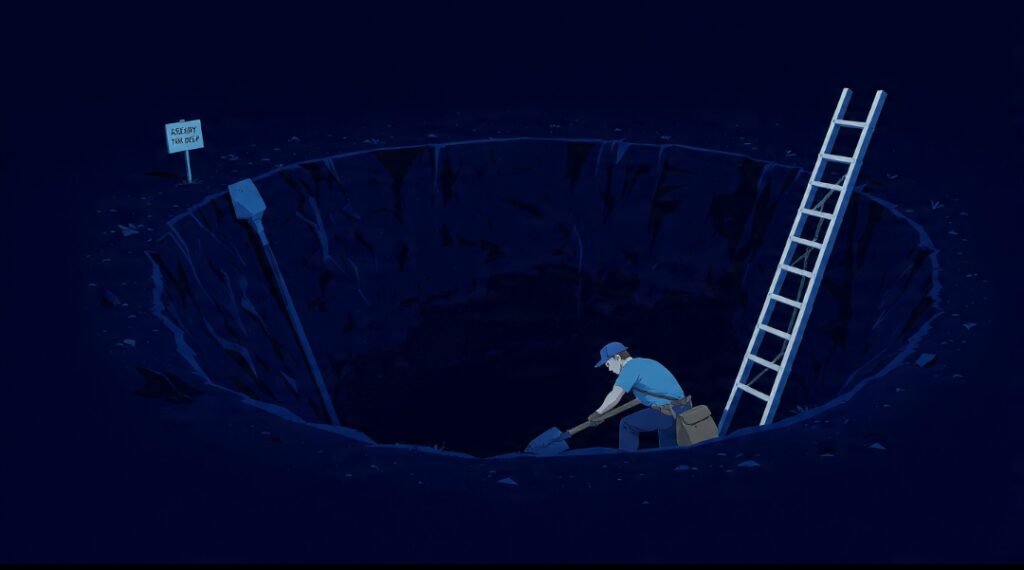
Escalation: Throwing Good Money After Bad
The sunk cost trap has an even more dangerous form, where it doesn’t just make you hold on — it makes you pour more in. This is called escalation of commitment, and it’s where the real damage happens.
It works like this: you’ve invested in something that’s failing, and instead of cutting your losses, you invest more to try to save what you’ve already put in — to make the original investment “worth it.” The car that’s already cost you a fortune in repairs gets one more expensive fix, because surely now it’ll be reliable. The failing venture gets another injection of cash, because you’re “so close” and can’t let the previous money be for nothing. Each new investment is justified by the previous ones, and so the hole deepens with every attempt to climb out of it. You’re throwing good money after bad — the textbook recipe for value-destroying bad debt — and the bad money you already threw is the very thing convincing you to throw more.
This is the trap at its most ruinous, because it converts a contained loss into an open-ended one. The rational move — accept the loss, stop, walk away — feels impossible precisely because of how much you’ve already sunk. So people ride failing things all the way down, adding more and more, until the loss is catastrophic instead of merely painful. The escalation feels like determination and grit. It’s actually the fallacy, dressed up as perseverance, marching you off a cliff.
“Refusing to quit isn’t always strength. Sometimes it’s just the sunk cost fallacy wearing the costume of perseverance, walking you deeper into a loss you could have stopped.”
Traders know this one intimately. The refusal to take a stop loss — holding a losing position, even adding to it, hoping it comes back to “break even” rather than accepting the loss — is the sunk cost trap in its purest, most expensive form. It’s the same psychology we examined in why traders confuse being right with being profitable: the need to not be wrong overrides the math, and a small manageable loss escalates into a devastating one. Whether it’s a trade, a car, or a career, the mechanism is identical.
What Nobody Tells You: The Trap Steals Your Future, Not Just Your Past

Here’s the part that makes the sunk cost trap far more expensive than it looks. People think the cost of staying in a bad thing is the money they already lost. It isn’t — that money is gone either way. The real, ongoing cost is the opportunity cost: every day you stay chained to the failing thing, you’re not free to put your money, time, and energy into something that could actually grow. It’s the same way the present bias trap robs your future self — except here you’re robbing tomorrow to protect a loss that’s already in the past.
Look at the math of a held-onto loser. Say an investment has dropped from $10,000 to $6,000. The $4,000 loss is sunk — gone, irrelevant. But the sunk cost trap whispers “hold until it gets back to $10,000,” so you leave the $6,000 stuck in a dead asset. Meanwhile, that same $6,000 redeployed into something that grows at a steady 7% would become roughly $11,800 over ten years — pure illustrative arithmetic. So the trap doesn’t just cost you the $4,000 you already lost. It costs you the $5,800 of growth the surviving $6,000 could have earned elsewhere. You’re not just honoring a dead loss; you’re sacrificing a living future to do it. The past money is the bait; your future is the actual price.
And this is why “waiting to break even” is the single deadliest form of the trap. Break-even is an emotional finish line, not a financial one. The asset doesn’t know or care what you paid for it; it will go where it goes regardless. Demanding that a position return to your purchase price before you’ll act is letting an arbitrary number from the past hold your future hostage. The market never promised to give you your money back, and waiting for it to “make you whole” can keep you stuck for years while better opportunities pass by untouched.
The Wrong Train Principle
There’s a piece of hard-won wisdom that cuts straight through the sunk cost trap, and it’s worth keeping in your pocket for the rest of your life: if you realize you’ve boarded the wrong train, get off at the very first station. Don’t ride it to the next one hoping it’ll somehow turn around. Don’t tell yourself that since you’ve already traveled this far in the wrong direction, you might as well keep going. The longer you stay on the wrong train, the more expensive the journey back becomes — every additional stop is more distance to retrace, more time lost, more cost to undo.
The power of this principle is that it reframes quitting entirely. Getting off the wrong train isn’t failure or weakness — it’s the single smartest, most disciplined move available, and the people who do it early are the ones who win in the long run. They recognize the mistake fast and exit fast, while everyone else rides their wrong trains for years out of pride and the refusal to “waste” the distance already covered. Notice the trap hidden inside this, though: the same instinct that says “I’ve come too far to turn back” is exactly the sunk cost fallacy talking. The distance already traveled in the wrong direction is precisely the thing that should carry no weight in deciding whether to keep going. A wrong train is a wrong train whether you’ve ridden it one stop or fifty — and the fifty-stop version is just a far more expensive reason to finally get off.
This principle applies everywhere money flows: a failing investment, a draining subscription, a money pit of a possession, a business that isn’t working, even a career path. The discipline is the same one that separates professionals from gamblers in trading — the willingness to take the small loss now to avoid the catastrophic one later, which we broke down in moving from gambler to professional through mechanical discipline. Cutting a loss early always feels worse in the moment and is almost always better in the end.
How to Escape the Sunk Cost Trap
You beat this trap by training yourself to ignore the past and judge only the future. Here’s how.

1. Ask the fresh-start question. The single most powerful tool: for anything you’re continuing, ask “knowing what I know now, if I were starting fresh today with none of this already invested, would I choose to start this?” If the answer is no, the only thing keeping you in it is sunk cost — and that’s not a reason. This question instantly strips away the past and forces a clean, forward-looking decision.
2. Consciously label the sunk cost as gone. Name it out loud: “That money is already spent. It’s gone in every scenario. It is not part of this decision.” Saying it explicitly disarms the brain’s instinct to drag the past into the present. The loss already happened; refusing to quit doesn’t undo it, it just adds to it.
3. Separate the decision from your identity. Quitting feels like admitting “I’m a failure” or “I was wrong.” Reframe it: changing course based on new information isn’t failure, it’s intelligence. The smartest people change their minds when the facts change. Cutting a loss isn’t a verdict on you as a person — it’s just good math, and protecting your ego at your wallet’s expense is a terrible trade. Often the urge to never look wrong traces back to the deeper beliefs we unpacked in money scripts.
4. Set exit rules in advance. Decide your quit conditions before you’re emotionally entangled — a maximum you’ll spend on repairs, a price at which you’ll sell, a deadline by which a venture must show results. Pre-set rules made by calm, rational you protect you from the trapped, escalating you who can’t see straight in the moment. This is exactly how disciplined investors avoid riding losers down, the same logic behind protecting yourself from emotional interference in your financial decisions.
5. Reframe walking away as winning. Every dollar and hour you stop pouring into a dead thing is a dollar and hour freed to go somewhere alive. Quitting the wrong thing isn’t a loss — it’s the moment you stop bleeding and start redirecting your resources toward things that actually pay you. The fastest way to a better future is often to stop funding a worse one — the same freed money that, protected from lifestyle creep, becomes the engine of real wealth.
| Sunk cost thinking | Rational thinking |
|---|---|
| “I’ve already put so much in” | “What’s the best move from here?” |
| Waits to “break even” before acting | Ignores the purchase price entirely |
| Pours more in to justify the past | Stops the bleeding immediately |
| Quitting feels like admitting failure | Quitting is updating on new facts |
| Honors the dead past | Protects the living future |
Now It’s Your Move
The sunk cost trap is one of the quietest ways money and years drain out of a life — not in dramatic disasters, but in the slow refusal to walk away from things that stopped being worth it long ago. The good news is that the escape is always available, in every single case, the instant you accept one liberating fact: the past is already paid, and nothing you do now can refund it. All you can decide is the future. So decide it on its own merits.
- Run the fresh-start audit. List the things you’re continuing out of “I’ve already invested so much.” For each, ask whether you’d start it today from scratch. The no’s are your exit list.
- Name one sunk cost as gone. Pick one and say it plainly: that money is spent, it’s irrelevant, and it doesn’t get a vote in what I do next.
- Cut one loss this week. Cancel the unused subscription, sell the dead asset, end the draining thing. Feel how much lighter freed resources are than honored losses.
- Set an exit rule going forward. For anything ongoing, decide now the condition under which you’ll walk away — before emotion clouds the call.
- Reframe your next quit as a win. The next time you walk away from a wrong train, count it as the disciplined victory it is, not a failure.
You can’t get back what you’ve already spent — on the bad investment, the dying car, the failing project, the wrong path. That money and time are gone, and no amount of staying will bring them back. But you can stop the bleeding right now, and redirect everything you have left toward a future worth building. The wrong train is still moving. The only question is how many more stops you’ll ride before you finally get off.
The sunk cost trap is the tendency to let money, time, or effort already spent and unrecoverable drive your future decisions, causing you to continue things you should quit. Because past costs are gone no matter what you choose next, they should carry no weight in forward decisions, yet the brain treats them as a reason to keep going. The result is people stay in failing investments, unused subscriptions, and draining ventures purely because of what they have already put in.
Because quitting forces you to face the loss directly and admit the money or effort was wasted, which is painful, while continuing lets you avoid that admission by telling yourself it might still work out. This is driven by loss aversion, since the pain of a loss feels larger than the pleasure of an equal gain, and by ego, since stopping means conceding a mistake. Together these make people cling to things long past the point where quitting is clearly the better choice.
Escalation of commitment is the more dangerous form of the sunk cost trap, where instead of just holding on, you invest even more to try to save what you have already put in. Each new investment is justified by the previous ones, so the hole deepens with every attempt to climb out. This converts a contained loss into an open-ended one, as people ride failing things all the way down while mistaking the fallacy for perseverance and determination.
Because break-even is an emotional finish line based on what you paid, not a financial one based on what the asset will actually do. The investment does not know or care about your purchase price and will move where it moves regardless. Demanding it return to that price before you act lets an arbitrary past number hold your future hostage, often keeping you stuck for years in a dead asset while better opportunities for that money pass by untouched.
The most powerful one is: knowing what I know now, if I were starting fresh today with none of this already invested, would I choose to start this? If the answer is no, then the only thing keeping you in it is sunk cost, which is not a valid reason to continue. This fresh-start question strips away the weight of the past and forces a clean decision based purely on the future costs and benefits from this point onward.
Very much so. Refusing to take a stop loss, holding a losing position, or adding to it hoping it returns to break-even rather than accepting the loss is the sunk cost trap in its purest form. The need to avoid admitting a loss overrides the math, and a small manageable loss can escalate into a devastating one. Disciplined investors counter this by setting exit rules in advance and judging positions on their future prospects, not on the entry price.
Not when the thing has genuinely stopped being worth it going forward. Changing course based on new information is intelligence, not weakness, and the smartest people update their decisions when the facts change. Walking away from something that no longer makes sense frees your money, time, and energy to go toward things that can actually grow. The real failure is riding a wrong choice down for years out of pride rather than cutting the loss early.
Disclaimer: This article is for educational and informational purposes only and does not constitute financial, investment, or legal advice. The numerical examples shown are simplified arithmetic illustrations, not predictions, promises, or guarantees of any specific return. All investing involves risk, including the loss of capital, and individual circumstances vary. Always do your own research and consult a qualified financial professional before making money decisions.