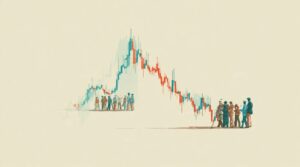
Two months into a killer forex streak — up 40% on gold pairs. I felt invincible. Then one Tuesday, I doubled my lot size on a “sure thing” EUR/USD trade after a small pullback. Within 48 hours, the account was at zero. That was me — a profitable trader who still managed to blow an account.
If you have nailed your strategies but keep resetting back to demo, you are not alone. It is not the charts. It is the head game that nobody talks about honestly. Today, from my own trading scars, I am going to break down exactly why traders blow accounts — even experienced ones — and what you can do to protect yourself for good.

What Does Blowing an Account Really Mean?
Blowing an account means your balance hits zero — or close enough to zero that it cannot function. Not a bad week. Not a drawdown. A total wipeout.
In trading, this is called an account blowup. It happens to beginners, yes. But profitable traders? Them too. Why? Because trading psychology can turn a solid edge into a crater faster than any losing strategy ever could.
As BabyPips explains, most blowups come from emotion rather than strategy. Their trader failure guide is worth reading if you haven’t already.
Real Numbers
- Over 70% of retail forex traders lose money — and many of those who are temporarily profitable cycle through blowups repeatedly, according to broker disclosures.
- The most damaging pattern is not the beginner who loses slowly. It is the experienced trader who wins big, then loses even bigger in a single emotional episode.
The Myth: Profitable Traders Don’t Blow Accounts
I have hit 70% win rates on gold setups. I have still blown three accounts. A profitable streak does not protect you — it often makes you more vulnerable because it inflates your confidence without changing your risk habits.
The illusion is: “I’ve got this now.” But the market has no memory of your last winning month. The moment your psychology slips, even a solid strategy becomes dangerous in your hands.
Trap 1: Overconfidence After Wins
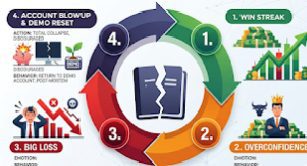
Win a streak and your brain floods with dopamine. You start feeling like you have cracked the market. Lot sizes creep up. Stop losses get moved. Risk rules get bent — just this once.
My own example: In early 2025, I ran a strong series of silver shorts — up 25% over six weeks. On the next trade I skipped my 1% risk rule because the setup “looked perfect.” Down 15% in one session. It snowballed from there.
Why Overconfidence Hits So Hard
- Recency bias: Recent wins make you blind to the statistical reality of your edge.
- Size illusion: “It worked before, so I should go bigger” is how most accounts die.
- Outcome: One oversized bad trade can erase months of disciplined gains in hours.
Mark Douglas warns about this directly in Trading in the Zone — your beliefs about the market shape your results more than any indicator. Investopedia’s trading psychology guide covers the same ground with practical examples.
Trap 2: Revenge Trading Kills Quietly
You lose a trade. Anger and frustration kick in immediately. “I’ll get it back right now.” So you re-enter the market at double the size without a proper setup. This is revenge trading — and it is one of the fastest ways to turn a manageable loss into a blown account.
I did this after a GBP/USD stop-out during a Fed news release. I jumped back in with a larger position out of frustration. By end of day the account was gone. It did not feel like a mistake in the moment — it felt like the right thing to do. That is what makes it so dangerous.
- Triggers: Unexpected market moves, stop hunts, news spikes.
- Cost: Turns a 2% loss into a 20% loss within one session.
- The fix: Walk away from the screen. Physically leave the room. Make it a rule, not a suggestion.
Trap 3: FOMO and Overtrading
FOMO — fear of missing out — makes you jump into trades that were never part of your plan. You see a strong XAU/USD move happening and you enter late with no confluence, no clear stop, and no real reason except that the candle is moving.
My worst period was in 2024 when crypto hype started bleeding into my forex mindset. I went from three structured trades per day to five or six impulsive ones. The overtrading created drawdown that took months to recover from.
Signs You Are Overtrading
- You are taking more trades than your plan allows.
- You are chasing moves after the session has already closed.
- You are entering without waiting for your full confluence checklist.
The market will always have another setup tomorrow. The account you blow today will not come back on its own.
Trap 4: Experience Hides Bad Risk Habits
This is the trap that catches experienced traders specifically. You have been profitable for a while so you start skipping the basics. No journal. No position sizing recalculation as the account grows. No systematic review.
A trading friend of mine had a consistent 60% win rate on stocks. He blew up when his account grew — because he kept his lot sizes fixed instead of scaling them proportionally. What was a manageable 1% risk at $5,000 became a 10% risk at $50,000 without him realizing it.
Risk management is not something you set up once and forget. It requires constant recalibration as your account size and market conditions change.
My Brutal Story: From 40% Gains to Zero
Early 2025. I had been nailing inflation-driven gold trades for two months straight — up 40%. I felt sharp, confident, and certain about where things were heading.
Then OPEC news flipped oil pairs unexpectedly. I took a small loss. Instead of accepting it and stepping back, I combined revenge trading with FOMO and re-entered at five times my normal size. The account was gone within 48 hours.
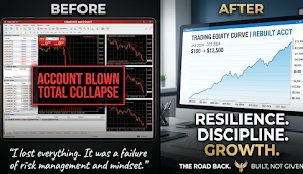
What followed was one of the most important months of my trading career. I walked away completely for thirty days. Then I came back and journaled every single psychological trigger from that period. I rebuilt with 0.5% risk per trade. Now I run consistent 5-10% monthly returns — not because my strategy changed, but because my psychology did.
The TradingView psychology community helped me during that rebuild. Real traders sharing real mistakes — worth following.
Fix It: Psychology Hacks That Stick
These are not motivational tips. These are the exact rules I rebuilt my trading around after losing everything:
- Journal ruthlessly: Log every trade with the emotion you felt before entering. Review weekly for patterns. The data will show you things you cannot see in the moment.
- Hard rules with no exceptions: 1% maximum risk per trade. Auto stop-losses on every position. A 24-hour cooldown after any revenge trading urge.
- Mindset drills: Daily affirmations sound soft until you realize elite athletes use them consistently. Visualize losing trades and your calm response to them — not just the wins.
- Accountability partner: Share your P&L weekly with another trader who will be honest with you. Shame is a powerful deterrent when it is shared.
- Scale smart: Only move profits to a new account after three consecutive months of disciplined, green trading. Not before.
“The market can remain irrational longer than you can remain solvent.”— John Maynard Keynes
Pro Tips from the Forex Trenches
- Pre-trade checklist: Before every trade ask yourself two questions — “Am I emotionally tilted right now?” and “Is my plan fully solid?” If either answer is no, do not enter.
- Demo for revenge urges: When you feel the urge to revenge trade, open a demo account and do it there. Let the emotion play out without risking real capital.
- Weekly psychology rating: After each week, rate your psychological state per trade on a scale of 1 to 10. Over time this data becomes invaluable.
- The 5% rule: If you are down 5% in a week, step away from screens for 48 hours. Non-negotiable. The market will still be there when you return.
Key Takeaways: Quick Action Steps
- Open your trading journal right now and log the emotions from your last 10 trades.
- Set a hard 1% risk limit on your next trade — no exceptions.
- Pick one psychology hack from this article and test it this week.
- Find a trading accountability partner before your next session.
- Read Trading in the Zone by Mark Douglas this month — it will change how you see every trade.
FAQ: Why Traders Blow Accounts
1. Why do profitable traders still blow accounts?
Because trading psychology — overconfidence, revenge trading, and FOMO — can override even a solid, proven strategy. Knowledge of the market does not automatically translate into emotional discipline at the trading terminal.
2. What is revenge trading and how do I stop it?
Revenge trading is re-entering the market out of frustration after a loss, usually with a larger position and no proper setup. The fix is a mandatory 24-hour cooldown rule after any loss that triggers emotional response. No exceptions.
3. Can trading psychology actually be fixed?
Yes — but it takes deliberate practice, not just awareness. Journaling, hard rules, accountability, and consistent review are what rebuild psychology over time. My own rebuild took about six months to reach genuine consistency.
4. How much should I risk per trade?
Never more than 1-2% of your total account balance per trade. This scales as the account grows but the percentage stays fixed. Changing this rule is how most blowups start.
5. Is overtrading the main cause of blown accounts?
It is one of the top three alongside revenge trading and poor position sizing. Check your journal — if you are taking more trades than your plan allows, that is your answer.
6. What is the best book for trading psychology?
Trading in the Zone by Mark Douglas. It is the most honest and practical book on trader psychology ever written. Read it, then read it again after your next losing streak.
7. How do I avoid FOMO in forex and gold trading?
Stick to your setup checklist. If the trade does not meet all your criteria, you do not enter — no matter how strong the move looks. There will always be another setup. There will not always be another account.
Stop the Cycle — Start Trading With Discipline
You have seen the traps. You know what they look like. Now pick one fix and apply it before your next session — not next week, today.
Drop a comment below with your biggest psychological slip in trading. And follow DataPips for more honest content on forex, gold trading, and the mindset work that actually produces consistent results.
About the Author: Shurah Beel Hamid
Trader, entrepreneur, and content creator. Shurah shares real experience in forex and stock trading, gold investment strategies, trading psychology, and elite mindset development — no theory, just what actually works from years in the market.
Disclaimer: This article is for educational purposes only and does not constitute financial advice. Trading involves substantial risk of loss. Past results do not guarantee future performance. Always consult a professional before making financial decisions.