In the history of human thought, few names command as much respect as Socrates. While many know him as the father of Western philosophy, for me he is something more personal — a mentor I found through an audiobook that arrived at exactly the right moment in my life.
After diving deep into “Socrates’ Philosophy Will Change Your Life,” I realized that his teachings are not just for textbooks or university lecture halls. They are a survival guide for the modern world — for traders, entrepreneurs, and anyone trying to build something real in a world full of noise and distraction.
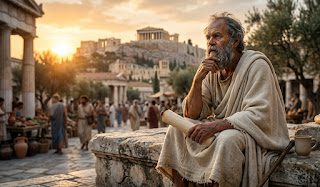
Here is how his wisdom changed my perspective — and why it might change yours too.
1. The Power of Not Knowing
Before I encountered Socrates, I felt constant pressure to always have the answers. In business, in trading, in life — admitting uncertainty felt like weakness. It felt like something that would cost me credibility or respect.
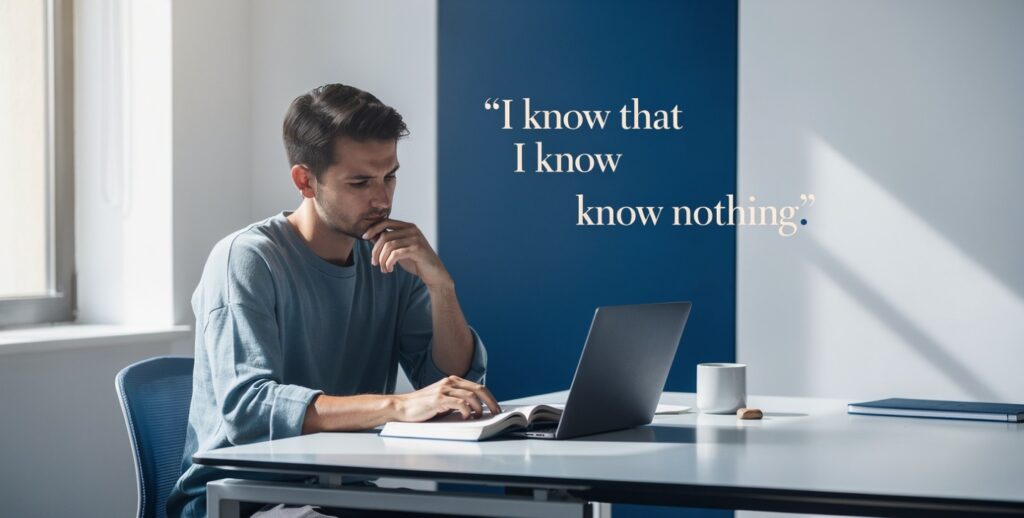
Then I encountered his famous paradox: “I know that I know nothing.”
This single statement gave me something I did not expect: freedom. The freedom to be wrong. The freedom to keep learning. The freedom to approach every situation as a student rather than performing the role of an expert I had not yet earned.
In my own journey, embracing this humility has saved me from ego-driven mistakes that once cost me real money and real time. The trader who thinks he knows everything stops studying. The entrepreneur who is certain he has all the answers stops listening. Both eventually pay for that certainty in ways they did not anticipate.
As Stanford Encyclopedia of Philosophy documents, Socratic humility was not false modesty — it was a genuine epistemic position that made continuous learning not just possible but inevitable. That is the real competitive edge: the willingness to always be a student.
2. Learning the Art of Questioning
One of the most practical changes Socrates introduced to my life was the Socratic Method — the disciplined practice of asking deep, honest questions rather than accepting surface-level explanations.
I used to accept things as they were. A trading strategy was working, so I did not question it. A habit was comfortable, so I did not examine it. A relationship felt familiar, so I did not evaluate it. Socrates showed me that this passive acceptance is not peace — it is stagnation disguised as stability.
I started asking “Why?” and “How?” about everything. My trading habits. My business decisions. The advice I was receiving. The beliefs I had never consciously chosen. By stripping away assumptions and demanding honest answers, I found clarity that no amount of information consumption had previously given me.
Questioning is not cynicism. It is the most direct path to clarity. And in trading especially, clarity is the difference between a disciplined decision and an emotional one.
3. The Gadfly Within: My Wake-Up Call
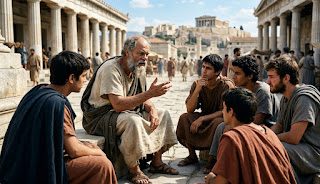
Socrates described himself as a “Gadfly” — an irritant sent to sting the citizens of Athens out of their comfortable complacency. Without him, he argued, they would drift into intellectual sleep, never questioning the assumptions that governed their lives.
Reading his story was my own sting. It made me realize how much of my life I was living on autopilot — following the crowd not because I had evaluated their direction but simply because movement felt like progress.
I made a decision after reading this: to become my own gadfly. To regularly question my own routines, my own assumptions, my own strategies. Not to be contrarian for its own sake, but to ensure that every significant choice in my life was genuinely mine — made consciously, not inherited by default.
This practice, applied to trading, means regularly reviewing not just your results but your process. Are you following your rules because they work, or because you have always followed them? Is your strategy still valid, or has the market evolved while your approach remained static? The gadfly asks these questions not to create doubt but to create genuine confidence — the kind built on honest examination rather than comfortable assumption.
4. The Examined Life
The quote that hit me the hardest was simple and absolute:
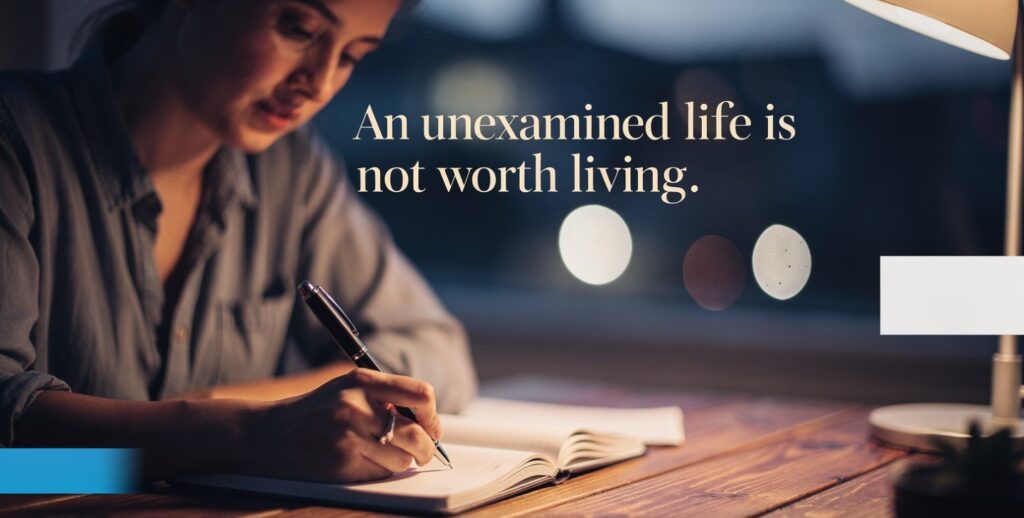
“An unexamined life is not worth living.”
This sentence changed my daily routine. I began auditing my life the way a serious trader audits their journal — honestly, without ego, looking for patterns that needed to change.
I started asking myself every week: are my daily actions actually moving me toward my long-term vision? Or am I staying busy while mistaking activity for progress? This distinction — between motion and direction — is one of the most important separations a person can make.
The examined life, as Psychology Today explores in depth, is not about constant self-criticism. It is about self-awareness. It is about making your choices consciously rather than by default. In practice, it means journaling, reflecting, and periodically stepping back from the urgency of daily activity to ask whether the direction is still right.
5. Integrity Over Everything
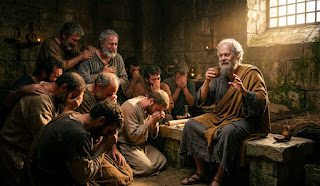
Socrates was eventually sentenced to death for his teachings. His crime was, essentially, asking too many honest questions and refusing to stop. Given multiple opportunities to escape, to apologize, or to simply agree to be silent, he refused every one of them.
He chose to drink the hemlock rather than betray his principles. He proved, through the most irreversible act possible, that a person’s character is more valuable than their physical survival.
This lesson lands differently when you apply it to modern life. You will face moments where the easier path is to compromise what you know to be true — in business, in relationships, in trading. Where cutting a corner would save time or discomfort. Where pretending not to know something would avoid a difficult conversation.
Socrates’ choice is the permanent answer to those moments. Success without integrity is a failure that has not yet fully arrived. The compromises that seem small in the moment compound over time into a character you no longer recognize — and a life built on a foundation that cannot hold weight.
Whether it is a small business deal or a major life decision, staying true to your values is the ultimate form of long-term strength.
6. Applying Socratic Philosophy to Trading and Business
For traders and entrepreneurs specifically, Socratic principles are not abstract philosophy — they are practical tools:
- Before every trade: Ask “Why am I entering this?” If the honest answer is FOMO, boredom, or hope rather than a clear technical reason — that is the Socratic method telling you to stay out.
- After every loss: Ask “What did I actually learn?” Not what you felt, but what the data shows. The examined loss is the foundation of consistent improvement.
- In business decisions: Ask “Why do I believe this will work?” Strip away the assumptions and examine the actual evidence. The business that survives is the one built on honest assessment, not optimism.
- About your habits: Ask “Are these habits actually serving where I want to go?” Most people never ask this question. The ones who do are the ones who actually change.
Frequently Asked Questions
Q: How can Socrates’ philosophy help a modern trader or entrepreneur?
The Socratic method — questioning assumptions, embracing humility, and examining decisions honestly — directly counters the emotional biases that destroy trading accounts and business decisions. It builds the kind of clarity that emotional reactivity destroys.
Q: What is the Socratic Method and how do I apply it daily?
The Socratic Method is the practice of questioning beliefs and assumptions through dialogue — asking “Why?” and “How?” until you reach the honest core of any position. Applied daily, it means regularly examining your habits, decisions, and beliefs rather than accepting them on autopilot.
Q: What does “an unexamined life is not worth living” mean practically?
It means making your choices consciously rather than by default. Practically: journaling regularly, reviewing your actions weekly against your stated goals, and periodically stepping back to ask whether your direction is still aligned with your genuine values — not just your immediate comfort.
Q: Why did Socrates choose death over compromise?
He believed that compromising his principles to survive would be a form of spiritual death that was worse than physical death. For him, the value of a life was in its integrity and its commitment to truth — not in its length. He chose the quality of his character over the continuity of his existence.
Q: Is intellectual humility a weakness in competitive environments like trading?
The opposite is true. The trader who believes they have nothing left to learn stops adapting. Markets evolve constantly. The trader who approaches every session as a student — genuinely open to being wrong — continues to improve. Intellectual humility is one of the most durable competitive advantages in any field.
Q: Where can I learn more about Socratic philosophy?
Start with Plato’s dialogues — particularly the Apology, which documents Socrates’ trial and his refusal to compromise. The Stanford Encyclopedia of Philosophy provides an excellent modern academic overview. And audiobooks on Socratic philosophy are an accessible starting point for those new to the subject.
Final Thoughts
Socrates did not just give me knowledge. He gave me a new way to exist — a framework for making decisions that are genuinely mine rather than inherited from the noise around me.
By embracing humility, asking the right questions, and living with intention rather than autopilot, I transformed a mindset that was previously reactive and ego-driven into one that is patient, curious, and honest.
As I reflect on his final moments, one thought stays with me:
“If Socrates had not drunk the poison, he would have truly died.”
By choosing to die for his principles, he ensured that his wisdom would live forever. If he had compromised to save his body, his message would have perished with the compromise. Today, he lives on in every person who dares to ask “Why?”
Are you living an examined life — or are you just following the crowd?
About the Author
Shurah Beel Hamid is a business enthusiast, active trader, and content creator who transformed his life by training his brain from an electrician’s mindset to an entrepreneur’s mindset. His expertise lies in practical brain training for entrepreneurship, trading psychology, compounding strategies, and elite mindset development. He shares his raw, unfiltered journey — from suicidal thoughts to strategic patience, from blowing trading accounts to consistent profitability — to provide actionable insights for those tired of theoretical advice and ready for real change. His writing combines hard-won experience, neuroscience-backed techniques, and relentless optimism.
Disclaimer: This article is for educational and informational purposes only.