In 1978, I was 19 years old. No company. No capital. No guarantee of anything.
But I made a decision — a quiet personal promise — that would later become the single biggest competitive advantage of my entire business life.
“If I ever run my own company, I will hire people under pressure — freshers hungry to prove themselves — not experienced professionals who come with a heavy price tag and a fixed mindset.”
That was my promise at 19. And I kept it.
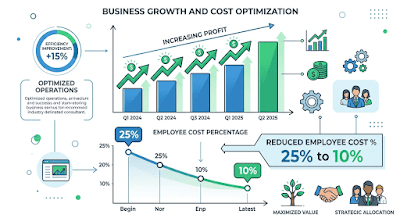
Today, my competitors spend 25% of their revenue on employee costs. Mine? Just 10%. That 15% gap — every single year — is not luck. It is a strategy. In this article, I will break it down completely.

The Riddle That Explains It All
Let me start with a riddle.
Take a long hair. Tie a knot in it. Throw it over a mountain.
If the hair comes back — the mountain is gone. If the mountain comes back — the hair is gone.
What does this mean for business? Simple. Some things cannot coexist. You cannot have ultra-low employee costs AND pay high experienced-professional salaries at the same time. You must choose — the mountain or the hair.
I chose the hair. The mountain of bloated employee costs never came back.
The Numbers That Tell the Story
My competitor’s employee cost: 25% of revenue. Mine: 10% of revenue.
On a business earning $500,000 per year, that is a saving of $75,000 every single year. That money goes back into growth, better pricing for customers, and business resilience during slow seasons.
This is not a small difference. This is the difference between surviving and thriving.
According to research by Harvard Business Review, the cost of hiring an experienced professional — including recruitment, onboarding, and the learning curve — can be 50 to 200% of their annual salary. Freshers, hired and developed internally, eliminate most of that hidden cost entirely.
Why Freshers Under Pressure Outperform Experienced Hires
The key word in my 1978 decision was not just “fresher.” It was under pressure.
A person who is hungry — who needs to prove themselves, who has everything to gain — shows up differently every single day. They do not clock-watch. They do not say “that is not my job.” They do not compare your company to their last employer.
Here is the honest comparison:

| Factor | Experienced Hire | Fresher Under Pressure |
|---|---|---|
| Salary Expectation | High | Low to moderate |
| Adaptability | Often rigid, set in their ways | Highly flexible, eager to learn |
| Company Culture | Brings old habits and mindsets | Shaped by your culture from Day 1 |
| Loyalty | May leave for a better offer quickly | Often deeply loyal — you gave them their start |
| Innovation | Relies on proven methods | Questions everything, brings fresh eyes |
| Employee Cost | ~25% of revenue | As low as 10% with the right system |
How to Make This Strategy Work: 5 Rules
This strategy only works if you follow a system. Here is what I learned over the decades.
Rule 1: Build a Training System — Not Just a Job Description
Freshers arrive with energy but no direction. Your job is to channel that energy. Build a clear 30-to-90-day onboarding program. Document your processes. Create checklists. Assign your best current employees as mentors to every new hire.
Tip: Your best current employee is your best trainer for the next hire. Build a “teach what you know” culture from day one. This compounds over time — each generation of trained employees becomes the trainer for the next.
Hiring is delegation in disguise — and why refusing to delegate caps your growth shows what it costs when the owner can’t step away for a week. That week-off test is the starting point of working on the business, not in it — the systems approach that turns delegation from a hope into a company habit.
Rule 2: Hire for Attitude, Train for Skill
Skills can be taught. Attitude cannot. In every interview, look for genuine hunger to grow, the ability to take feedback without ego, honesty about gaps in knowledge, and a track record of taking initiative — even in small personal things.
As Inc. Magazine has consistently reported, companies that hire for attitude and train for skill outperform those that hire for credentials alone — both in retention and long-term output.
Rule 3: Create Clear Career Pathways
Freshers stay loyal when they can see their future. Show every new hire where they can be in 1 year, 3 years, and 5 years inside your company. A person who sees a future with you will not leave for a small salary bump elsewhere.
This is the most underrated retention tool available to any business owner — and it costs nothing except clarity and commitment.
Rule 4: Use Pressure as Fuel — Not Punishment
Under pressure means challenged, not crushed. Give freshers real responsibility early. Nothing develops talent faster than genuine accountability paired with genuine support and mentorship.
Warning: High pressure without support creates burnout and fast turnover. Always pair challenge with clear goals and regular recognition. The fuel analogy works both ways — pressure without oxygen extinguishes the flame.
Rule 5: Retain Your Best Before a Competitor Does
Your top freshers will eventually become experienced. When that day comes — keep them. A loyal, trained employee who knows your culture and your systems is worth far more than any external experienced hire at three times the cost.
Retention at this stage is the final step that makes the entire strategy compound. You are not just saving on hiring costs — you are building institutional knowledge that competitors cannot replicate.
Real Companies That Win With This Strategy
This is not just one person’s philosophy. The pattern shows up across some of the most successful companies in history.
Facebook in its early days prioritized fresh graduates with little or no corporate experience. The result was a culture of bold innovation that moved faster than any competitor built on conventional hiring.
Japanese corporations have hired fresh university graduates and built them internally for decades, creating some of the most loyal and productive workforces on earth. According to McKinsey, companies that invest in internal talent development consistently outperform those that rely primarily on external experienced hiring.
Countless successful startups globally started lean with freshers and used the saved capital to grow faster than competitors who were spending heavily on experienced staff from day one.
The pattern is clear. Freshers do not come with bad habits. They do not resist your culture. They become your culture.

When This Strategy Needs Adjustment
Honest strategy includes knowing its limits.
Some highly technical roles require certified experience by law — medicine, aviation, and legal work are examples. If you need urgent scaling with no training system in place, experienced hires may bridge the gap temporarily. And if your industry has strict compliance requirements, those must be followed without compromise.
The smartest version of this strategy: hire 80 to 90 percent freshers, and keep 10 to 20 percent experienced senior people as mentors and leaders. Let experience guide — not dominate — your cost structure.
This hybrid model gives you the cost efficiency of fresh talent while ensuring quality control through experienced oversight. It is not a binary choice — it is a ratio decision.
The Compounding Effect of This Hiring Philosophy
Here is what most business owners miss when they first hear this strategy: the benefits compound over time.
In year one, you save 15% on employee costs. That is real money redirected into growth. In year three, your trained freshers are now mid-level professionals who understand your systems better than any external hire ever could. In year five, your best people are now senior leaders who have grown entirely within your culture — loyal, capable, and deeply invested in outcomes.
Meanwhile, competitors who kept hiring expensive experienced professionals are still paying 25% of revenue in employee costs, dealing with cultural friction from people who bring old habits, and facing regular turnover from people who see your company as just another stop on their career path.
The compounding effect of building people from scratch, inside your culture, with your values, is one of the most undervalued assets in business. It does not show up on a balance sheet. But it shows up in everything else.
Frequently Asked Questions
Q: Is this strategy only for small businesses or does it work at scale?
It works at scale — but requires stronger systems as you grow. The training infrastructure, onboarding processes, and career pathway documentation become more important as headcount increases. Companies like Unilever and Procter & Gamble have built global empires largely on graduate hiring and internal development programs.
Q: What if I hire a fresher and they leave after 6 months?
This is the biggest risk and the most common objection. The solution is Rule 3 — clear career pathways. When a fresher can see exactly where they will be in 12, 24, and 36 months, the early departure rate drops dramatically. You are competing not just on salary but on opportunity. Make that opportunity visible.
Q: How long does it take before a fresher becomes genuinely productive?
With a good onboarding system — documented processes, a mentor, and real accountability from day one — most freshers reach baseline productivity within 60 to 90 days. Full productivity, including independent decision-making in their role, typically comes by month 6. This is actually faster than many experienced hires who spend months unlearning old habits before adopting yours.
Q: What roles should never be filled with freshers?
Roles that require legally mandated certification — medical, legal, aviation, and certain financial compliance roles. Also, any role where a mistake has catastrophic consequences and cannot be supervised. For everything else, a structured training system makes fresh hiring viable.
Q: How do I identify a fresher who is truly “under pressure” in a good way?
Look for someone who has had to work for what they have — not necessarily someone who is financially desperate, but someone who has demonstrated initiative without being handed opportunity. Ask: “Tell me about a time you created an opportunity rather than waited for one.” The answer tells you everything.
Q: What is the 80/20 fresher to experienced ratio in practice?
Start with 70% freshers and 30% experienced in your first year if you do not yet have strong internal trainers. As your best freshers develop and become your internal mentors, gradually shift toward 85% freshers and 15% senior experienced staff. The ratio evolves as your training capacity grows.
Hire under pressure — find the hungry ones, not just the qualified ones.
Train with patience — build systems that turn raw energy into real capability.
Retain with purpose — show them a future that makes leaving feel like a loss.
Final Thought
In 1978, a 19-year-old made a promise. Not a business plan. Not a spreadsheet. A promise born from instinct and a belief that a hungry person with the right guidance will always outwork a comfortable person with a big salary.
Today, that decision shows up every month in one simple number: 10%.
While competitors carry a 25% burden, my business has capital, flexibility, and a loyal team — because I chose the hair, not the mountain.
Hire under pressure. Train with patience. Retain with purpose. That is the formula.
About the Author
Shurah Beel Hamid is a business enthusiast, active trader, and content creator who transformed his life by training his brain from an electrician’s mindset to an entrepreneur’s mindset. His expertise lies in practical brain training for entrepreneurship, trading psychology, compounding strategies, and elite mindset development. He shares his raw, unfiltered journey — from suicidal thoughts to strategic patience, from blowing trading accounts to consistent profitability — to provide actionable insights for those tired of theoretical advice and ready for real change. His writing combines hard-won experience, neuroscience-backed techniques, and relentless optimism.
Disclaimer: This article reflects personal business experience and opinions. Results vary based on industry, market conditions, and implementation quality.